Indus Waters Treaty Row Deepens After India Builds Ladakh Rock Dam
The Indus Waters Treaty has entered another contentious phase after a Hague-based arbitration panel ruled that the 1960 water-sharing agreement between India and Pakistan remains fully in force, while New Delhi rejected the ruling and said its decision to keep the treaty in abeyance remains unchanged.
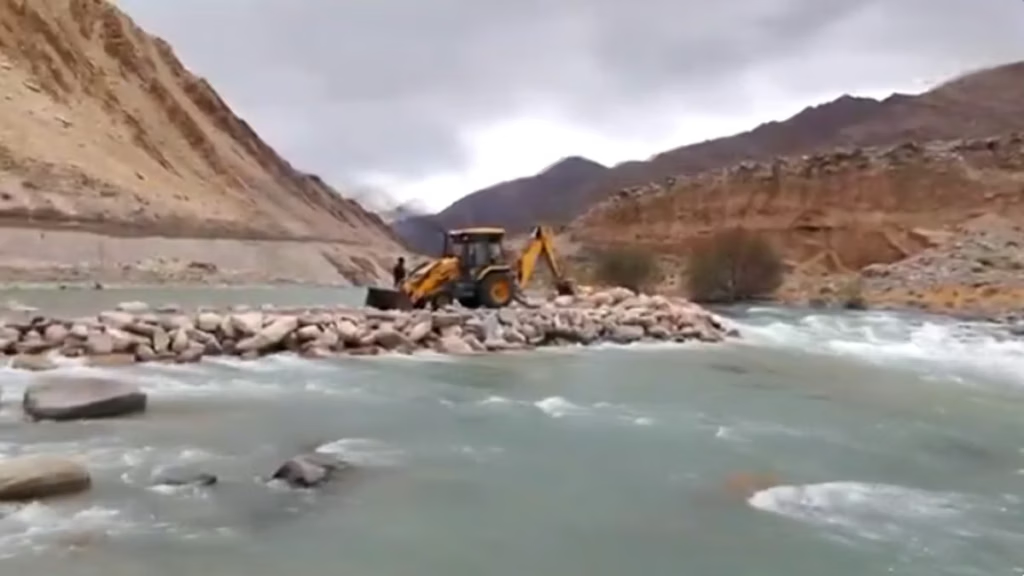
The latest legal dispute comes as India has built its first rock check dam on the Indus River at Upshi in Ladakh. The project was inaugurated in May and is intended primarily to improve irrigation and local water security, but its location on the Indus has given the infrastructure added significance as India and Pakistan remain sharply divided over the treaty.
The Ladakh administration says the roughly 200-foot structure was built from large rocks without cement or concrete. It has created a pondage area capable of storing nearly 40 million litres of water, with the stored water being channelled towards agricultural fields through the Igoo-Phey irrigation canal.
The check dam itself is not part of the Hague proceedings involving the Indus Waters Treaty. Its stated purpose is local irrigation rather than a major diversion or hydropower project. But the timing has put the project in the wider spotlight over how India intends to use water resources covered by the treaty.
Indus Waters Treaty: What the Hague ruling said
The Permanent Court of Arbitration in The Hague issued its latest award on August 31, ruling that the Indus Waters Treaty remains fully in force.
The court rejected the argument that India could unilaterally suspend or terminate the agreement. It also said India remained bound by treaty obligations concerning the design and operation of hydroelectric projects on the western rivers — the Indus, Jhelum and Chenab.
The ruling followed Pakistan’s application concerning India’s April 2025 decision to place the treaty in abeyance.
The court also issued interim measures concerning the Ratle hydroelectric project in Jammu and Kashmir. It prohibited India from carrying out certain concreting work on the dam wall and power-intake structure above specified levels until 90 days after the World Bank-appointed Neutral Expert issues a final decision on the project’s compliance with the treaty.
That decision is expected in July 2027.
The tribunal’s ruling did not simply address the technical design of a hydroelectric project. It also dealt directly with the legal status of India’s decision to place the treaty in abeyance.
The court said none of the grounds examined could justify suspension or termination of the treaty. It also considered India’s argument that Pakistan’s alleged sponsorship of cross-border terrorism had affected India’s ability to exercise its treaty rights. The court concluded that, even assuming the allegation to be true, it would not establish a material breach of the treaty that could justify suspension.
India rejects the Indus Waters Treaty ruling
India has rejected the Hague proceedings and the latest award.
The Ministry of External Affairs said the so-called Court of Arbitration was illegally constituted and had no jurisdiction over India’s sovereign decisions. New Delhi has also reiterated that its decision to hold the Indus Waters Treaty in abeyance remains in force.
India did not participate in the Court of Arbitration proceedings. It has maintained that the tribunal’s creation violated the dispute-resolution structure of the treaty and has instead backed the separate Neutral Expert process concerning the Kishenganga and Ratle projects.
The MEA has therefore taken the position that the Hague body’s latest pronouncements will not affect India’s actions concerning its projects.
That creates the central contradiction in the current dispute: the arbitration panel says the treaty remains binding, while India says the tribunal itself has no authority to make that determination.
Pakistan welcomes the Hague decision
Pakistan has taken the opposite view and described the ruling as confirmation of its long-standing position.
In a September 2 briefing, Pakistan’s Foreign Office said the Permanent Court of Arbitration had reaffirmed that the Indus Waters Treaty remained fully in force and binding and had rejected India’s unilateral attempt to place it in abeyance.
Islamabad said the ruling reinforced the principle that disputes over the Indus waters should be handled through the treaty’s mechanisms and international law. Pakistan also urged India to return to full compliance and engage through the framework established by the agreement.
Pakistan has gone further in its criticism of India’s rejection. Its Foreign Office said Islamabad retains both diplomatic and non-diplomatic options regarding the follow-up to the ruling and what it described as India’s “weaponization of water.”
The Pakistani position is particularly sensitive because the Indus River system is central to the country’s agriculture and water supply. Pakistan has consistently opposed Indian hydroelectric projects that it believes could affect downstream flows or violate treaty provisions.
Pakistan’s National Assembly Speaker Sardar Ayaz Sadiq also welcomed the Hague decision, describing it as an affirmation of international law and treaty obligations. He said the Indus Waters Treaty was directly connected to the region’s agriculture, livelihoods and economic development.
Why the treaty dispute matters
Signed in 1960 with World Bank involvement, the Indus Waters Treaty divided the six rivers of the Indus system between India and Pakistan.
The eastern rivers — Ravi, Beas and Sutlej — were allocated primarily to India, while the western rivers — Indus, Jhelum and Chenab — were allocated primarily to Pakistan. India nevertheless retains specified rights to use the western rivers, including for certain hydroelectric projects subject to treaty conditions.
The agreement survived wars and repeated periods of severe hostility between the two countries.
Its current crisis began in April 2025, when India announced that it was placing the treaty in abeyance following the deadly Pahalgam attack in Jammu and Kashmir. India accused Pakistan of supporting cross-border terrorism. Pakistan denied involvement in the attack.
The treaty dispute subsequently became intertwined with India’s plans for hydroelectric infrastructure in Jammu and Kashmir and Pakistan’s objections to those projects.
Where the Ladakh rock dam fits in
The Upshi check dam is considerably smaller than the hydroelectric projects at the centre of the legal dispute.
The Ladakh administration describes it as an irrigation and water-conservation project. The structure was built from large rocks sourced from the riverbed and surrounding areas and was completed in seven days, according to government information reported about the project.
The project is designed to raise the local water level and make it easier to draw water for agriculture, particularly during the spring sowing period.
The Ladakh administration has also proposed additional check dams. A recent report said a proposal submitted to the Union Ministry of Jal Shakti included seven Himalayan rock check dams in Leh and 29 reinforced-concrete check dams or weirs in Kargil, with an estimated combined cost of more than ₹56 crore.
There is no indication in the available official material that the Upshi check dam was ordered or built as a response to the Hague ruling. Its stated objective predates the latest legal decision and centres on Ladakh’s local water shortage.
Its significance lies instead in the broader question of how India manages water resources in the Indus basin while the treaty dispute remains unresolved.
Two competing positions, one unresolved treaty
The latest developments leave India and Pakistan with sharply different interpretations of the same legal framework.
The Hague arbitration panel says the treaty remains binding and that India cannot unilaterally suspend it. Pakistan accepts that interpretation and wants India to return to treaty compliance.
India rejects the tribunal’s jurisdiction and maintains that its abeyance decision remains valid. It has also said the tribunal’s pronouncements will not affect India’s actions on its projects.
The legal dispute is therefore not resolved simply by the August 31 ruling.
The separate Neutral Expert process concerning the Kishenganga and Ratle projects remains active, with a final decision expected in July 2027. The interim restrictions imposed by the Court of Arbitration on parts of the Ratle project are tied to that process.
For Pakistan, the immediate objective is to preserve the treaty framework and ensure that India’s upstream projects remain subject to its provisions.
For India, the current position is that the treaty cannot be treated as an instrument that remains insulated from wider security concerns and that the particular arbitration mechanism used in The Hague lacks legitimacy.
The construction of a small rock check dam at Upshi does not settle that dispute. But with the Indus Waters Treaty now at the centre of a fresh legal confrontation, even relatively modest water infrastructure along the Indus is being viewed through a much larger India-Pakistan strategic lens.
The next major legal marker will be the Neutral Expert’s expected decision on the hydropower projects in 2027. Until then, the treaty’s legal status may be settled in the eyes of the arbitration panel, but it remains contested in practice between the two countries.