Cuba Walks Out at UN After Trump Says Island Will Fall
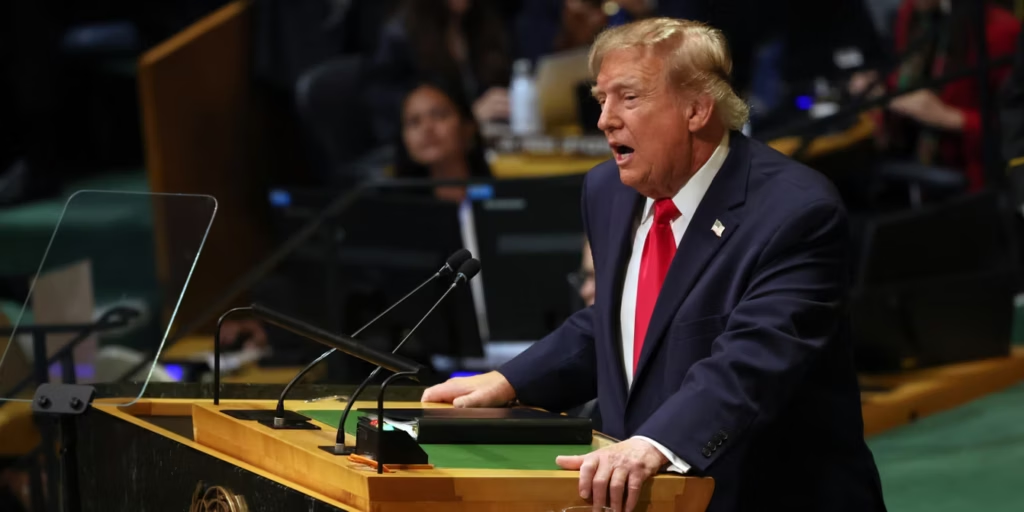
NEW YORK, Sept. 23, 2026 — Cuba’s delegation walked out of the United Nations General Assembly during US President Donald Trump’s speech after he described Cuba as an “absolutely failed state” and said the country’s communist government “will fall.”
Trump made the remarks on Tuesday, Sept. 22, during the opening day of the high-level general debate of the UN General Assembly’s 81st session in New York. The Cuban delegation, led by Foreign Minister Bruno Rodríguez, left the chamber as the US president discussed his administration’s policy toward Havana.
“My administration is also seeking a fundamental change in the situation in Cuba,” Trump said, describing what he called the greatest pressure the Cuban government had faced. He then said Cuba was “an absolutely failed State,” that it was “failing like never before,” and that “it will fall.” Trump also said, “Communism will never be coming to America, but freedom will be coming to Cuba.”
The walkout added a visible diplomatic confrontation to an already tense US-Cuba relationship. Trump also said Secretary of State Marco Rubio was deeply involved in discussions with Cuba, but he did not provide details about the nature or status of those contacts. Reuters reported that Cuban delegates left the hall as Trump referred to his pressure campaign against Havana.
Cuba rejects Trump’s characterization
Cuban Foreign Minister Bruno Rodríguez responded shortly after the speech, rejecting Trump’s description of Cuba and defending the island’s right to sovereignty.
“The US government is unable to accept that Cuba is, and has the right to be, a fully sovereign and independent country,” Rodríguez wrote in a post on X. He also rejected what he described as “falsehoods” and “slander” delivered by Trump at the United Nations.
Cuban President Miguel Díaz-Canel likewise accused Washington of using what he called false claims about Cuba to justify pressure on the island. He said Cuba would continue defending its sovereignty and pursuing what he described as a peaceful response.
The Cuban response was not limited to Trump’s comments about the political system. Havana has repeatedly criticized US economic restrictions and has blamed Washington for worsening economic and energy conditions on the island.
Trump says Rubio is negotiating with Havana
One of the more significant elements of Trump’s remarks was his assertion that Rubio was handling negotiations with Cuba.
Trump said Rubio was “deep into negotiations with Cuba” but offered no timetable, details or description of what Washington was seeking from Havana. Reuters also reported Trump’s statement that Rubio was overseeing negotiations.
There is, however, a notable discrepancy between Trump’s account and statements made by Cuban officials earlier this month.
On Sept. 7, Rodríguez said there were no negotiations or planned negotiations with Washington, although he said Cuba remained willing to maintain contact. Reuters reported at the time that Rodríguez described the US embargo and additional pressure from Washington as major sources of strain on the Cuban economy.
That means the existence and scope of any current US-Cuba negotiations remain unclear from the publicly available statements reviewed for this report. Trump’s assertion that talks are taking place has not been accompanied by publicly released details establishing their format, participants or agenda.
A relationship under renewed pressure
The confrontation at the UN comes after months of escalating tensions between Washington and Havana.
The United States has maintained a broad economic embargo against Cuba for more than six decades. The Trump administration has also intensified pressure on the Cuban government, while repeatedly linking its Cuba policy to broader US national-security and regional concerns.
Cuban officials, meanwhile, have accused Washington of seeking to undermine the government and have argued that US economic restrictions have imposed high costs on ordinary Cubans.
The two governments also differ sharply over the effects and purpose of the US measures. Washington has framed its pressure campaign as a means of forcing political and policy changes in Havana, while Cuban authorities describe the measures as an attack on the country’s sovereignty and economy. Those competing claims remain central to the dispute.
The United Nations has long provided a prominent diplomatic forum for the US-Cuba confrontation. The General Assembly has previously debated the US economic embargo against Cuba, including during the 80th session.
What happens next
Trump’s comments do not, by themselves, establish that a change of government in Cuba is imminent. His statement that the Cuban government “will fall” was a prediction made during his UN address rather than an announcement of a specific US policy timetable or military operation.
Likewise, the publicly available information reviewed for this report does not establish the details of the negotiations Trump said Rubio was conducting.
The immediate diplomatic significance of the episode is clearer. The Cuban delegation’s walkout demonstrated Havana’s rejection of the language used by the US president, while the statements from Trump and Cuban officials showed that the dispute between Washington and Havana remains sharply focused on sovereignty, political change and US economic pressure.
The 81st UN General Assembly general debate continues through Sept. 26, with an additional day scheduled for Sept. 28. Further statements from the United States, Cuba, or other governments could provide more information about the claimed US-Cuba contacts and the next stage of the dispute.