Rahul Gandhi Demands CEC Gyanesh Kumar’s Resignation Amid Vote Row
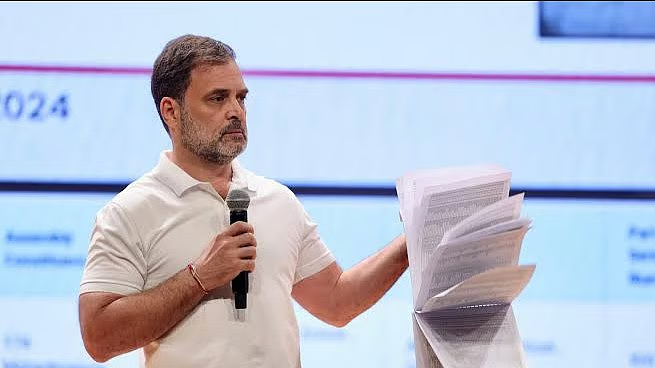
NEW DELHI — Congress leader and Leader of the Opposition in the Lok Sabha Rahul Gandhi on Thursday demanded the immediate resignation of Chief Election Commissioner Gyanesh Kumar, escalating a political confrontation over the Election Commission’s handling of electoral rolls and the ongoing Special Intensive Revision (SIR).
Gandhi’s demand came a day after an investigation by The Indian Express reported that Election Commissioners Sukhbir Singh Sandhu and Vivek Joshi had formally raised objections at least 14 times over 10 months to decisions and orders concerning voter registration, deletions, electoral-roll databases and other aspects of the SIR process.
At a press conference at the Congress headquarters in New Delhi on September 24, Gandhi repeated his long-running allegation of “vote chori” and said Kumar should step down. He also alleged that the 2024 Lok Sabha and state elections had been manipulated, claims that have not been established as fact by the Election Commission or through an independent finding cited in the reports reviewed for this article.
Gandhi links electoral-roll dispute to wider questions about democracy
Gandhi framed the dispute as extending beyond individual voter deletions or additions.
He argued that the vote is the foundation from which constitutional authority, legislation and public institutions derive their legitimacy. He described what he called “vote chori, kanoon chori and sanstha chori” — alleging that irregularities in the electoral process could have consequences for the wider constitutional system.
Gandhi also questioned why anti-incumbency, which has historically affected governments and political parties in India, had not affected the BJP in the same manner in recent elections. He cited several states while making that argument.
Those comments were part of Gandhi’s broader political case against the Election Commission and the BJP-led government. They represent his assessment of electoral trends and alleged manipulation, rather than an independently established finding that elections were rigged.
What triggered the latest confrontation
The immediate trigger was an Indian Express investigation published on September 23.
The report said Sandhu and Joshi had objected at least 14 times over 10 months to actions involving the electoral rolls. Among the matters reported were changes to Form 6, which is used for new voter registration; voter deletions and restorations; appeals involving electoral-roll decisions in West Bengal; and changes involving the management and access of electoral databases.
The report also said the two commissioners separately approached Cabinet Secretary T V Somanathan over concerns relating to changes in the allocation of responsibilities surrounding the Election Commission’s information-technology systems.
One particularly contentious issue concerned Form 6. According to the Indian Express investigation, changes introduced through the ECINet system asked first-time voters to provide information connected to electoral rolls from an earlier SIR exercise. Joshi reportedly questioned whether such a change could be introduced without the relevant rules being amended by the government.
The investigation said the wider SIR exercise, which began in Bihar in 2025, had subsequently expanded across states and Union territories and involved large-scale changes to electoral rolls.
Election Commission rejects the suggestion of an institutional split
The Election Commission has pushed back against the characterization of the reported objections as evidence of a breakdown within the three-member poll panel.
EC sources said that individual commissioners can express opinions, objections and technical suggestions during internal deliberations, but that the final decisions of the Commission, including those concerning SIR, were unanimous and approved by all three commissioners.
The Commission did not dispute the existence of the 14 notes described in The Indian Express investigation. Instead, it characterized such exchanges as part of the normal decision-making process within a multi-member constitutional body. A statement signed by all three commissioners said that focusing on selected internal notes presented only part of the wider decision-making record.
That distinction is central to the dispute: the published investigation describes repeated formal objections by two commissioners, while the Election Commission says those objections did not translate into disagreement over its final decisions.
Opposition parties join the criticism
The controversy has extended beyond the Congress.
Several Opposition leaders have called for action against Kumar following the Indian Express report. MNS chief Raj Thackeray also demanded the CEC’s resignation, while other Opposition figures have questioned the Election Commission’s handling of SIR and electoral-roll revisions.
Jammu and Kashmir Chief Minister Omar Abdullah said corrective action was required and called on the Election Commission and the central government to consider the concerns raised by the report. DMK leader M.K. Stalin also called for Kumar to step down and for the SIR process to be halted.
The BJP, meanwhile, has rejected the Opposition’s broader allegations. BJP spokesperson Sambit Patra described the controversy as a political attack and argued that differences during internal deliberations do not establish electoral manipulation. NDTV reported that the BJP rejected Gandhi’s argument that the disappearance of anti-incumbency in some states was evidence of election manipulation.
The allegations remain contested
The latest dispute should be separated into two different questions.
The first is whether two Election Commissioners formally raised objections during the SIR-related decision-making process. That is supported by the Indian Express investigation and has not been denied by the Election Commission.
The second is Gandhi’s much broader allegation that elections were “rigged” or that votes were deliberately stolen. That remains a political allegation. The Election Commission has defended the legality and unanimity of its decisions, while the BJP has rejected Gandhi’s accusations. The material reviewed for this report does not establish an independent finding that the 2024 elections were rigged.
That distinction is particularly important because concerns over electoral-roll administration, internal objections and alleged election manipulation are not interchangeable claims.
What happens next
Gandhi has indicated that the Congress and other Opposition parties intend to continue pressing the issue. He has also called for investigations into the conduct of those he accuses of involvement in what he describes as a conspiracy to manipulate elections.
The immediate institutional questions concern the objections raised by Sandhu and Joshi, the Election Commission’s explanation of those objections, and the administration of SIR and electoral-roll databases.
The Election Commission has not announced that Kumar will resign. Nor is there an established finding in the sources reviewed that would substantiate Gandhi’s allegation that the country’s elections were systematically rigged.
The political confrontation is therefore likely to remain focused on two competing narratives: Gandhi and other Opposition leaders demanding greater accountability from the poll panel, and the Election Commission maintaining that its decisions were taken collectively and within its legal authority.
This story may be updated as new information becomes available.