Moscow Drone Attack: Ukraine Targets Russian Capital During Election
MOSCOW — Moscow and the surrounding region were hit by a major wave of Ukrainian drone attacks on Sunday, September 20, as Russians cast ballots on the final day of a three-day parliamentary election.
Russian authorities said hundreds of drones were directed toward the capital. Moscow Mayor Sergei Sobyanin said more than 1,600 drones had been intercepted across the country since Saturday, including about 450 heading toward Moscow. Russian officials described the assault as the largest of its kind against the capital.
The attacks killed at least two people in the wider Moscow region, according to regional authorities. A major oil refinery in Moscow was also damaged, while a drone strike or falling debris caused damage to a residential building in the Moscow region.
The attack came as Russia held the last day of its parliamentary vote, giving the incident an unusually sensitive political backdrop.
Explosions reported across Moscow region
Russian officials said air defenses engaged drones approaching Moscow during the overnight assault.
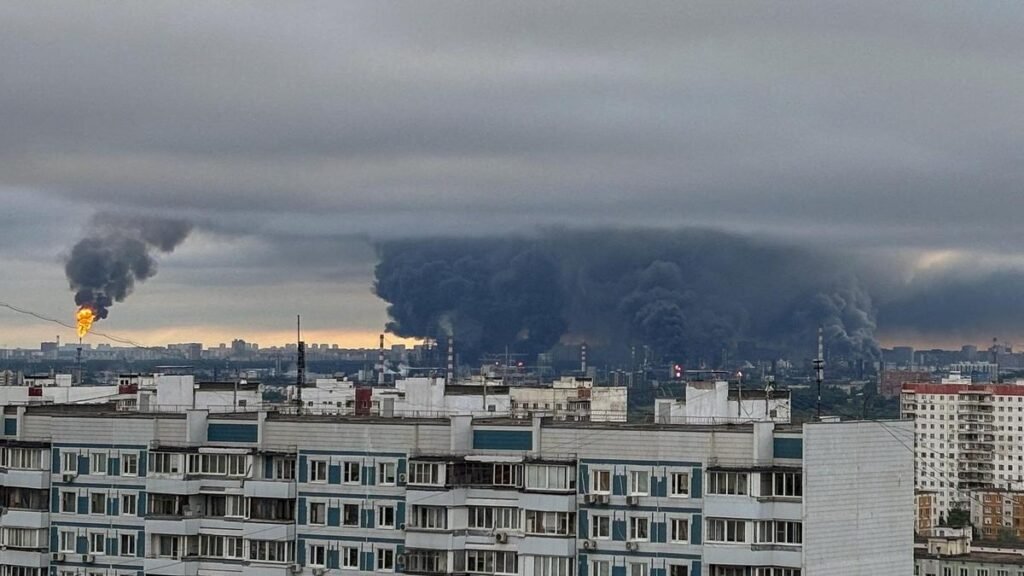
Sobyanin said several drones reached the premises of the Moscow oil refinery in the capital’s Kapotnya district. He also said one drone hit an apartment, although there were no reported casualties inside Moscow itself in the initial account. Reuters witnesses reported hearing explosions and seeing columns of smoke rising from the refinery area.
The full extent of damage to the refinery was not immediately clear.
The facility has previously been targeted during the war and is an important part of Moscow’s fuel infrastructure. Reuters reported that the refinery processed 11.6 million metric tons of crude oil in 2024, producing about 2.9 million tons of gasoline and 3.2 million tons of diesel.
In the surrounding Moscow region, Governor Andrei Vorobyov said two people were killed in separate incidents. Authorities also evacuated about 400 people, including 70 children, from a 21-storey residential building in the Ramenskoye district after a fire. Several homes were damaged.
Reports of the casualty toll have varied as the situation developed. Reuters’ initial Moscow-region report put the death toll at two, while a later Reuters election report separately included two deaths in the Russian-controlled Kherson region, bringing the wider toll associated with the day’s attacks to four. Those incidents should not be conflated with the two deaths reported in the Moscow region.
Moscow accuses Ukraine of trying to disrupt the vote
Sobyanin said the attack was intended to interfere with Russia’s parliamentary election.
“The unprecedented attack was clearly planned to disrupt the elections,” he said, according to Reuters. He added that the attempt had failed.
That motive is a Russian government claim and has not been independently established.
Ukraine did not immediately issue a formal statement accepting responsibility for the specific attack in Reuters’ initial reporting. Later, Ukrainian President Volodymyr Zelensky said Ukrainian forces had struck a major Russian oil-industry facility and a logistics facility in the Moscow region. He described the strikes as part of Ukraine’s long-range response against infrastructure supporting Russia’s war effort.
Zelensky’s statement did not independently establish the full scale of the drone barrage reported by Russian authorities.
Videos show smoke and damage
Video and photographic material from Moscow showed smoke rising from the area of the refinery following the reported strikes. Reuters published imagery of smoke and fires at the facility on September 20.
Other footage circulating online showed drones and explosions over the Moscow area, although individual social-media videos can be difficult to authenticate independently and may not establish when or where every clip was recorded.
The visual evidence is therefore useful in showing that explosions and fires occurred, but it does not by itself establish the number of drones involved or the precise trajectory of individual weapons.
Russia reports different interception figures
The number of drones involved remains one of the areas where official accounts require careful attribution.
Sobyanin said more than 1,600 drones had been brought down across Russia since Saturday, with 450 directed toward Moscow. Russia’s Defence Ministry separately reported intercepting or destroying more than 1,100 Ukrainian drones across Russian territory, Crimea and the Black Sea.
Those figures cover different geographic areas and reporting periods, so they should not be treated as directly interchangeable measurements of the same attack.
What is clear from multiple reports is that the overnight assault was exceptionally large and involved a substantial number of drones directed toward the Moscow region.
Attack coincides with final day of parliamentary election
The drone barrage occurred on the third and final day of Russia’s parliamentary election, which began on September 18.
The election is the first parliamentary vote since Russia’s full-scale invasion of Ukraine in 2022. The Associated Press reported that the contest has been conducted under tight political restrictions, with major anti-war opposition figures and parties excluded, jailed or otherwise prevented from competing.
The election is taking place across Russia, while voting has also been organized in territories Ukraine and many Western governments regard as illegally occupied or annexed by Russia. Ukraine and the European Union have criticized the inclusion of those territories.
The Kremlin has presented the election as an expression of national support, while critics have questioned the competitiveness and transparency of the process. Those political disputes are separate from the factual question of whether the drone attacks were specifically intended to disrupt voting.
A continuing battle over Russia’s energy infrastructure
The attack also fits into a broader pattern of Ukrainian strikes on Russian energy infrastructure.
Ukraine has increasingly used long-range drones against oil refineries and other facilities inside Russia, seeking to damage infrastructure that generates fuel and revenue for Moscow’s war effort. Russia, meanwhile, has continued striking Ukrainian energy and civilian infrastructure.
The latest attack came shortly after U.S. President Donald Trump said Russia and Ukraine had agreed to stop targeting each other’s energy facilities. Reuters reported that attacks on energy infrastructure have nevertheless continued.
Ukraine has not publicly accepted the Russian allegation that the purpose of the Moscow operation was to disrupt the election.
For now, the precise scale of the physical damage to the refinery and other infrastructure remains under assessment. Russian authorities have also not provided an independently verifiable accounting of every drone involved in the attack.
The immediate significance of the incident is clear: one of the largest reported Ukrainian drone barrages against Moscow unfolded while Russians were voting, killing people in the surrounding region and putting a major oil facility in the capital in the line of fire.