Wildfire Smoke Crisis Deepens as WMO Bulletin Warns Extreme Smoke Events Have Tripled Since the 1990s
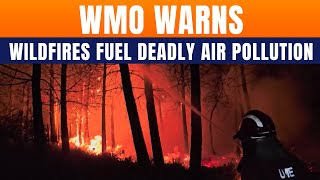
GENEVA: Extreme wildfire smoke events have tripled globally since the 1990s, raising fresh concerns about the health consequences of worsening pollution and the ability of current air-quality systems to measure the danger. The latest WMO Bulletin says wildfire-related pollution is becoming an increasingly important threat as climate and air pollution risks become more closely connected.
Extreme wildfire smoke events triple worldwide
The finding comes from the World Meteorological Organization’s latest Air Quality and Climate Bulletin, released on September 7, 2026. The WMO says one study cited in the bulletin found that extreme fire-smoke events have tripled globally since the 1990s.
The increase comes as exposure to fire-related fine particulate matter, particularly PM2.5, becomes a growing concern. These microscopic particles can penetrate deep into the lungs and enter the bloodstream, making them a major public-health hazard.
The WMO Bulletin also points to an estimated nearly 100,000 additional deaths per year linked to extreme fire-smoke exposure during 2010–2018, while cautioning that the true impact could be higher.
Current Air Quality models may underestimate deaths
One of the most alarming findings concerns how wildfire pollution is assessed. According to the bulletin, an epidemiological study found that conventional risk models based on overall PM2.5 concentrations may underestimate wildfire-attributable mortality by up to 93%.
That gap matters because wildfire smoke is not necessarily equivalent to pollution from other sources. The toxicity of fire-derived particles can vary according to what burns and how combustion occurs, meaning a measurement based only on particle concentration may not fully capture the associated health risk.
The WMO Bulletin therefore calls for stronger consideration of wildfire-specific toxicity when assessing Air Quality risks.
Climate change and wildfire pollution collide
The report highlights a broader connection between climate conditions and pollution. More extreme wildfire activity can release large quantities of smoke, while increasingly severe fire weather can make dangerous events more likely.
The WMO says exposure to fire-related PM2.5 has increased even as regulations have helped reduce pollution from industry and transportation in Europe and North America. The pattern illustrates how improvements in some pollution sources can be undermined by rising wildfire emissions.
The latest WMO Bulletin also notes that PM2.5 concentrations in 2025 were above the long-term average in northern Canada, parts of the Russian Federation and western-central Africa because of increased fire activity.
India among regions facing pollution concerns
The bulletin also identifies India as an area where PM2.5 concentrations remained above the long-term average in 2025, with biomass burning and other pollution contributing to elevated levels.
The findings underline why Air Quality monitoring cannot be treated as a local issue alone. Smoke can travel across borders and affect populations far from the original wildfire, making atmospheric monitoring and international cooperation increasingly important.
WMO scientists say improved observations of pollutants and aerosols are needed because several harmful substances remain insufficiently monitored.
Health risks expected to grow
The report warns that meeting World Health Organization air-quality guidelines could become increasingly difficult as extreme fire weather becomes more common.
For policymakers, the message is increasingly clear: wildfire prevention, climate adaptation and Air Quality protection cannot be handled separately. The WMO Bulletin argues for coordinated climate and pollution policies, along with better atmospheric observations.
As wildfire seasons become more damaging in several regions, the latest WMO Bulletin suggests that the health burden from smoke may be substantially larger than existing assessments indicate. The challenge for governments will be turning improved warnings and measurements into faster protection for communities exposed to hazardous smoke.