8th Pay Commission OPS vs NPS: What Employees Are Demanding
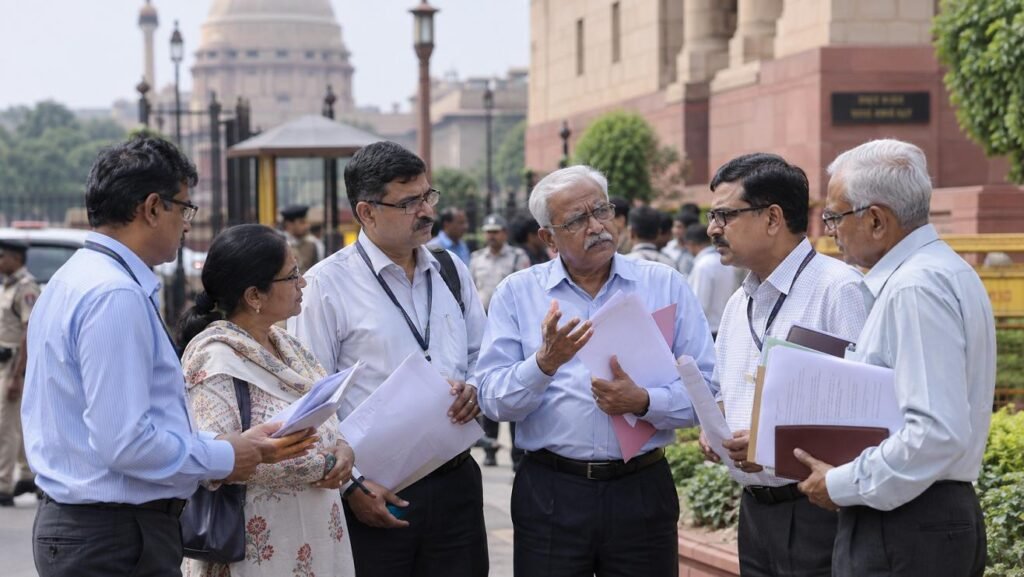
The debate over the Old Pension Scheme (OPS) and National Pension System (NPS) remains unresolved as the 8th Central Pay Commission continues consultations with employee and pensioner organisations. Several employee bodies have asked the commission to recommend a return to the defined-benefit pension system, while the Central government has maintained that there is currently no proposal to restore OPS for central government employees.
The issue has remained prominent in submissions made to the 8th Pay Commission. The commission has been holding consultations across India, including meetings in Chandigarh on September 16-18, 2026. Its official calendar shows the next scheduled state visit in Bengaluru on October 7-8.
For employees covered by NPS, the central question is whether the existing contributory system will continue, be modified, or eventually be replaced by a defined-benefit arrangement.
What has the government said about OPS?
The latest clear government position available is that there is no proposal under consideration to restore OPS for central government employees covered by NPS.
A July 23, 2026 reply in Parliament, as reported by Economic Times, said the Department of Expenditure had confirmed that no proposal to restore the Old Pension Scheme for central government employees was under consideration.
That position is also consistent with an earlier official Finance Ministry response placed before Parliament. In August 2025, the government said there was no proposal to restore OPS for central government employees covered by NPS. It said NPS had been introduced for new central government employees, other than the armed forces, joining from January 1, 2004.
There has been no verified announcement, as of September 22, 2026, indicating that the Centre has reversed that position.
Why are employee organisations demanding OPS?
Employee organisations have put pension security among their major demands before the 8th Pay Commission.
The National Council-Joint Consultative Machinery (NC-JCM), the Federation of National Postal Organisations (FNPO), the All India Defence Employees Federation (AIDEF), the All India NPS Employees Federation (AINPSEF) and the Indian Railways Technical Supervisors Association (IRTSA) are among the organisations that have sought changes to the pension framework.
The demands are not identical.
AINPSEF has sought an option allowing NPS-covered central government employees to move to OPS after completing a specified period of service. Its president, Manjeet Singh Patel, told Economic Times that the organisation had placed this demand before the commission during its April 30 interaction.
Other organisations have called for a broader restoration of the defined-benefit pension system. The Ministerial Staff Association of the Survey of India, for example, has demanded restoration of OPS and a pension equivalent to 50% of last pay drawn, according to reporting on its memorandum.
These are demands made by employee organisations. They are not recommendations already accepted by the Pay Commission or decisions taken by the government.
Where does the 8th Pay Commission stand?
The 8th Central Pay Commission was formally constituted on November 3, 2025, with Justice Ranjana Prakash Desai as chairperson, Professor Pulak Ghosh as part-time member, and Pankaj Jain as member-secretary. The commission has been given 18 months from its constitution to submit its recommendations.
Its terms of reference specifically cover pension-related matters.
For employees covered by NPS, including those covered by the Unified Pension Scheme (UPS), the commission has been asked to review death-cum-retirement gratuity. For employees outside NPS and UPS, it has been asked to review death-cum-retirement gratuity and pensions.
The commission must also take into account the country’s economic position, fiscal prudence, the availability of resources for development and welfare spending, and the unfunded cost of non-contributory pension schemes.
That wording is significant because it puts pension recommendations within a broader fiscal framework. It does not, by itself, amount to an announcement that OPS will be restored.
NPS, OPS and UPS: What is the difference?
The Old Pension Scheme is a defined-benefit system in which pension is linked to the employee’s service and pay under the applicable pension rules.
NPS, by contrast, is a defined-contribution system. The Central government introduced it for new central government recruits, other than the armed forces, joining from January 1, 2004.
The government subsequently introduced the Unified Pension Scheme as an option under the NPS framework.
Under UPS, a subscriber completing at least 25 years of qualifying service is entitled to an assured payout calculated at 50% of the average basic pay for the final 12 months before superannuation. A minimum guaranteed payout of ₹10,000 per month applies after at least 10 years of qualifying service, subject to the scheme’s conditions.
The UPS benefit can be reduced in specified circumstances, including where the individual corpus is below the benchmark corpus or where a subscriber makes a final withdrawal.
This means the current policy debate is not simply a choice between two systems. Central government employees now have NPS and, for eligible subscribers, the UPS option, while employee organisations continue to press for restoration of OPS.
What are employees asking the 8th Pay Commission to change?
The pension demands vary among organisations, but several themes have emerged.
One is the restoration of OPS for employees recruited under NPS. Another is providing an option to switch from NPS to OPS after completing a specified period of service.
Some employee bodies have also sought guaranteed pension provisions rather than retirement benefits whose eventual value depends partly on accumulated pension assets and scheme conditions.
Pensioner organisations have raised separate demands involving minimum pension levels, pension parity and family pension.
The Bharat Pensioners’ Samaj, for example, has sought a higher minimum pension and changes to pension and family-pension calculations in its submissions to the commission.
These proposals should be treated as submissions to the commission rather than as confirmed changes.
What happens next?
The 8th Pay Commission is still in its consultation stage. Its official website lists meetings with associations and unions across different locations and shows a scheduled visit to Bengaluru on October 7 and 8, 2026.
The commission is required to submit its recommendations within 18 months of its constitution, although it can consider issuing interim reports where appropriate.
For now, there is no confirmed decision to restore OPS for central government employees.
The clearest distinction is therefore between employee demand and government policy: unions and associations are asking the 8th Pay Commission to consider OPS restoration or stronger pension guarantees, but the Centre’s latest stated position remains that no proposal to restore OPS is under consideration.
Any change would require a formal recommendation and subsequent government decision. Until that happens, NPS and the UPS option remain part of the existing central-government pension framework.