Chirag Paswan Seeks Jitan Manjhi’s Resignation Over SC Quota Row
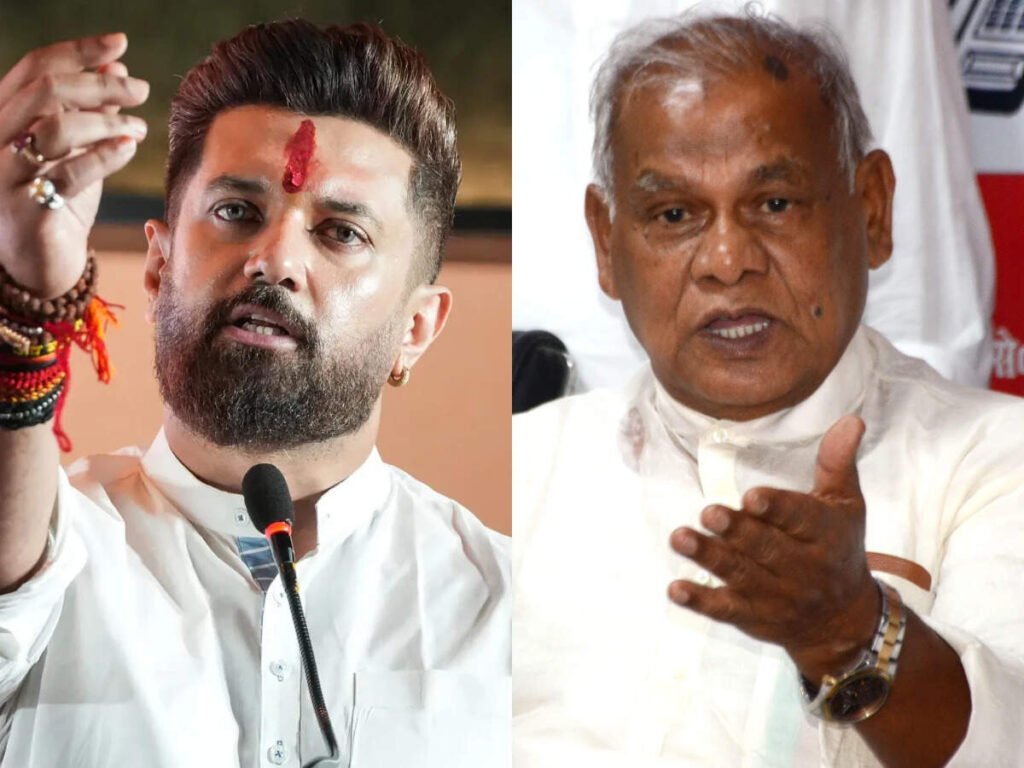
NEW DELHI/PATNA — A dispute over Scheduled Caste and Scheduled Tribe reservations has erupted into an unusually public confrontation between two Union ministers from the BJP-led National Democratic Alliance, with Chirag Paswan demanding the resignation of Jitan Ram Manjhi and his son, while the Manjhi camp hit back by asking Paswan to step down first.
The confrontation unfolded on Saturday, August 29, after Manjhi’s Hindustani Awam Morcha (Secular) backed a review of the reservation system and argued for greater internal distribution of quota benefits among the most disadvantaged communities.
Paswan, the Union minister for food processing industries and Lok Janshakti Party (Ram Vilas) chief, rejected the proposal. He argued that SC/ST reservation is rooted in historical and social discrimination rather than economic status and opposed introducing a creamy-layer filter within the existing quota system. Multiple reports placed his remarks in Patna on Saturday.
How the dispute escalated
The immediate trigger was a series of statements by Bihar minister Santosh Kumar Suman, Manjhi’s son and a senior HAM(S) leader, who supported reviewing how reservation benefits are distributed.
Suman argued that the existing system had not adequately benefited some of the most deprived Dalit communities. He pointed to disparities among communities within the Scheduled Castes and questioned why some groups appeared to have gained substantially more representation than others.
He also cited the Mushahar community, to which his father belongs, saying it remained severely underrepresented despite its population in Bihar. The Times of India reported Suman as calling for a comparative study of who has benefited from reservation and who remains at the bottom of the social ladder.
The HAM(S) position includes support for sub-categorisation — effectively creating a more targeted distribution of benefits within the existing SC/ST reservation framework.
Paswan took a sharply different view.
He said that if Manjhi and Suman supported a creamy-layer provision or similar changes, they should first give up the benefits of reservation themselves.
“If Jitan Ram Manjhi feels these measures should be implemented, should he not resign first?” Paswan said, according to reports of his remarks. He also called for Suman to resign.
Paswan has consistently opposed dividing the SC reservation pool into sub-quotas. His argument is that reservation for Dalits is intended to address discrimination and social exclusion, rather than simply differences in income.
Manjhi camp hits back
The response came quickly.
Manjhi and Suman rejected the suggestion that their position amounted to an attack on reservation itself. Suman said the objective was to ensure that the most disadvantaged sections received greater opportunities, not to abolish the quota system.
Suman also countered Paswan’s resignation demand by saying that Paswan should resign first. The exchange turned what had initially been a policy disagreement into a confrontation between NDA allies.
Manjhi, a former Bihar chief minister and now a Union minister, also criticised Paswan’s position and demanded that he step down, according to reports published Saturday evening. The two sides therefore moved from debating reservation policy to publicly challenging each other’s positions within the ruling alliance.
There is no indication from the reporting reviewed that either minister has actually resigned.
The Supreme Court judgment behind the debate
The political dispute comes against the backdrop of a major Supreme Court ruling from August 2024.
In State of Punjab v. Davinder Singh, a seven-judge Constitution Bench held that states can sub-classify Scheduled Castes for the purpose of reservation, allowing governments to identify comparatively more disadvantaged groups within the broader SC category. The judgment dealt with the constitutional question of sub-classification and revisited earlier precedent.
That ruling has since become an important reference point for political demands seeking a more targeted distribution of reservation benefits.
But sub-classification and the “creamy layer” question are not identical issues.
The creamy-layer principle is traditionally associated with excluding relatively advanced sections of the Other Backward Classes from reservation benefits. The Centre has maintained that this principle does not currently apply to SC/ST reservations.
What the Centre told the Supreme Court
The distinction has become particularly relevant in recent weeks.
In an affidavit filed before the Supreme Court in response to petitions seeking an income-based exclusion within SC/ST reservation, the Union government opposed extending the creamy-layer principle to these communities.
The Centre argued that SC and ST reservations are based on historical and social disadvantage, including discrimination associated with untouchability in the case of Scheduled Castes, rather than simply economic circumstances. It also said any fundamental change to reservation policy would require a broader empirical review and legislative action.
The government cited earlier Supreme Court rulings, including Indra Sawhney, E.V. Chinnaiah and Ashoka Kumar Thakur, in support of its position that the creamy-layer principle has not been applied to SC/ST reservations in the same manner as it has to OBC reservations.
The Centre’s position adds another layer to the political disagreement. While the Manjhi camp is pressing for greater scrutiny and a more equitable distribution of benefits, the Union government’s recent position before the court is that an income-based creamy-layer mechanism cannot simply be introduced for SC/ST reservations through executive action.
A disagreement within the NDA
Both Paswan’s LJP (Ram Vilas) and Manjhi’s HAM(S) are NDA allies at the Centre and in Bihar.
That makes the confrontation politically significant, although the statements themselves do not establish that either party intends to leave the alliance.
For now, the disagreement is focused on reservation policy and how benefits should reach communities that remain disadvantaged within the broader SC/ST categories.
Paswan has framed the issue primarily around protecting the constitutional and social basis of reservation and maintaining unity among Scheduled Castes. Manjhi and Suman have argued that treating all communities within the category identically can leave some of the most marginalised groups behind.
The dispute has therefore exposed two competing approaches to the same broad objective: whether existing reservation should remain largely undivided, or whether its benefits should be more specifically targeted within the reserved categories.
What happens next
There has been no announced resignation by either Union minister as a result of the exchange, and no confirmed decision from the Centre to alter the existing SC/ST reservation framework.
The legal debate over the creamy layer remains separate from the political statements in Bihar. The Centre has opposed introducing such a mechanism for SC/ST reservations and has argued that major changes require empirical evidence and Parliament’s involvement.
For the moment, the immediate story is less about a change in reservation policy than about a widening political disagreement inside the NDA over how reservation benefits should be distributed.
The resignation demands have raised the temperature, but the underlying policy question remains unresolved: how should the reservation system respond when some communities within the protected categories remain substantially less represented than others?