UPI MDR Explained: Fuel, Phone and Restaurant Payments After Rs. 2,000
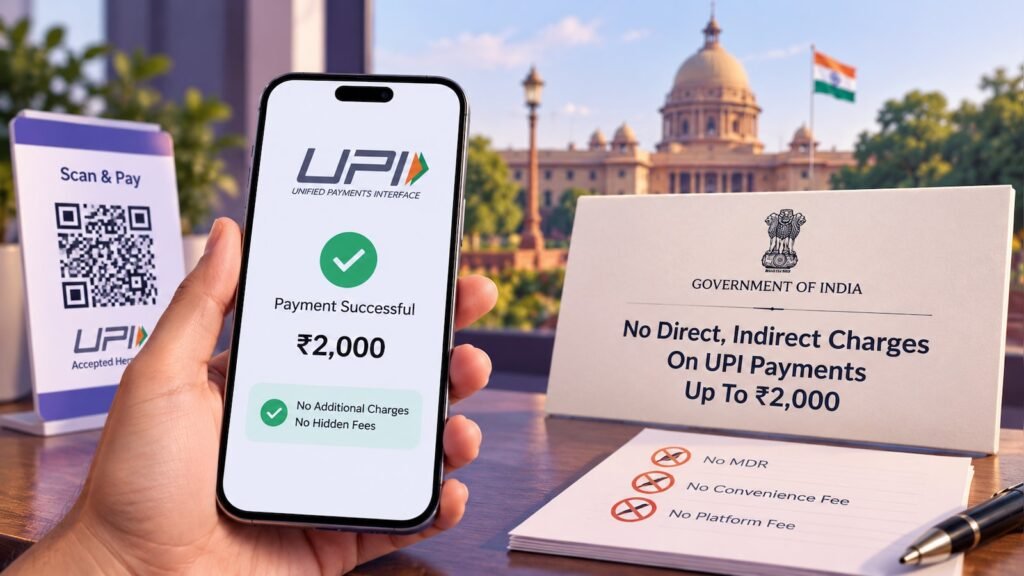
India’s UPI payment system is set to introduce a merchant charge on certain higher-value transactions from October 15, but consumers will not have to pay the new Merchant Discount Rate (MDR).
Under the framework announced on September 15, UPI payments made to merchants above ₹2,000 will generally attract an MDR of 0.4%. The charge will be borne within the merchant-payment ecosystem, rather than being added to the customer’s bill.
The government has also set different rates for some sectors, including fuel, railways, telecommunications, insurance and agricultural inputs. Transactions above ₹2,000 in those categories will carry a flat ₹5 MDR.
The changes have prompted questions about everyday purchases, particularly when customers use UPI to pay for petrol, a mobile phone or a restaurant bill.
What happens when you pay a merchant?
For a regular merchant transaction above ₹2,000, the MDR will be 0.4%, subject to a maximum of ₹300 per transaction.
That means a customer buying goods worth ₹10,000 through UPI will still pay ₹10,000. The corresponding MDR would be ₹40, but that amount is a merchant-side payment within the UPI ecosystem.
The maximum MDR of ₹300 is reached at a transaction value of ₹75,000. Payments above that amount remain subject to the ₹300 cap.
Payments to merchants of up to ₹2,000 will continue to carry zero MDR. The government has also said that eligible small merchants covered by the zero-MDR framework will remain exempt.
The Finance Ministry said the new framework will leave about 96% of merchant transactions unaffected.
What about petrol and diesel payments?
Fuel is one of the categories receiving a separate treatment.
For eligible fuel transactions above ₹2,000, the MDR will be a flat ₹5 rather than 0.4% of the transaction value.
For example, if a customer buys ₹3,000 worth of fuel and pays through UPI, the customer pays the fuel bill of ₹3,000. The applicable ₹5 MDR is a merchant-side charge.
The distinction matters because the new framework does not introduce a ₹5 UPI fee for consumers buying fuel. It establishes the amount payable within the merchant payment ecosystem.
What if you buy a ₹30,000 phone?
A mobile phone purchase is generally treated as a regular merchant transaction rather than one of the specially listed sectors.
If a customer buys a phone priced at ₹30,000 and pays through UPI, the 0.4% MDR works out to ₹120.
The customer still pays ₹30,000.
The ₹120 MDR is calculated against the merchant transaction and is not supposed to be separately added to the customer’s UPI payment.
The same principle applies to other ordinary purchases above ₹2,000, subject to the merchant’s classification and the applicable rules.
What happens when you pay a restaurant bill?
Restaurant payments provide another straightforward example.
Suppose a restaurant bill is ₹6,000 and the customer pays the full amount through UPI. At the standard 0.4% MDR, the merchant-side charge would be ₹24.
The customer is not supposed to pay ₹6,024 simply because UPI was used.
The Finance Ministry has said banks have been advised to ensure merchants do not pass MDR charges on to customers. UPI application providers are also prohibited from imposing platform fees or hidden charges under the new framework.
Sending ₹10,000 to a friend remains free
The new MDR does not apply to person-to-person, or P2P, UPI transfers.
If someone transfers ₹10,000 to a friend or family member through UPI, there is no MDR on the transaction.
The government has specifically clarified that P2P UPI transactions will remain free regardless of the amount transferred.
This means the ₹2,000 threshold should not be interpreted as a general limit above which every UPI payment becomes chargeable.
It applies to specified merchant transactions, not ordinary transfers between individuals.
Is MDR a tax?
No.
The Finance Ministry has clarified that MDR is neither a tax nor a government charge collected by the government or NPCI.
It is a charge within the merchant-payment ecosystem, with the proceeds distributed among participating entities such as banks, payment service providers and UPI application providers.
The government says the framework is intended to support the long-term sustainability, infrastructure and resilience of the UPI ecosystem.
Which payments remain free?
Several categories remain outside the new MDR regime or retain zero-MDR treatment.
These include:
- Person-to-person UPI payments, regardless of value
- Merchant payments up to ₹2,000
- Eligible transactions covered by the zero-MDR framework for small merchants
- Other merchant transactions specifically exempted under the framework
The government estimates that roughly 96% of merchant transactions will remain unaffected.
Small merchants receiving up to ₹1 lakh a month through UPI QR payments under the relevant small-merchant classification will also continue to receive zero-MDR treatment.
When do the new rules start?
The new MDR framework takes effect on October 15, 2026.
It is therefore not a charge that consumers should already be seeing on UPI payments on September 16.
Banks, payment applications and merchants will have time to update their systems before the framework comes into force.
The immediate issue for consumers is largely one of understanding the distinction between the amount they pay and the MDR that applies within the merchant-payment system.
For a customer paying ₹3,000 for fuel, ₹30,000 for a phone, or ₹6,000 at a restaurant, the announced framework does not create a separate UPI fee to add to those bills.
The new charges apply to specified merchant transactions, while P2P payments remain free.
The framework could still affect how merchants account for digital-payment costs once it becomes operational, but the government’s stated position is that those costs should not be passed on to customers as a UPI surcharge.