Supreme Court Electoral Reform Case Heads to 5-Judge Constitution Bench
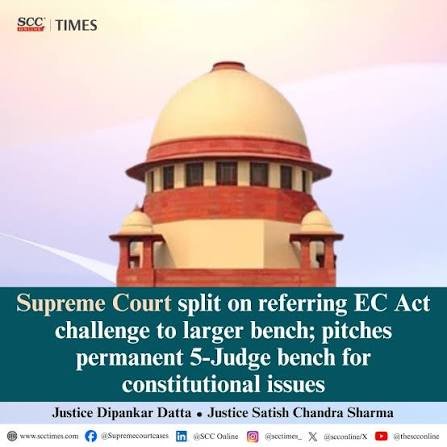
NEW DELHI: The Supreme Court has moved a major challenge to India’s Election Commission appointment law closer to a five-judge Constitution Bench after a two-judge bench delivered a split opinion on September 23. The case concerns the 2023 law governing the appointment of the Chief Election Commissioner and Election Commissioners and raises questions about the independence of the poll panel.
The development has put Electoral Transparency India and the structure of the Election Commission’s appointment process back at the centre of a major constitutional dispute.
Supreme Court Electoral Reform Case Raises Constitutional Questions
Justices Dipankar Datta and Satish Chandra Sharma disagreed on whether the petitions challenging the 2023 law required consideration by a larger bench.
Justice Datta held that the core constitutional principles concerning free and fair elections and the independence of the Election Commission had already been addressed by the Supreme Court’s 2023 judgment in Anoop Baranwal v. Union of India. In his view, applying those established principles to the 2023 legislation did not necessarily require a five-judge bench.
Justice Sharma took the opposite position. He held that the challenge raised substantial constitutional questions, including whether Parliament’s framework for appointing election commissioners meets the constitutional requirements governing the independence of the electoral process.
SC Constitution Bench Question Now Before CJI
Although the judges differed on the need for a larger bench, they issued a common order directing that the papers be placed before Chief Justice of India Surya Kant for consideration of constituting a Constitution Bench.
The court said sending the matter first to another bench merely to decide the reference could create further delay. It also urged consideration of a permanent five-judge bench for constitutional cases, citing concerns over long-pending references.
The SC Constitution Bench would ultimately determine the validity of the challenged provisions if such a bench is constituted.
The case was brought by petitioners including Congress leader Jaya Thakur and the Association for Democratic Reforms. They have challenged provisions of the Chief Election Commissioner and other Election Commissioners (Appointment, Conditions of Service and Term of Office) Act, 2023.
Why The 2023 Election Law Is Being Challenged
The dispute centres on the composition of the selection committee for the CEC and Election Commissioners.
Under the 2023 law, the committee consists of the Prime Minister, a Union Cabinet minister nominated by the Prime Minister and the Leader of the Opposition in the Lok Sabha. The law replaced the Chief Justice of India with a Union minister on the panel.
The petitioners argue that removing the CJI weakens the neutrality of the appointment mechanism and could affect public confidence in the Election Commission.
That argument has renewed debate over Electoral Transparency India, particularly as the country prepares for further electoral contests. Earlier coverage of Election Commission bypoll preparations has also highlighted the growing importance of the poll body’s decisions and independence.
Judges Flag Delays In Constitutional Cases
The bench also expressed concern about delays in cases referred to larger benches. The judges urged the CJI to consider establishing a permanent five-judge bench so that important constitutional questions do not remain unresolved for prolonged periods.
The Supreme Court Electoral Reform dispute will now depend on the next step taken by the CJI. Until a Constitution Bench is formally constituted and hears the merits, the Supreme Court has not finally ruled on the constitutional validity of the 2023 appointment law.
The case therefore remains at a significant procedural stage, with its eventual ruling potentially affecting how India’s top election officials are selected.