Supreme Court Refuses to Stay 0.4% UPI MDR Charges Above ₹2,000 Ahead of October 15 Rollout
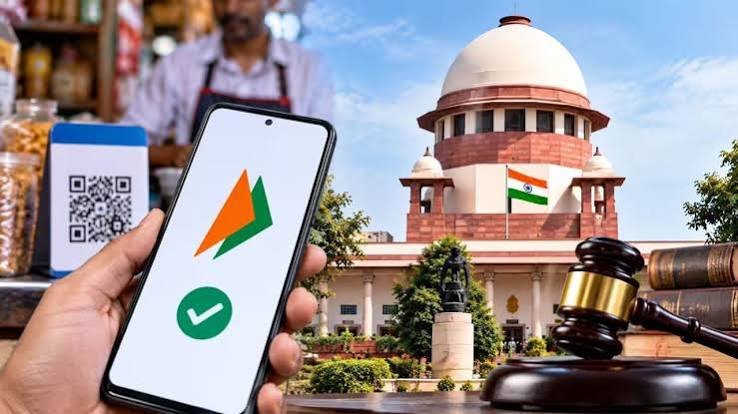
NEW DELHI: The Supreme Court on Monday, September 28, refused to stay the Centre’s new Merchant Discount Rate (MDR) framework for specified Unified Payments Interface (UPI) person-to-merchant transactions above ₹2,000. The Supreme Court UPI hearing came after a public interest litigation challenged the legal basis of the new payment charges, which are scheduled to begin on October 15.
The bench comprising Chief Justice of India Surya Kant and Justices Joymalya Bagchi and V. Mohana issued notices to the Centre, the Reserve Bank of India and the National Payments Corporation of India (NPCI), while seeking the government’s response to the petition.
What The Supreme Court Decided
The court declined to grant interim relief against the proposed UPI MDR charges, meaning the October 15 implementation remains in place while the challenge is considered.
The petition was filed by advocate Anjan Datta, who challenged the Finance Ministry notifications issued on September 14 and 15. The petition questions the statutory basis for the levy and raises concerns about the effect of the charges on merchants and the wider digital payments system.
During the hearing, the bench sought greater clarity on the nature and legal basis of the charge. The Centre has maintained that the MDR is part of the payment-settlement system rather than a government tax or fee.
How The New UPI Charges Will Work
Under the announced UPI fee update, a standard MDR of 0.4% will apply to specified person-to-merchant payments above ₹2,000. The charge will be capped at ₹300 for transactions of ₹75,000 or more.
The framework also provides a zero-MDR treatment for eligible small merchants receiving up to ₹1 lakh a month through UPI QR payments. Person-to-person transfers remain outside the new charge.
The government has also advised banks to ensure that merchants do not pass the MDR directly to customers. The Centre told the court that about 96% of merchant transactions would remain unaffected under the framework.
Why The Petitioner Challenged The Policy
The petition argues that the new UPI MDR charges could increase merchants’ payment costs and encourage some businesses to avoid UPI or pass costs into prices.
The petitioner has also questioned the ₹2,000 threshold and the distinction between UPI and other digital payment instruments. Those arguments remain part of the pending legal challenge and have not been accepted as findings by the Supreme Court.
For consumers, existing UPI and online banking services will continue to operate, but the financial arrangement behind qualifying merchant transactions will change from October 15.
Government Asked To Explain Its Position
The Supreme Court has given the Centre and other respondents time to file their responses. The case therefore remains at an early stage, and Monday’s order should not be interpreted as a final ruling upholding the legality of the new framework.
The Supreme Court UPI proceedings will now focus on the government’s explanation of the mechanism, its legal foundation and the technical structure behind the MDR.
The UPI fee update is therefore still subject to judicial scrutiny even though the court has declined to halt its scheduled rollout.
According to Reuters, the new framework is part of a broader change ending UPI’s long-standing zero-MDR arrangement for specified high-value merchant payments.
For now, the immediate position is clear: the Supreme Court UPI challenge continues, but there is no interim stay preventing the new UPI MDR charges from taking effect on October 15.