SEMICON India 2026 Opens in Delhi as PM Modi Set to Inaugurate Fifth Edition
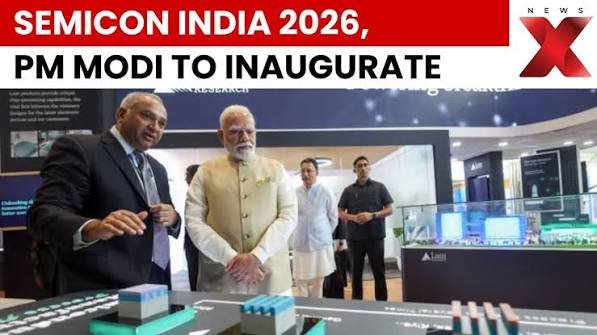
NEW DELHI: SEMICON India 2026 opens at Yashobhoomi in New Delhi on Thursday, September 17, with Prime Minister Narendra Modi scheduled to inaugurate the fifth edition of the semiconductor and electronics event. The three-day programme will run until September 19 under the theme “Silicon to Systems: Building the Ecosystem.” The Prime Minister’s Office said more than 600 companies and representatives from 52 countries are expected to participate.
Global semiconductor industry converges on Delhi
The scale of SEMICON India 2026 has expanded significantly, with the government saying more than 600 exhibitors, including 300 international companies, will participate across 15,000 square metres of exhibition space. The event will bring together semiconductor manufacturers, electronics companies, investors, researchers, startups, policymakers and academic institutions.
The exhibition will include six country pavilions representing Japan, South Korea, Malaysia, the Netherlands, Singapore and Sweden, alongside state booths and dedicated startup, innovation and workforce-development showcases.
PM Modi to underline India’s chip ambitions
The PM Modi semiconductor conference comes as New Delhi seeks to build capabilities across more stages of the semiconductor value chain, from materials and equipment to chip design, fabrication, advanced packaging, electronics and systems.
Modi held a meeting with senior semiconductor executives in New Delhi on September 16, a day before the inauguration, with discussions focused on investment and the development of India’s semiconductor ecosystem.
The PM Modi semiconductor conference will therefore serve as both an industry gathering and a platform for the government to outline its semiconductor priorities.
India targets a larger semiconductor ecosystem
A major focus of SEMICON India 2026 is the expansion of domestic manufacturing and supporting infrastructure. Government projections indicate that India’s semiconductor requirement could rise from around $100 billion to approximately $200 billion as demand for chips grows across electronics, vehicles, artificial intelligence and other industries.
The figure represents a projected future requirement, rather than the current size of India’s semiconductor market.
The PM Modi semiconductor conference is expected to bring companies and policymakers together around investment, supply chains, technology partnerships and talent development.
From chips to complete systems
The programme of SEMICON India 2026 extends beyond chip fabrication. Sessions will address advanced packaging, artificial intelligence, display technology, supply-chain resilience, sustainability, startups and workforce development.
The government has also said 12 semiconductor projects have been approved under the Semicon India Programme, with three having commenced commercial production. The event is designed to showcase how those efforts are developing across a broader ecosystem rather than focusing on manufacturing alone.
This approach reflects India’s broader technology push, which also includes domestic capabilities in areas such as space technology, electronics and advanced engineering. The EOS-5 mission is another example of India’s efforts to expand indigenous technological capabilities.
What SEMICON India 2026 means for India
The significance of SEMICON India 2026 goes beyond the three-day exhibition. India is seeking a larger role in global semiconductor supply chains at a time when governments and manufacturers are placing greater emphasis on resilient production networks.
The PM Modi semiconductor conference provides a platform for companies from across the value chain to assess potential investments, partnerships and technology opportunities in India.
For New Delhi, the longer-term objective is to move beyond semiconductor consumption and develop greater domestic capacity in design, manufacturing, packaging and electronics systems. SEMICON India 2026 places that strategy in front of an international industry audience, while the PM Modi semiconductor conference gives the government an opportunity to highlight the progress and remaining challenges in building that ecosystem.