Nepal Flash Floods Live: 469 Dead as New Flood Threat Emerges
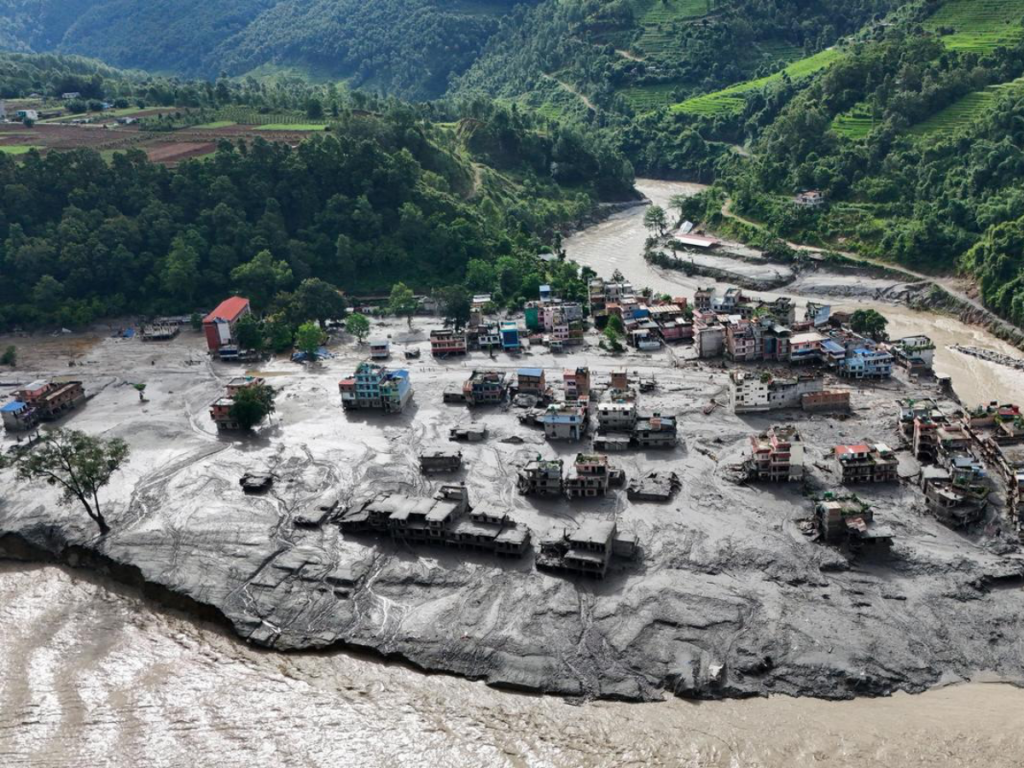
KATHMANDU, Aug. 28, 2026 — Nepal’s death toll from this week’s catastrophic flash floods has reached 469, according to Nepal Police, while authorities have issued a fresh warning after water levels rose at a barrier lake formed near the Nepal-China border.
The renewed danger emerged as rescue teams searched for people still missing after Wednesday’s disaster, which sent water, ice, rock and mud through communities along the Bhote Koshi and Trishuli river systems.
Nepal authorities warned residents and rescue workers in vulnerable areas to move to safer ground as the water level rose again at the site of the earlier disaster. Reuters reported that rescue operations were temporarily suspended and helicopter operations halted as officials assessed the threat.
Fresh threat near the Nepal-Tibet border
The immediate concern is a newly formed barrier lake created by debris from the earlier disaster.
Nepal’s National Disaster Risk Reduction and Management Authority warned that the water level mixed with mud had increased at the same location where Wednesday’s flash flood struck, creating a risk of further flooding. Authorities urged people in the Bhote Koshi and Trishuli areas, including search-and-rescue personnel, to remain alert and move away from danger zones where necessary.
A senior official in Rasuwa district, Narendra Pariyar, told Reuters that authorities had received information that the lake had broken its banks. He said the precise size of the overflow was not yet known but that the river level could be seen rising.
Reuters reported that the lake had accumulated more than 2.5 million cubic metres of water, compared with an estimated 1.5 million to 2 million cubic metres a day earlier, before overflowing toward the Bhote Koshi River.
Residents were seen moving uphill with belongings as warnings were issued to stay away from riverbanks. Chinese rescue personnel and vehicles were also moved to safer areas because of concerns over further flooding and possible secondary hazards, including landslides and avalanches.
Death toll reaches 469
Nepal Police said 469 people had died in the disaster as of Friday morning.
Bodies had been recovered from eight districts, with the largest number recorded in Chitwan, where 178 were found. Nawalparasi East reported 110, followed by Gorkha with 44, Nuwakot with 37, Dhading with 33, Tanahun with 28, Nawalparasi West with 27, and Rasuwa with 12.
At least 1,545 people have been rescued from affected areas, including people who were stranded by the flood. Eighty-four were receiving treatment in hospitals in Kathmandu, according to Nepal Police figures cited by The New Indian Express.
The rescue effort involves thousands of security personnel, with helicopters being used to reach isolated communities and ground teams searching river corridors and areas buried under mud and debris.
The number of people still missing remains fluid as authorities verify reports from different districts and nationalities. One Nepal Police update cited by Indian media put the number missing in Nepal at 977, including security personnel, foreign tourists and Nepali travellers. A separate report said 910 people were missing in Nepal and 558 on the Tibet side, for a combined figure of 1,468.
Because search operations are continuing and lists are still being reconciled, the missing-person figure should be treated as provisional.
What caused the disaster?
The original flood struck on Wednesday, August 26, after a large ice-and-rock mass collapsed near the Nepal-Tibet border.
Satellite imagery reviewed by scientists for The Associated Press showed that a section of glacier on Langtang Lirung appeared to have broken away along with a much larger section of underlying bedrock. The resulting avalanche of ice, rock and debris entered the mountain river system and drove an enormous surge downstream.
The force of the flood dramatically altered sections of the Trishuli River. Satellite images showed wider river channels and large areas covered by brown and black sediment, while settlements and infrastructure along the riverbanks were buried or swept away.
Scientists cited by AP said a direct link between the specific collapse and climate change cannot yet be established. However, researchers said warming temperatures and the degradation of high-altitude permafrost can destabilise mountain slopes and increase the likelihood of glacier- and rock-related hazards.
Search operations face a new obstacle
The newly formed lake has complicated an already difficult rescue operation.
Authorities temporarily stopped rescue activity after receiving information that the lake had breached its natural barrier. Helicopter operations were also suspended while people living downstream moved toward higher ground.
Nepal’s Department of Hydrology and Meteorology continues to operate its national warning and river-monitoring systems, with flood and weather warnings in effect on Friday. The department advises people to use its flood early-warning service for current information.
The situation has also prompted concern beyond the immediate disaster zone. Nepal’s Ministry of Foreign Affairs established an emergency control room to coordinate information about foreign nationals affected by the Bhote Koshi floods and urged families and diplomatic missions to rely on official information rather than unverified reports.
Foreign nationals among those missing
Foreign travellers and pilgrims were caught in the disaster, particularly in areas used by people travelling toward Tibet and Mount Kailash.
Nepal’s Foreign Ministry said in an August 27 update that 596 foreign nationals from 33 countries were still missing at that stage. The ministry said the figures were subject to verification as search and rescue operations continued.
India has also been working to establish the whereabouts of its citizens. The New Indian Express, citing India’s Ministry of External Affairs, reported that 290 Indian nationals remained uncontactable, while 84 had been rescued.
The figures are expected to change as communication is restored and search teams reach areas that remain difficult to access.
Nepal suspends examinations
The disaster has also disrupted normal life beyond the flooded districts.
The Nepal government has decided to halt examinations scheduled from August 29, with educational institutions instructed to reschedule postponed examinations. The government also asked schools and colleges to maintain contact with students and parents and arrange psychological counselling where needed.
The decision reflects the wider disruption caused by damaged roads, bridges and other infrastructure.
What happens next
For authorities, the immediate priority is monitoring the barrier lake and downstream river levels while continuing the search for missing people.
The risk of another surge means rescue teams cannot simply continue operations regardless of conditions. Authorities are having to balance the need to reach isolated communities with the possibility of another rapid rise in water levels.
Nepal’s flood-monitoring authorities continue to track river conditions, while officials in affected districts have instructed residents and rescue personnel to move to safer locations when necessary.
The death toll of 469 remains the latest figure reported by Nepal Police and cited by Nepal’s public broadcaster and multiple news organisations. An earlier Reuters version carried a higher figure for deaths in Nepal, but a subsequent Reuters report cited the Nepal toll as 469. Reportiva is using the Nepal Police figure pending further official clarification.
The search for missing people and monitoring of the new lake are continuing, with conditions capable of changing rapidly.