RBI Repo Rate Hike: RBI Raises Rate to 5.50% as Inflation Pressures Build
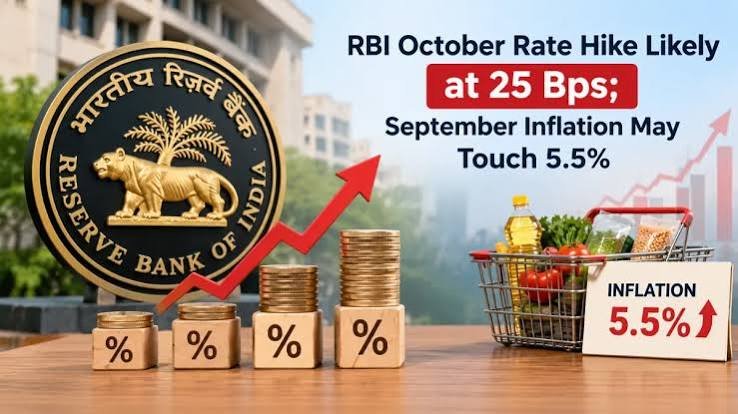
MUMBAI: The Reserve Bank of India raised its benchmark repo rate by 25 basis points to 5.50% on Wednesday, October 7, marking its first increase in nearly four years. The move signals a clear shift in the RBI Monetary Policy approach as policymakers respond to broader inflation pressures while economic growth remains strong.
RBI Repo Rate Hike Marks First Increase In Nearly Four Years
The six-member Monetary Policy Committee unanimously voted to raise the repo rate from 5.25% to 5.50%. The RBI also increased the Standing Deposit Facility rate to 5.25%, while leaving the cash reserve ratio unchanged at 3%.
The decision comes after the central bank kept rates unchanged at its August meeting. The earlier RBI repo rate decision had left the benchmark rate at 5.25% as policymakers assessed inflation, growth and global risks.
The latest RBI Repo Rate Hike represents the first increase since early 2023 and moves monetary policy into a more restrictive phase.
Inflation Concerns Drive The Policy Shift
Inflation has become a stronger concern for policymakers in recent months. Rising energy costs, food-price pressures and global geopolitical tensions have complicated the outlook for consumer prices.
According to Reuters, the RBI has projected headline inflation at 5.8% and core inflation at 4.4%, while Governor Sanjay Malhotra said the changing inflation environment required a recalibration of policy.
The central bank also shifted its policy stance from neutral to “calibrated tightening”. That change indicates that future decisions will remain closely linked to incoming inflation and economic data rather than following a predetermined path.
What The RBI Monetary Policy Change Means For Borrowers
The RBI Monetary Policy decision could affect borrowing costs for households and businesses, particularly where loans are linked to external benchmarks.
A higher repo rate increases the cost at which banks obtain short-term funds from the central bank. Banks may pass some or all of that increase through to borrowers, depending on the loan structure, benchmark and individual lender.
Home-loan borrowers with repo-linked floating-rate loans could therefore see their interest rates or repayment schedules change. The actual impact will vary between lenders and loan agreements.
The RBI Repo Rate Hike could also influence demand for new loans if borrowing becomes more expensive. Businesses assessing fresh credit may likewise face higher financing costs if banks adjust lending rates.
Indian Economy Remains Strong Despite Inflation Risks
The rate increase comes against a backdrop of strong economic activity. Reuters reported that the RBI expects India’s economy to grow by 7.1% during the year, giving policymakers more room to focus on inflation without an immediate need to support demand through lower borrowing costs.
The decision is also important for financial markets. Higher domestic interest rates can influence government bond yields, bank stocks, the rupee and investor expectations about future monetary policy.
Recent market volatility has already been linked to higher oil prices and global interest-rate pressures. Earlier Indian market losses showed how closely investors have been watching crude prices, bond yields and currency movements.
RBI Keeps Focus On Future Inflation Data
The latest RBI Monetary Policy decision does not establish a fixed path for further rate increases. The central bank is expected to continue assessing inflation, economic growth, energy prices, liquidity and global financial conditions.
For households, businesses and investors, the immediate question is whether inflation continues to broaden or begins to moderate.
The RBI’s move to 5.50% marks a significant change in India’s interest-rate environment. Further policy decisions will depend on whether price pressures persist and how the Indian Economy responds to tighter financial conditions.