
Taiwan AI Chip Development Advances With Two New Generations Of Processors
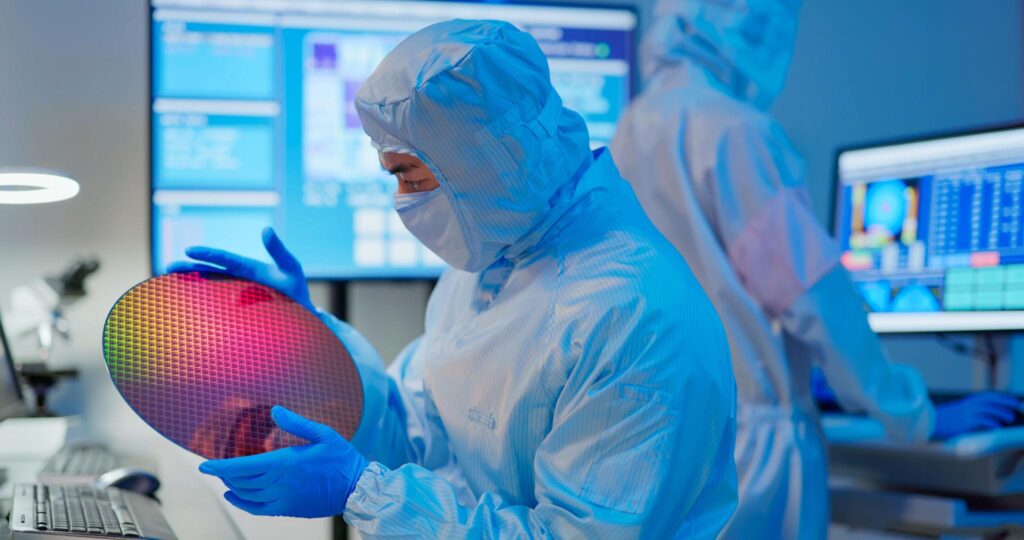
TAIWAN: Taiwan AI chip development has gained momentum after researchers at National Taiwan University (NTU) developed two generations of energy-efficient processors designed to run generative artificial intelligence directly on electronic devices.
Announced by Taiwan’s National Science and Technology Council (NSTC) on November 25, 2026, the research focuses on reducing unnecessary calculations and data transfers during AI processing. The development could help smartphones, robots, industrial equipment and unmanned vehicles run advanced AI applications with less dependence on cloud computing.
The research team is led by Yang Chia-hsiang, a professor in NTU’s Department of Electrical Engineering and Graduate Institute of Electronics Engineering.
According to the Taipei Times, the researchers developed Transformer learning processors by integrating AI algorithms, hardware architecture and semiconductor chip design.
The two generations have achieved peak energy efficiencies of 99.2 and 157 tera operations per second per watt (TOPS/W), respectively, according to the NSTC.
The research comes as semiconductor manufacturers and technology companies increasingly focus on developing processors capable of handling artificial intelligence workloads without relying entirely on remote data centres.
1. First-Generation Chip Achieves 99.2 TOPS/W Efficiency
The first-generation processor represents an important step in the development of hardware designed specifically for Transformer-based artificial intelligence applications.
Manufactured using a 40-nanometre process, the chip is described by the NSTC as the first reported learning processor capable of accelerating both Transformer inference and training.
Transformer technology forms the foundation of many modern generative AI systems, including large language models.
These systems process information by analysing relationships between different elements of data, commonly called tokens. However, processing every relationship can require considerable computing power and memory resources.
NTU’s research team addressed this challenge by developing a processor capable of identifying important relationships before carrying out more intensive calculations.
The approach allows the chip to reduce unnecessary operations while directing computing resources towards information considered more relevant.
The first-generation processor achieved a peak energy efficiency of 99.2 TOPS/W.
The NSTC said this represented between 2.6 and 162 times the energy efficiency of advanced Transformer processors designed for inference that were reported in the research literature at the time of comparison.
These figures reflect specific research benchmarks and should not be interpreted as a universal performance advantage across all AI applications.
2. Second-Generation Chip Reaches 157 TOPS/W
The second-generation processor builds on the first design by further simplifying model training and reducing computing and memory requirements.
According to the NSTC, the processor achieved peak energy efficiency of 157 TOPS/W.
This represents between 1.6 and 7.6 times the energy efficiency of advanced Transformer learning processors used for comparison in the research.
The improvement reflects the team’s continued efforts to optimise the relationship between AI algorithms and semiconductor architecture.
Rather than treating software and hardware as separate development challenges, the researchers designed the processing architecture around the specific requirements of Transformer-based AI workloads.
The second-generation chip is particularly relevant because training and running AI models can place different demands on processors.
Reducing the amount of computation and memory required could make advanced AI applications more practical on devices with limited hardware resources.
However, the reported efficiency figures do not establish that every large generative AI model can run locally on ordinary consumer devices.
Actual performance will depend on model size, memory capacity, processing requirements and the specific application.
3. On-Device Generative AI Could Reduce Cloud Dependence
One of the most important objectives of the research is expanding the possibilities of on-device generative AI.
Most widely used generative AI services rely on cloud data centres to process user requests. Devices send information through internet connections, remote servers perform the calculations and the results are returned to the user.
This arrangement supports powerful AI applications but can introduce transmission delays, network limitations and additional energy consumption associated with moving data.
Running AI models directly on local hardware offers an alternative.
NTU professor Yang Chia-hsiang explained that improving computational efficiency alone is not sufficient. Reducing the energy consumed when transferring data is equally important.
The team’s stated objective is to compute only what is necessary and move less data.
The NSTC identified several potential applications:
-
Smartphones: Running certain AI functions locally without sending every request to remote servers.
-
Robotics: Processing information from cameras and sensors to support quicker responses.
-
Industrial equipment: Analysing operational data closer to where it is generated.
-
Unmanned vehicles: Supporting local environmental analysis and decision-making.
-
Connected devices: Maintaining selected AI functions when network connectivity is unreliable.
Local processing may also provide privacy advantages because some information can be analysed without transmitting it to external servers.
However, these benefits depend on how individual applications are designed. On-device processing does not automatically guarantee complete data privacy or eliminate the need for cloud services.
4. NTU Has Already Fabricated A Next-Generation 16nm Chip
The research has progressed beyond the first two generations.
NTU’s team is developing another processor designed to address memory bandwidth limitations during AI inference.
Memory bandwidth is an important factor in AI computing because processors need to access and transfer large amounts of information while running complex models.
As models become larger and handle longer sequences of information, moving data between processors and external memory can become a significant performance and energy bottleneck.
The next-generation design aims to improve this process through data compression and more efficient management of external memory transfers.
The NSTC confirmed that the new chip was fabricated in October 2026 using a 16-nanometre manufacturing process.
This is a separate development from the two earlier generations, which were designed around improving Transformer computation and training efficiency.
The new processor is intended to address a different challenge: reducing the memory-related limitations that can affect AI inference.
The council has not announced a commercial release date, consumer availability or a complete set of performance benchmarks for the new chip.
The development nevertheless represents another step in Taiwan’s research into specialised AI semiconductor technology.
5. Taiwan Strengthens Its Position In The Global AI Chip Race
The NTU research is part of a wider government-supported effort to strengthen Taiwan’s semiconductor research and development capabilities.
The project was conducted under the NSTC’s Taiwan Chip-based Industrial Innovation Program.
The programme supports research into advanced AI processors and other critical semiconductor technologies.
Taiwan already occupies an important position in the international semiconductor industry, with its manufacturing ecosystem playing a major role in supplying advanced chips to global technology companies.
Its expanding focus on specialised AI processors could help strengthen its position beyond traditional semiconductor manufacturing.
The development also comes amid growing international competition over advanced computing hardware.
The US-China AI chip war has demonstrated how access to advanced processors has become an important part of international technology and economic policy.
Meanwhile, the SEMICON India semiconductor initiative illustrates how other countries are also investing in semiconductor research, manufacturing and domestic technology capabilities.
The wider industry is also dealing with questions surrounding access to advanced AI hardware, as highlighted by the US investigation into Nvidia chip exports.
In this environment, specialised processors designed for energy-efficient AI applications could become increasingly important.
What Happens Next In Taiwan AI Chip Development?
The next stage of Taiwan AI chip development will depend on how effectively NTU’s research can translate into practical applications.
The first two generations have demonstrated improvements in computational efficiency, while the next-generation 16nm processor targets memory bandwidth limitations.
However, research achievements do not automatically translate into commercially available products.
Further development will be needed to establish how the processors perform across different AI models, device categories and real-world workloads.
The research also highlights an important direction for the future of on-device generative AI: reducing the amount of computing power and data movement required to run increasingly capable artificial intelligence applications.
For Taiwan, the project adds another development to its broader semiconductor research programme.
For the technology industry, it demonstrates why improving AI hardware efficiency is becoming as important as developing more powerful AI models.




