Hanle Dark Sky Reserve Gives Ladakh Women New Work Through Astro-Tourism
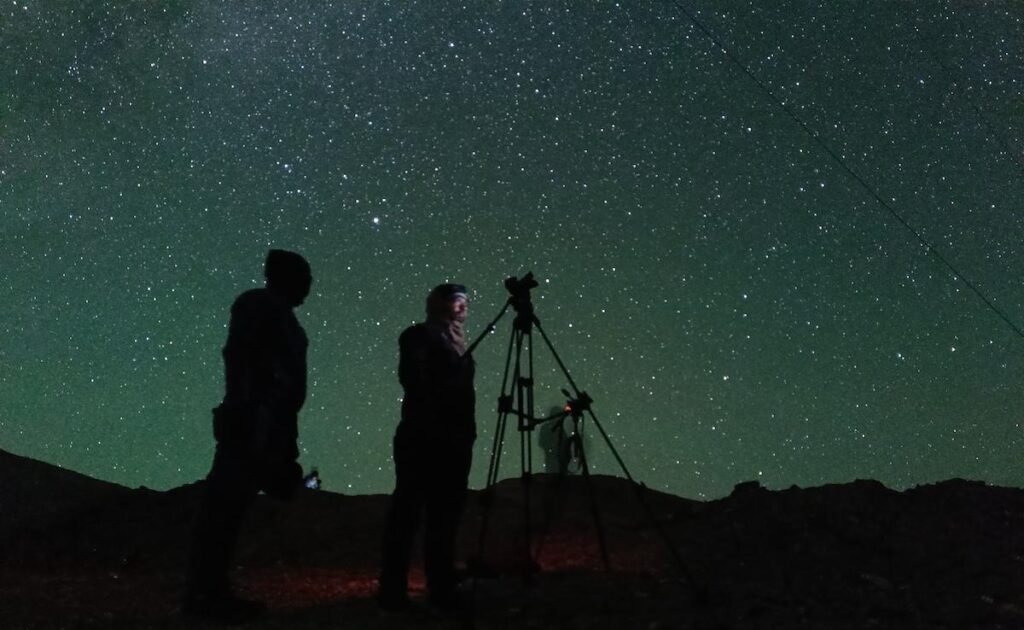
At 4,500 metres above sea level, Hanle in eastern Ladakh is turning its exceptionally dark skies into an opportunity for local communities. Among those benefiting are women who have been trained to guide visitors through the night sky as astro-ambassadors.
Hanle is home to the Hanle Dark Sky Reserve, designated in December 2022 as India’s first dark sky reserve. The reserve covers an area of roughly 22 kilometres around the village and the Indian Astronomical Observatory, operated by the Indian Institute of Astrophysics.
The astronomy programme has trained 24 local people as astronomy ambassadors, two-thirds of them women, according to the Indian Institute of Astrophysics. Each ambassador was provided with an 8-inch telescope funded by the Union Territory of Ladakh.
For the ambassadors, the work is about more than pointing telescopes towards planets and distant celestial objects. It has created a new source of income in a remote region where employment opportunities are limited.
From village life to guiding visitors through the cosmos
As darkness settles over Hanle, local guides take visitors outside and introduce them to objects that are difficult or impossible to see from heavily lit cities.
The experience can include views of the Milky Way, planets and deep-sky objects through small telescopes. Artificial lighting is also regulated in the reserve to protect the quality of the night sky, which is important both for tourism and for astronomical research.
Tsering Dolker, one of the astro-ambassadors, told NDTV that she guides visitors during stargazing sessions and uses a telescope to show them celestial objects. She said the growing number of tourists visiting Hanle had changed the lives of residents.
The Indian Institute of Astrophysics says the astro-tourism model is intended to bring economic benefits to villages inside the reserve while encouraging local participation in protecting the dark sky.
Women find a new source of income
The growth of astro-tourism has also been accompanied by an expansion of homestays and other visitor services.
NDTV reported that some women in Hanle who previously had little or no income are now earning through tourism-related work. One local homestay operator identified by the publication as Angmo said she was earning about Rs 1.5 lakh a month and that her property was regularly booked.
Those income figures come from individuals interviewed for the NDTV report and should not be interpreted as an average income for all astro-ambassadors or women working in Hanle.
The broader model combines several sources of local economic activity. Residents can operate homestays, provide meals and offer stargazing sessions, allowing tourism revenue to circulate within the village.
The Indian Institute of Astrophysics has described this community-based approach as a means of supporting science-led socio-economic development in the region.
Protecting the darkness that attracts visitors
Hanle’s appeal depends on something increasingly difficult to find: a natural night sky.
The Indian Institute of Astrophysics says the region’s high altitude and favourable atmospheric conditions were important factors behind the establishment of the observatory and the dark sky reserve.
The reserve also has a Light Management Plan designed to reduce artificial light. Measures include the use of curtains, appropriate lighting and lampshades, along with regulations intended to limit unnecessary illumination.
That creates a delicate balance. More tourists can generate income for residents, but excessive development or poorly managed lighting could damage the very conditions that attract visitors.
The astronomy programme therefore links tourism with conservation. Residents are not simply providing an experience for visitors; they are also part of the effort to maintain the night sky.
Astronomy meets local knowledge
The initiative has another dimension. Ladakh has a long tradition of observing the sky, and residents have historically relied on celestial patterns for aspects of daily life.
The recent training gives younger villagers a scientific framework for understanding the stars and planets while keeping them connected to their communities.
Earlier reporting by The Guardian found that some astro-ambassadors had begun comparing scientific astronomy with knowledge passed down by older generations, including traditional observations of stars and seasonal changes.
That connection gives the programme a cultural dimension beyond tourism.
Hanle’s growing role as an astronomy destination
The Hanle Dark Sky Reserve was created around an existing scientific asset: the Indian Astronomical Observatory, one of the major astronomical research facilities in the region.
The Indian Institute of Astrophysics has continued to develop astronomy outreach and tourism activities around Hanle. Its programme includes training for local guides, public stargazing and astronomy events.
The institute has also listed a 2026 Hanle Dark Sky Reserve Star Party among its activities, reflecting the area’s growing role in amateur astronomy and astrophotography.
For visitors, the attraction is straightforward: a chance to see a sky largely hidden from people living in cities.
For Hanle’s residents, however, the value is more immediate. The same darkness that makes the village scientifically important is becoming an economic resource.
And for the women working as astro-ambassadors, the telescope has become something more than an instrument for looking at distant planets and galaxies. It has become a way to build a livelihood without leaving home.