The 1980s Are Back, This Time Through AI-Generated Photos
The 1980s have returned to social media, but not through old photographs or vintage clothing. This time, artificial intelligence is doing the work.
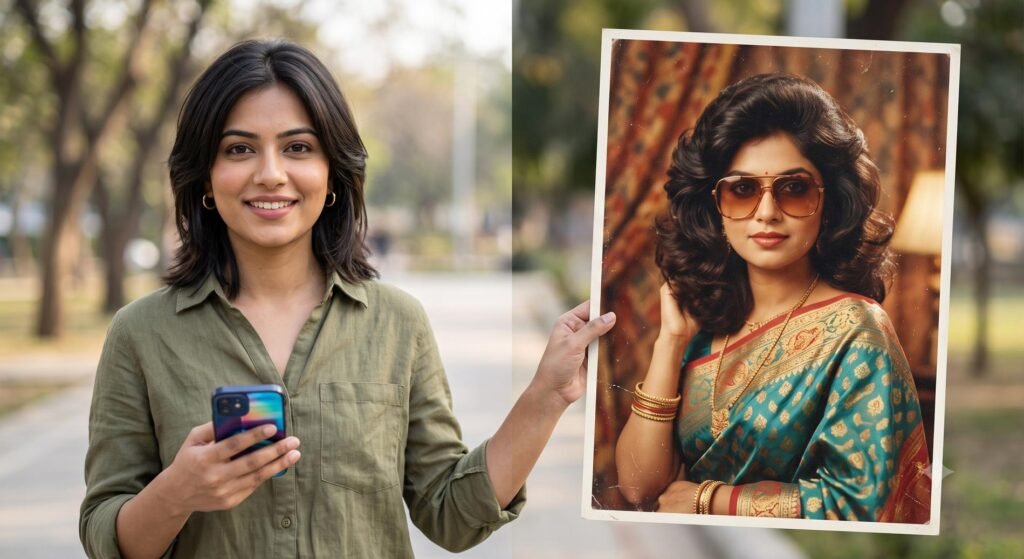
A viral photo trend is prompting users to upload contemporary pictures and recreate them as if they had been photographed in the 1980s. The resulting images typically feature period clothing, large hairstyles, vintage accessories, warm lighting, and the grainy appearance associated with analogue photography.
The trend has spread across Instagram and X, with users sharing their AI-generated portraits and the prompts used to make them. Indian celebrities, creators and politicians have also joined the wave, giving the trend a distinctly local flavour through Bollywood-inspired portraits, regional fashion and family-album aesthetics.
How the 1980s AI photo trend works
Unlike a conventional photo filter, the trend involves asking an AI image-generation system to reinterpret an existing photograph.
Users can provide a photograph and describe the appearance they want. A prompt might specify a 1980s Indian studio portrait, vintage Bollywood styling, a family photograph, or a period-specific fashion look.
The AI can then alter elements such as clothing, hairstyle, background, lighting, and photographic texture while attempting to retain the person’s recognizable facial features.
Recent reports have described users creating everything from old-fashioned family portraits to Bollywood-style hero and heroine images. Some versions are designed to resemble photographs from old film cameras, with soft focus and visible film grain.
The appeal is partly the ease of the process. Creating an elaborate-looking period portrait no longer requires professional photo-editing software or extensive design skills.
From Instagram users to Indian politicians
The trend has also reached India’s political circles.
Union Commerce and Industry Minister Piyush Goyal shared an AI-generated 1980s-style image on X on September 8, joining the growing social media trend.
Parliamentary Affairs and Minority Affairs Minister Kiren Rijiju also posted a 1980s-inspired image the following day. His post showed him in a retro setting alongside styling associated with the period.
Other public figures have followed with their own versions, helping push the trend beyond ordinary social media users.
The participation of politicians has given the trend another layer of visibility, although the images remain primarily social-media content rather than official political communications.
Shashi Tharoor takes a different approach
Congress MP Shashi Tharoor offered a twist on the trend.
Rather than relying entirely on AI-generated images, Tharoor shared photographs that he said were actually taken during the 1980s.
In one post, he wrote that the 1980s appeared to be back “courtesy of AI” and that he would join the trend “the old-fashioned way” by sharing photographs from the actual decade.
He later reposted an older photograph showing himself with his two sons and corrected a detail from the original caption. The photograph had previously been described as having been taken in New York, but Tharoor clarified that it was actually taken in Geneva.
That distinction has become part of the conversation around the trend: AI can create a convincing approximation of the past, while genuine photographs provide an actual record of it.
Why the 1980s work so well for AI images
The decade has an unusually recognizable visual identity.
Bright clothing, oversized hairstyles, bold jewellery, distinctive sunglasses, vintage cars, studio portraits and analogue film textures provide AI image generators with a wide range of visual cues.
Indian users can also draw on a particularly rich archive of 1980s popular culture. Bollywood cinema, regional films, wedding photography and family albums all offer recognizable styles that can be recreated through detailed prompts.
The trend has consequently developed beyond a single visual formula. Users are experimenting with Bollywood portraits, traditional Indian clothing, college photographs, wedding pictures, and regional styles.
Some users have also adapted the concept to specific parts of India, including Kerala-inspired 1980s portraits and regional cinema aesthetics.
It is more than a vintage filter
One reason the images attract attention is that AI can reconstruct parts of the scene rather than simply applying a colour effect.
A traditional vintage filter may change contrast, colour and texture. An AI image-generation tool can be instructed to change the person’s clothes, hairstyle, surroundings and lighting as well.
That makes the result closer to a visual reinterpretation than a simple filter.
It also means the final picture should not be treated as a historical photograph. Even when an AI-generated image looks convincingly old, it is a newly created representation rather than evidence that the person actually appeared that way in the 1980s.
That distinction matters when such images involve public figures or are shared without clear labeling.
The privacy question behind the trend
The trend is relatively easy to participate in, but users are still handing photographs to an AI service.
Anyone uploading a personal photograph should consider what information is visible in the image and how comfortable they are with submitting it to an online service.
Extra care is warranted when photographs contain children, identification documents, private locations or other sensitive information.
Users should also check the generated result before publishing it. AI image systems can introduce visual errors or alter facial characteristics, clothing details and backgrounds.
The more realistic the image looks, the easier it can be for viewers to mistake an AI recreation for a genuine photograph.
A broader pattern in AI-driven social media
The 1980s trend follows a series of AI image trends that have turned personal photographs into different artistic or cultural styles.
What has changed is the speed at which users can move from an ordinary selfie to a highly customized visual concept.
The technology has effectively made the prompt part of the creative process. Instead of simply choosing a filter, users can describe an era, location, outfit, lighting style, and photographic treatment and ask an AI system to construct the image.
For social platforms built around visual sharing, that makes the format particularly easy to replicate. One person’s prompt can quickly become another person’s starting point.
For now, the 1980s trend is largely a nostalgia-driven social media phenomenon. Its popularity nevertheless shows how AI image tools are changing the way people experiment with personal photographs — and how quickly a recognizable visual style can become a participatory online trend.