Lucknow Stuns Indore to Top Swachh Vayu Survekshan 2026: The Clean-Air Ranking Has a Surprising Catch
LUCKNOW: Lucknow has emerged as the top-performing million-plus city in the Swachh Vayu Survekshan 2026, finishing narrowly ahead of Indore and Jabalpur in the Centre’s annual assessment of air-pollution control measures. The result has put the Uttar Pradesh capital in the national spotlight, although the ranking comes with an important qualification: first place does not mean Lucknow currently has the lowest pollution levels in India.
Lucknow takes the No. 1 spot
Lucknow scored 198 out of 200 points among cities with populations above 10 lakh. Indore followed with 197 points, while Jabalpur finished third with 195.
The fifth edition of the survey assesses how cities tackle major pollution sources, including road dust, vehicle emissions, waste burning, solid-waste management and construction-related pollution. The Indian Express reported that Lucknow’s result reflects a combination of cleaner transport, dust control, waste management and greening efforts.
That makes the Swachh Vayu Survekshan 2026 result more than a simple air-quality table. It measures implementation and improvement alongside environmental performance.
Electric vehicles and dust control drive the result
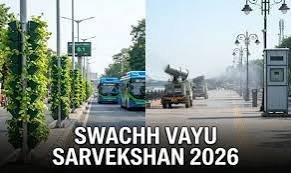
One of Lucknow’s biggest interventions has been the expansion of electric mobility. Around 1,100 electric vehicles are being used for door-to-door waste collection, while the city has also introduced 140 electric buses.
Road dust has received similar attention. The municipal corporation has deployed 97 electric mechanised sweeping machines, while about 559.85 kilometres of roads have been paved end-to-end to reduce exposed surfaces and dust being re-suspended by traffic.
Waste management has also been central to the Lucknow Cleanest Air Ranking, with authorities working to increase scientific processing of municipal waste and prevent open garbage burning.
The clean-air ranking comes with a major caveat
Despite its first-place finish, Lucknow has not yet reached the national annual PM10 standard of 60 micrograms per cubic metre.
That distinction is crucial when interpreting the Lucknow Cleanest Air Ranking. The survey rewards pollution-control measures and improvements; it does not mean Lucknow’s air is already within every prescribed pollution limit.
The city has nevertheless recorded a major long-term decline in PM10 from its 2017-18 baseline. That progress helps explain why Swachh Vayu Survekshan 2026 has recognised Lucknow’s efforts even though particulate pollution remains above the national standard.
The broader issue is increasingly important as air pollution continues to pose a major environmental and public-health challenge.
Ward-level action strengthens Lucknow’s case
The 2026 exercise also places greater emphasis on action at the neighbourhood level. Lucknow Ward 70 ranked first nationally among urban wards with populations above 30,000.
Local measures include reducing roadside dust, preventing waste burning and improving cleanliness in individual neighbourhoods. This ward-level approach gives the Lucknow Cleanest Air Ranking a wider significance because it shows how pollution-control programmes are being carried into residential areas rather than remaining limited to city-level policy.
The Swachh Vayu Survekshan 2026 framework similarly reflects a broader push toward measurable, ground-level action against pollution.
What Lucknow’s victory really means
Lucknow beating Indore by just one point makes the result particularly striking. Jabalpur’s 195 points put it only three points behind the winner, showing how closely the leading cities performed.
For residents, however, the real test begins after the award. The Lucknow Cleanest Air Ranking is evidence that sustained municipal action can produce measurable improvement, but the city still has to bring annual pollution concentrations down further.
For Swachh Vayu Survekshan 2026, Lucknow’s victory is therefore best understood as a marker of progress rather than proof that its air-quality battle is over.