
South Korea Cabinet Resignation: 3 Crucial Facts Behind the Misleading 2026 Report
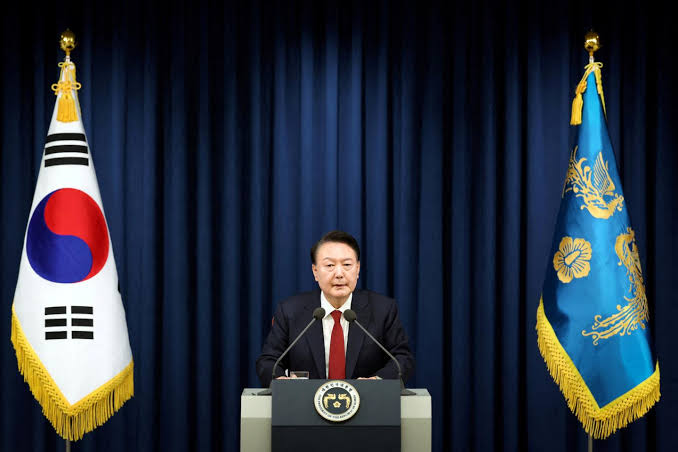
SOUTH KOREA: Claims that the country’s entire cabinet offered to resign amid mass demonstrations on November 24, 2026, require an important correction. The news report circulating online appears to reproduce an account of a political crisis from June 2008, rather than describe a newly confirmed development under the current administration of President Lee Jae Myung.
The report, attributed to Reuters and circulated through the VoteKansas news aggregator, states that South Korea’s cabinet offered to resign as the country’s president faced widespread street demonstrations and warned about a possible economic crisis.
However, the wording closely matches historical reporting about former South Korean President Lee Myung-bak, whose government faced intense public opposition over a controversial decision to expand imports of American beef.
The distinction matters because presenting the historical South Korea cabinet resignation as a November 2026 development would give readers an inaccurate understanding of the country’s political situation.
Why The South Korea Cabinet Resignation Report Is Misleading
The central claim in the circulating report is not new.
On June 10, 2008, South Korea’s entire cabinet offered to resign as President Lee Myung-bak struggled to contain growing public anger over his government’s decision to reopen the country’s market to US beef imports.
The political controversy had developed over several weeks, with demonstrations attracting large crowds in Seoul.
The original report described a government facing mounting pressure over food safety concerns, economic policy and public confidence.
According to historical reporting published by The Guardian on June 10, 2008, the prime minister offered the cabinet’s resignation during a regular meeting with the president.
This was a significant political development at the time, but it happened more than 18 years before the November 24, 2026 report currently circulating online.
Consequently, the claim cannot be treated as evidence of a fresh cabinet resignation.
What Triggered The Original South Korea Protests?
The original demonstrations were primarily connected to a controversial agreement involving US beef imports.
The South Korean government had decided to lift restrictions on American beef imports, prompting concerns among sections of the public about the possible risk of bovine spongiform encephalopathy, commonly known as mad cow disease.
The controversy developed into a broader movement against the government’s handling of the issue.
Demonstrations initially attracted students and concerned citizens before expanding to include labour organisations, political activists and other members of the public.
Thousands of people gathered in central Seoul, with some demonstrations continuing into the night.
The protests became a major challenge for Lee Myung-bak, who had taken office only a few months earlier.
The government faced criticism over its communication with the public, its handling of food safety concerns and its approach to negotiations with the United States.
The political pressure eventually contributed to the cabinet’s collective offer to resign.
Who Was South Korea’s President During The 2008 Crisis?
An important detail missing from the circulating report is the identity of the president involved.
The president in June 2008 was Lee Myung-bak, a conservative politician who served as South Korea’s head of state from 2008 to 2013.
He must not be confused with Lee Jae Myung, who became South Korea’s president in June 2025.
Although both politicians share the surname Lee, they belong to different political administrations and historical periods.
The distinction is particularly important when reporting developments involving cabinet decisions, public demonstrations and government resignations.
A report that identifies only the country and the cabinet’s decision, without properly establishing its historical date, can easily create confusion among readers.
What Is Happening In South Korean Politics In November 2026?
South Korea has continued to experience political disagreements and opposition activity in 2026, but these developments should not automatically be connected to the historical cabinet resignation.
On November 23, President Lee Jae Myung announced changes involving several senior government positions, including nominations for foreign minister, unification minister and National Intelligence Service director.
The appointments formed part of a cabinet and national security reshuffle.
On November 24, political discussions also continued around the administration’s nominations and domestic political disputes.
However, these developments are different from the collective cabinet resignation described in the circulating report.
There is an important difference between a government reshuffle, opposition demonstrations and an entire cabinet formally offering to resign.
Journalists must establish which of these developments actually occurred before publishing a headline suggesting a national political crisis.
Why Accurate Dates Matter In International Political Reporting
The South Korea protests story demonstrates how historical news can become misleading when it appears without its original publication date.
International news aggregators frequently collect reports from multiple publications and distribute them through centralised feeds.
If historical material is incorrectly dated, displayed without sufficient context or reproduced through an unreliable feed, readers may mistake an old political development for breaking news.
This is particularly problematic when the story concerns government resignations, elections, protests, national security or economic instability.
The South Korea cabinet resignation claim illustrates why checking the original reporting date is just as important as verifying the central event.
A credible news report should establish the identity of the officials involved, the date of the incident, the political circumstances and whether the development has been confirmed by reliable contemporary reporting.
Similarly, the South Korea protests should not be described as a new nationwide movement simply because an old report has appeared in a current news feed.
Final Fact-Check: Should The November 24 Report Be Published As Breaking News?
No.
The available evidence establishes that the cabinet resignation account closely matches the June 2008 political crisis involving former President Lee Myung-bak.
It does not establish that South Korea’s entire cabinet offered to resign on November 24, 2026.
The separate political developments involving President Lee Jae Myung and his administration should be reported independently.
For readers, the key distinction is straightforward: the historical resignation report and the current political situation are two different stories.
Publishing the old account as breaking news would risk spreading misinformation about South Korea’s government.




