
US Flight Disruption: 5 Critical Failures Behind Nationwide FAA Ground Stop
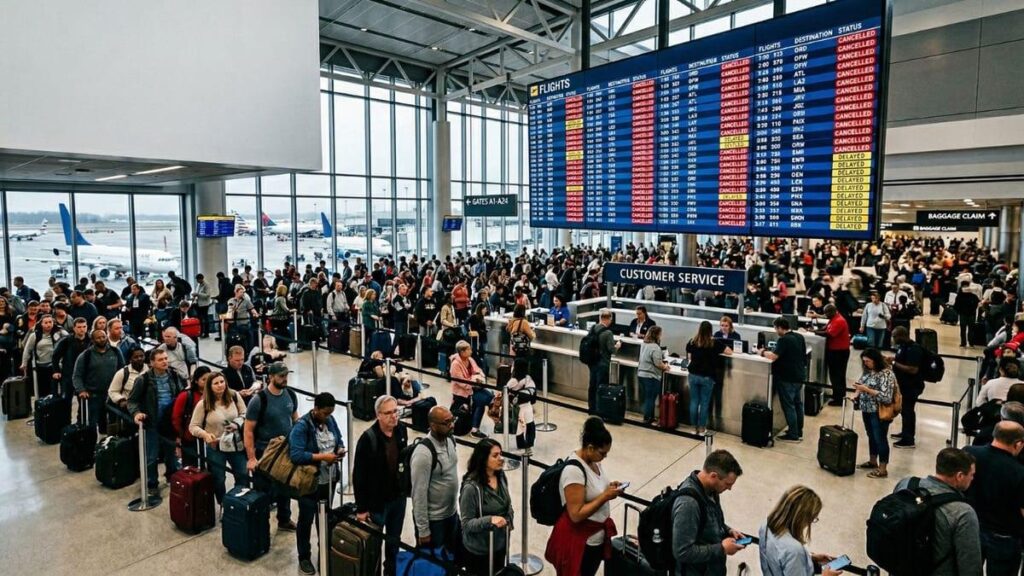
WASHINGTON, D.C.: US flight disruption spread across the country on Friday, November 13, after a telecommunications failure forced the Federal Aviation Administration (FAA) to issue a nationwide ground stop, disrupting thousands of flights and raising fresh questions about the condition of America’s ageing air traffic control infrastructure.
The incident affected communication and radar systems used by air traffic controllers to coordinate aircraft movements. US authorities said the problem emerged during maintenance work involving the replacement of old copper telecommunications lines with fibre-optic connections at a remote FAA facility.
Transportation Secretary Sean Duffy said a router-related problem caused repeated connection attempts across the network, affecting the reliability of communications between controllers and aircraft.
The FAA nationwide ground stop was introduced as a precautionary safety measure while technicians isolated the fault and restored affected systems. According to the US Department of Transportation, more than 3,500 flights were grounded during the initial response, while more than 8,000 flight operations resumed after the restrictions were lifted.
How The US Flight Disruption Began
The disruption began on November 13 when communication problems affected multiple Air Route Traffic Control Centers.
The FAA confirmed that it had ordered a nationwide ground stop for all US airports following communication issues involving several air traffic control facilities. Its initial statement described the information as preliminary and said technicians were investigating the problem.
The interruption affected two critical parts of aviation operations: communication between air traffic controllers and pilots, and the radar information used to monitor aircraft movements.
These systems allow controllers to coordinate aircraft positions, manage traffic separation and issue instructions during different stages of a flight.
When the reliability of these systems became uncertain, authorities decided to restrict departures rather than risk continuing normal operations without dependable information.
The decision resulted in widespread disruption for passengers, airlines, airport operators and aviation personnel.
L3Harris Contractor Work Under Investigation
Transportation Secretary Sean Duffy provided further details about the incident during a briefing on Saturday, November 14.
He identified L3Harris, a long-standing FAA telecommunications contractor, as the company carrying out maintenance work at a remote facility.
The work involved replacing ageing copper telecommunications lines with fibre-optic connections. The transition also involved moving from an older analogue-based system to an internet protocol-based digital network.
According to Duffy, the equipment involved may have caused other routers in the air traffic control network to receive an unusually high volume of connection attempts.
He said the affected router generated more than 1,000 connection attempts every four to five seconds.
This placed pressure on other network components and contributed to instability in the systems supporting aircraft communications and radar feeds.
However, authorities have not established whether the failure resulted from incorrect installation, human error or a faulty router.
Duffy explicitly said the investigation had not determined the precise fault. Therefore, L3Harris’s responsibility should not be treated as established.
Why The FAA Nationwide Ground Stop Was Necessary
The FAA nationwide ground stop was intended to protect passengers and aviation personnel while communication and radar reliability were assessed.
Air traffic control depends on continuous communication between pilots and controllers. Controllers also require reliable information about aircraft positions to maintain safe separation between flights.
If these systems become unstable, continuing normal operations can create unacceptable safety risks.
Duffy explained that the FAA chose to bring aircraft safely to the ground and isolate the affected network before reopening the airspace.
He also praised air traffic controllers, pilots, flight attendants, airport authorities and ground crews for their response.
According to the Department of Transportation, approximately 3,500 aircraft were in the air when the ground stop was implemented. Officials said the aircraft were brought down safely.
The nationwide restriction was subsequently lifted after the affected systems were restored and checked.
Ageing Aviation Infrastructure Raises Fresh Concerns
The latest US flight disruption has renewed attention on the condition of America’s air traffic control infrastructure.
The FAA continues to operate parts of its telecommunications network using technology developed decades ago. Replacing older copper connections with fibre is part of the effort to improve the system’s reliability and performance.
However, the incident demonstrates that infrastructure upgrades can also introduce operational risks if equipment changes are not properly managed.
During the November 14 briefing, Duffy said approximately 69% of the FAA’s copper communications network had been replaced with high-speed fibre.
He also outlined other modernisation work, including upgrades to radio sites, control tower technology and voice communication systems.
FAA Administrator Bryan Bedford clarified that the specific maintenance operation involved in the disruption was separate from the larger $12.5 billion modernisation programme supported by Congress.
Bedford also said the agency spends approximately $1 billion annually maintaining and sustaining its existing telecommunications network.
The scale of this maintenance requirement highlights the challenge of operating essential aviation infrastructure while simultaneously replacing older systems.
The issue is particularly relevant to airports handling large volumes of domestic and international traffic, where even temporary restrictions can affect airline schedules across multiple regions.
The importance of maintaining reliable airport infrastructure has also featured in earlier aviation developments, including Delhi Airport’s third runway upgrade, which focused on improving aircraft movement and operational efficiency.
Officials Say There Is No Evidence Of A Cyberattack
The technical failure initially raised questions about whether the communication problems could have resulted from a cyberattack.
However, Duffy said officials did not believe the incident was caused by malicious cyber activity.
He explained that systems returned to normal after technicians isolated the work being carried out at the remote location.
This assessment does not mean that every aspect of the technical investigation has been completed. Officials are still examining the precise cause of the equipment failure.
The distinction is important because a telecommunications malfunction and a deliberate cyberattack require different investigative approaches.
As of November 15, authorities have not publicly established evidence linking the disruption to an external attack.
Flight Operations Resume But Passengers May Still Face Delays
Although the nationwide restrictions were lifted, the restoration of normal flight schedules required additional work from airlines.
Aircraft and crew members were left out of position after flights were grounded, delayed or diverted. Such operational problems can continue even after air traffic control systems become available again.
The Department of Transportation warned passengers on November 14 that further delays and cancellations could occur as flight operations returned to normal.
Airlines also needed to reorganise aircraft assignments, crew schedules and passenger bookings to manage the backlog.
The US flight disruption therefore extended beyond the period when the FAA formally restricted departures.
Passengers travelling during the recovery period were advised to check their flight status directly with their airlines before heading to airports.
What Happens Next In The FAA Investigation?
The immediate priority for US aviation authorities is determining precisely why the router-related problem affected other components of the telecommunications network.
Investigators must establish whether the incident involved installation errors, equipment failure or another technical issue.
The findings could influence how future maintenance operations are planned, particularly when contractors work on telecommunications infrastructure connected to critical air traffic control systems.
The incident has also strengthened calls for continued investment in modern aviation technology and better safeguards during infrastructure upgrades.
For now, the FAA has restored operations, and officials have said the national airspace is functioning again.
However, the FAA nationwide ground stop has exposed the potential consequences of relying on ageing telecommunications infrastructure during a period of major technological change.
The investigation into the November 13 failure remains important not only for identifying what went wrong but also for preventing similar disruptions across the country’s aviation network.




