
Beijing Drone Ban: 5 Major Restrictions Take Effect Across China’s Capital
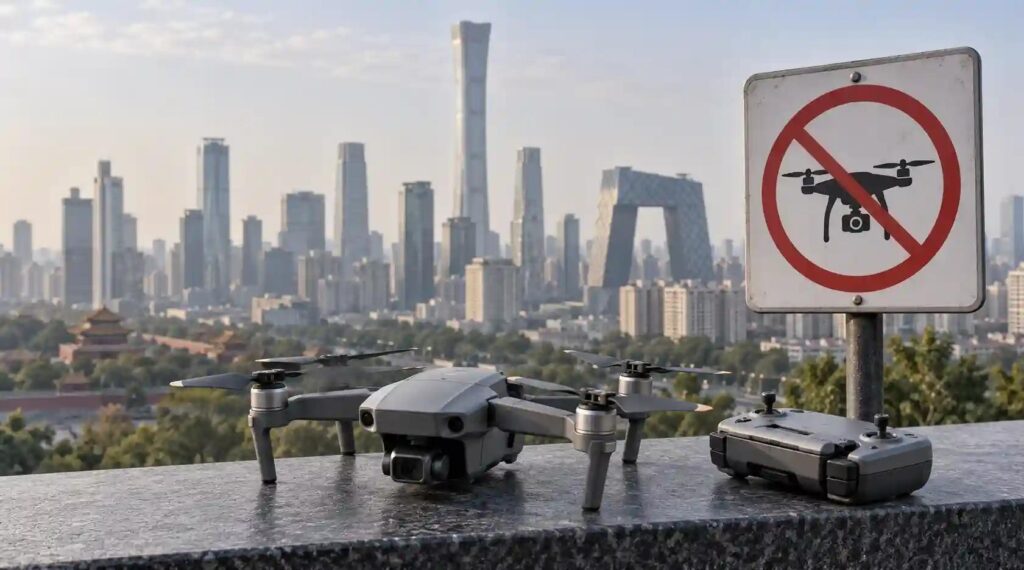
BEIJING: The Beijing drone ban officially came into force on Sunday, November 15, prohibiting individuals and organisations from possessing or storing unmanned aerial vehicles (UAVs) across the Chinese capital. The restrictions also prohibit transporting drones and their core components into Beijing, marking a significant expansion of the city’s aviation and security regulations.
The new rules cover Beijing’s entire administrative territory, including urban and rural areas spanning approximately 16,400 square kilometres (6,300 square miles). Authorities introduced the measures to strengthen security in the capital, which houses China’s central government, senior political leadership and major state institutions.
Under the revised regulations, individuals who continue to possess prohibited drones can face confiscation of their equipment and financial penalties. The changes represent a significant shift from the earlier registration-based system, which allowed existing owners to retain their devices under specified conditions.
The revised Beijing Municipal Regulations on the Management of Unmanned Aerial Vehicles were adopted by the Standing Committee of the Beijing Municipal People’s Congress on September 11 and published on September 13.
What Does The Beijing Drone Ban Prohibit?
The revised regulations establish a comprehensive prohibition covering the possession, storage, transportation and operation of drones within Beijing’s administrative boundaries.
The entire municipality has been designated as controlled airspace for unmanned aircraft. The regulations prohibit drone flights throughout the territory, alongside the possession and storage of UAVs and their core components.
The rules also prohibit individuals and organisations from transporting or carrying drones and their core components into Beijing.
This means the restrictions extend beyond recreational drone users. Businesses, commercial operators and other organisations must also comply with the revised requirements unless they fall within the specific arrangements permitted under the regulations.
The authorities have also prohibited establishing warehouses or temporary storage facilities for drones within the municipality, subject to the provisions for authorised special-purpose arrangements.
Why Has China Introduced Such Strict Drone Restrictions?
Security concerns are central to the new regulations.
Beijing is home to the country’s highest political institutions, government offices and the headquarters of the ruling Chinese Communist Party. Authorities have increasingly focused on controlling activities that could create risks around sensitive locations and restricted airspace.
An aviation incident in June 2026 also raised concerns about airspace safety in the capital.
A small aircraft crashed into the CITIC Tower, also known as China Zun, Beijing’s tallest building. The incident killed the pilot and injured 13 people, according to reports.
Although the incident involved a small aircraft rather than a conventional consumer drone, it brought additional attention to the potential consequences of unauthorised aircraft activity around major urban infrastructure.
The revised China drone restrictions are part of a broader effort to strengthen oversight of unmanned aircraft and reduce potential security vulnerabilities.
The authorities have described the objective as safeguarding the security of the capital. However, the regulations do not establish that the June aircraft crash alone caused the decision to introduce the possession ban.
What Happens To Existing Drone Owners?
Beijing had already introduced restrictions on drone sales in May 2026. Under the earlier framework, existing owners were required to register their devices and complete identity verification but were generally allowed to retain them.
The revised regulations changed that position.
Existing owners were required to dispose of their drones or move them outside Beijing before November 15. Authorities provided several options to help residents comply without simply abandoning their equipment.
These included selling eligible devices through government-approved buy-back locations, using designated recycling facilities or transporting the equipment outside the municipality.
Residents were also offered postal arrangements to send drones to addresses outside Beijing.
The disposal programme included financial incentives for eligible individuals whose devices had completed the required registration and verification process.
For approved buy-backs completed between September 12 and October 31, owners could receive 30% of the transaction price, subject to a maximum subsidy of 3,000 yuan per device.
For transactions completed between November 1 and November 14, the subsidy was reduced to 15%, with a maximum payment of 1,500 yuan.
The government also offered recycling subsidies of 200 yuan per device for eligible disposals completed by October 31 and 100 yuan for those completed between November 1 and November 14.
The free postal option was available for qualifying shipments outside Beijing through November 14.
These arrangements were intended to give existing owners time to comply before the new restrictions became effective.
What Penalties Will Drone Owners Face?
The revised regulations provide for confiscation and financial penalties for violations.
Individuals found possessing or storing prohibited drones and their core components can face fines ranging from 500 yuan to 5,000 yuan, alongside confiscation of the equipment.
For organisations, the applicable financial penalties can range from 5,000 yuan to 50,000 yuan.
Unauthorised drone flights carry separate penalties. Depending on the violation, authorities can order flights to stop, confiscate the aircraft and impose fines ranging from 1,000 yuan to 10,000 yuan.
The regulations also provide for additional legal consequences where violations constitute offences under China’s public security or criminal laws.
The enforcement framework gives local authorities powers to investigate violations and take action against individuals and organisations that fail to comply.
Are Any Drone Operations Still Permitted?
Although the Beijing drone ban establishes a broad prohibition, the regulations provide arrangements for specific authorised activities.
Special support units are required to establish security management systems and clearly assign responsibility for preventing incidents.
Activities covered by these special arrangements must follow the applicable national rules and approval requirements.
This distinction is important because the new rules should not be interpreted as meaning that every government-authorised or specially protected aviation operation has automatically become illegal.
However, ordinary private ownership and recreational drone use are no longer permitted under the revised framework.
The China drone restrictions therefore create a substantially different regulatory environment for residents, businesses and visitors who previously used drones in the capital.
How Could The Ban Affect Drone Users And Businesses?
The immediate impact will fall on private drone owners, retailers, commercial operators and businesses that previously stored or used unmanned aircraft in Beijing.
Photography and videography enthusiasts will no longer be able to keep their personal drones within the municipality under the general rules.
Businesses that depend on drone equipment will also need to assess whether their operations qualify for authorised arrangements or whether they must relocate their equipment and activities outside Beijing.
The restrictions may also affect visitors who travel to the capital with personal drones. Bringing prohibited equipment into Beijing is covered by the new rules, meaning tourists cannot assume that devices legally owned elsewhere in China can be carried into the city.
The development comes amid growing international attention on aviation safety and the regulation of emerging aircraft technologies. Similar discussions have also involved aviation restrictions around Delhi, although those temporary controls were introduced for a different purpose and should not be confused with Beijing’s permanent regulatory framework.
For now, Beijing has moved beyond regulating drone registration and sales to prohibiting ordinary private ownership and storage across its entire administrative territory.
The implementation of the new rules on November 15 marks a major change in how China’s capital regulates unmanned aircraft, with security and controlled airspace management taking priority over private drone use.




