CONSTITUTION DAY 2026: 5 Major Political Flashpoints as PM Modi Targets Opposition Over Constitutional Values
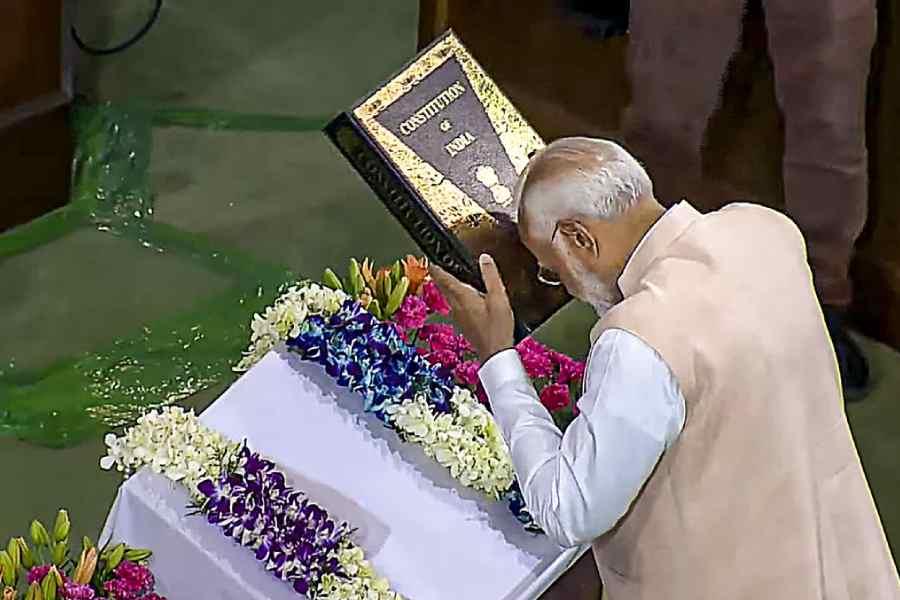
NEW DELHI: Constitution Day 2026 brought a fresh political confrontation between Prime Minister Narendra Modi and the Opposition on November 26, as the Prime Minister used a published opinion article to criticise Congress over constitutional amendments, reservation policies and women’s representation in legislative bodies.
Marking the 77th anniversary of the Constituent Assembly’s adoption of the Constitution on November 26, 1949, Modi paid tribute to Dr BR Ambedkar, Dr Rajendra Prasad and other members of the Constituent Assembly. However, his message also contained pointed criticism of previous Congress governments and the current Opposition.
In his article published in The Indian Express, Modi argued that constitutional values must extend beyond Parliament and the courts. He also accused the leading Opposition party of obstructing democratic processes and opposing legislation intended to improve women’s representation.
The remarks have placed constitutional accountability, political disagreements and the role of the Opposition at the centre of this year’s Indian Constitution Day discussions.
1. PM Modi Accuses Opposition Of Becoming An Obstructionist Force
One of the strongest political messages in Modi’s article concerned the role of the Opposition in India’s parliamentary democracy.
The Prime Minister argued that the Opposition has an important constitutional responsibility to question government decisions, raise public concerns and participate in legislative discussions.
However, he accused the leading Opposition party of moving away from this responsibility.
Using the expressions Virodh Paksh and Avrodh Paksh, Modi suggested that the party had become more focused on obstructing proceedings than performing its role as an opposition force.
He argued that disrupting democratic processes cannot replace the responsibility of constructive political opposition.
The comments add to an already tense relationship between the BJP and Congress, with both parties frequently accusing each other of undermining democratic institutions.
The disagreement follows earlier political confrontations, including the Rahul Gandhi debate with PM Modi, which involved competing allegations and demands for a direct public discussion.
2. Women’s Representation Becomes A Major Political Issue
Women’s representation in legislative bodies was another significant subject raised by the Prime Minister.
Modi criticised the Opposition over the failure to pass legislation that he said was intended to provide women with adequate representation in elected institutions.
He described the development as a setback to constitutional values and assured women that his government remained committed to securing greater representation.
The issue is politically significant because women’s reservation has remained an important subject in discussions about parliamentary representation and electoral reforms.
The Constitution (106th Amendment) Act, 2023, provides for reservation of one-third of seats for women in the Lok Sabha and state legislative assemblies, subject to the constitutional conditions concerning delimitation and the publication of relevant census figures.
Modi’s latest remarks bring renewed attention to the political disagreements surrounding the implementation of women’s reservation.
However, his criticism of the Opposition represents the government’s political position. The reasons behind the failure of the proposed legislative move must be understood through the parliamentary proceedings and the positions taken by individual parties.
3. PM Modi Raises Questions Over Earlier Constitutional Amendments
The Prime Minister also revisited the constitutional amendments introduced during previous Congress-led governments.
He specifically referred to the First Amendment of 1951 and the 42nd Amendment of 1976, introduced during the Emergency.
According to Modi, the First Amendment restricted fundamental freedoms, while the 42nd Amendment affected judicial review and the balance between constitutional institutions.
He also urged young people to study the 38th and 39th Amendments to understand how constitutional powers could be used by governments.
These remarks reflect the BJP’s long-standing criticism of Congress’s constitutional record.
The historical debate is particularly significant because the Constitution has undergone several amendments since it came into force in 1950. Their implications for fundamental rights, Parliament and judicial authority continue to feature in political and legal discussions.
Modi also criticised the repeated use of Article 356 to dismiss elected state governments, alleging that Congress had frequently used the constitutional provision for political purposes.
4. OBC Reservation And Article 370 Feature In Modi’s Criticism
Reservation policy formed another major part of the Prime Minister’s political argument.
Modi accused the largest Opposition party of seeking to reduce OBC reservation while introducing reservation benefits for Muslims.
He described the alleged position as contrary to the principles followed by the makers of the Constitution, particularly Dr BR Ambedkar.
These statements are political allegations made by the Prime Minister and should not be treated as an independently established finding about the Opposition’s policy intentions.
He also revisited the removal of the special constitutional status previously enjoyed by Jammu and Kashmir under Article 370.
Modi argued that Articles 370 and 35A had prevented the full implementation of the Constitution in the region for decades and affected the rights of Scheduled Castes, Scheduled Tribes, OBC communities and women.
The government removed the special status provisions in August 2019 through constitutional and parliamentary measures.
The issue remains an important part of India’s constitutional and political debate, particularly concerning federalism, statehood and the rights of residents of Jammu and Kashmir.
5. Constitutional Values And Democratic Institutions Remain Under Political Scrutiny
Beyond his criticism of Congress, Modi used the occasion to highlight the importance of constitutional values in everyday public life.
He recalled the contributions of Dr BR Ambedkar, Dr Rajendra Prasad and the other members of the Constituent Assembly.
He also argued that constitutional principles should reach citizens beyond the institutions of government, particularly young people.
The Prime Minister highlighted social welfare programmes, economic opportunities and the availability of the Constitution in all 22 scheduled languages as examples of efforts to strengthen public engagement with constitutional principles.
However, questions concerning democratic institutions, electoral transparency and the exercise of constitutional powers continue to generate political debate.
Earlier, Rahul Gandhi’s demand for CEC Gyanesh Kumar’s resignation brought the Election Commission and electoral processes into the centre of a wider political confrontation.
Similarly, the Saurav Das passport controversy has raised questions about administrative powers, individual rights and freedom of expression. The allegations in that matter remain distinct from the political arguments surrounding Constitution Day.
The Indian Constitution Day observance therefore comes at a time when constitutional interpretation, institutional accountability and political representation remain major subjects of national discussion.
Why Constitution Day Matters
India observes Constitution Day every year on November 26 to commemorate the adoption of the Constitution by the Constituent Assembly in 1949. The government officially began observing the occasion as Constitution Day in 2015.
The date provides an opportunity to remember the people who drafted the Constitution and revisit the principles of justice, liberty, equality and fraternity.
This year’s Constitution Day 2026 has also highlighted the continuing political disagreements over how these principles should be interpreted and implemented.
While Modi has accused Congress of weakening constitutional institutions and obstructing reforms, the wider debate also concerns the responsibility of every political party to uphold democratic processes.
The Constitution remains the foundation of India’s parliamentary democracy. Its protection and implementation require accountability from the government as well as the Opposition.