Global Stock Market News: 5 Warning Signs as AI Stocks Fall and Investors Brace for Nvidia Earnings
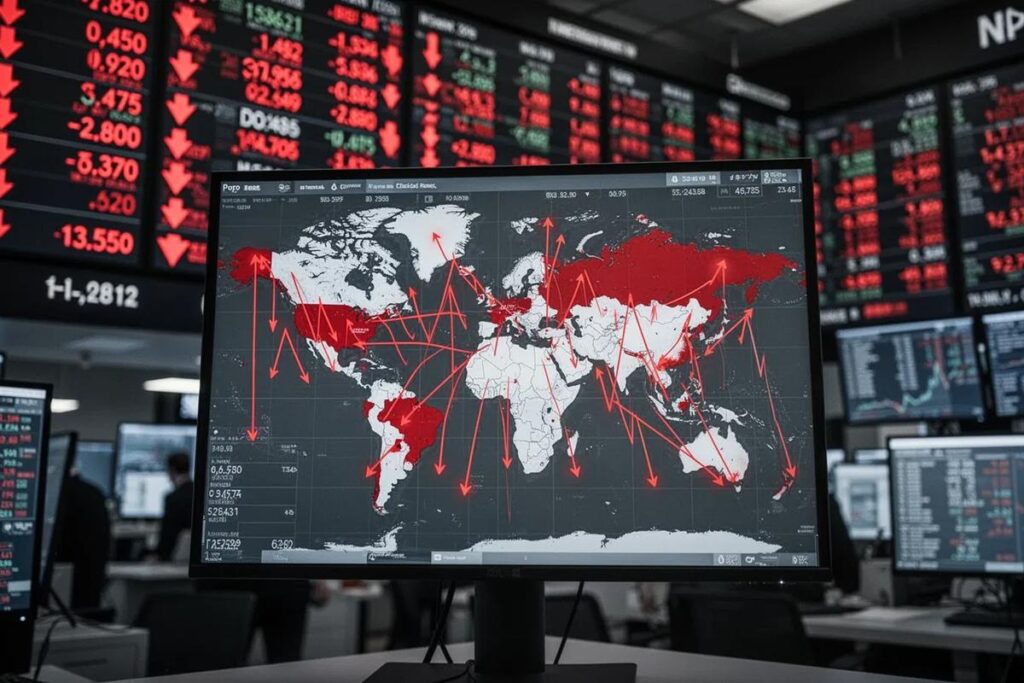
GLOBAL MARKETS: Global Stock Market News remained dominated by technology-sector weakness on Tuesday, November 17, as investors reassessed the financial outlook for artificial intelligence companies and prepared for Nvidia’s latest quarterly earnings announcement.
Asian and European markets recorded declines following a difficult session on Wall Street, where semiconductor companies faced renewed selling pressure. Investors are increasingly questioning whether the enormous investments being made in artificial intelligence infrastructure can generate returns quickly enough to justify current market expectations.
The uncertainty has also been intensified by new US restrictions on access to advanced artificial intelligence chips, concerns surrounding Nvidia’s leadership transition and the anticipated market debut of AI company Anthropic.
According to the Associated Press, the Nasdaq Composite fell 2.5% on Monday, while the S&P 500 declined 1.9%. The Dow Jones Industrial Average also recorded losses.
1. Global Stock Market News Reflects Growing Technology Sector Pressure
The latest Global Stock Market News highlights how weakness in a relatively concentrated group of technology companies can influence broader financial markets.
On Monday, November 16, the Nasdaq Composite experienced a particularly difficult session, falling 2.5%. The S&P 500 declined 1.9%, while the Dow Jones Industrial Average also moved lower.
Semiconductor companies were among the major contributors to the decline. US chipmakers recorded a collective drop of approximately 5.3%, reflecting investor concerns about the future direction of the artificial intelligence industry.
The selling pressure was not restricted to American exchanges. Asian markets followed Wall Street lower on Tuesday, with technology-heavy indices experiencing significant declines.
South Korea’s Kospi fell 2.6%, while Japan’s Nikkei 225 declined 1.3%. European markets also opened lower, indicating that concerns surrounding technology valuations and semiconductor demand were influencing international investor sentiment.
However, the situation was not uniform across every market. US stock futures showed signs of stabilisation on Tuesday as investors awaited Nvidia’s financial results.
2. AI Stocks Fall as Investors Question Artificial Intelligence Spending
The latest technology selloff reflects a growing debate about the financial sustainability of the artificial intelligence boom.
Major technology companies have committed substantial resources to developing AI infrastructure, including advanced processors, data centres, networking equipment and cloud computing facilities.
These investments have helped drive demand for semiconductor manufacturers and companies supplying the infrastructure required to operate large AI systems.
However, investors are increasingly examining whether the expected financial returns will justify the scale of spending.
The concern is not necessarily that artificial intelligence will lose its commercial importance. Instead, the uncertainty centres on how quickly companies can convert their investments into sustainable revenue and profits.
The possibility that data-centre spending could slow has become another concern for semiconductor investors.
This uncertainty is particularly important for Nvidia, whose processors are widely used in AI training and computing infrastructure.
The broader expansion of AI infrastructure can also be seen in projects such as SpaceX’s planned $74 billion AI infrastructure investment, which illustrates the enormous capital requirements associated with the industry’s expansion.
3. US Restrictions on Advanced AI Chips Add Pressure
Another important development influencing the markets is Washington’s decision to introduce additional restrictions affecting China’s access to advanced American AI chips.
The new measures target the ability of Chinese companies to access computing capacity through overseas data centres using US-origin semiconductor technology.
This development has raised concerns across the global semiconductor industry because advanced processors are central to the development and operation of sophisticated AI models.
Companies involved in semiconductor manufacturing, equipment production and cloud computing could face changes in their commercial opportunities as governments introduce tighter technology controls.
The restrictions also create uncertainty for international data-centre operators that provide computing services to customers in different countries.
For investors, the concern extends beyond immediate sales. Changes in export regulations could influence future demand, supply-chain arrangements and the ability of semiconductor companies to access international markets.
The development has added another layer of uncertainty to an industry already facing questions about valuations and investment returns.
4. Nvidia Earnings Become The Biggest Market Test
Investors are closely watching Nvidia’s third-quarter fiscal 2027 financial results, scheduled for November 17.
The company has become one of the most influential businesses in the global artificial intelligence industry because its processors are widely used in data centres and advanced computing systems.
Its quarterly results are therefore expected to provide important information about semiconductor demand and the financial performance of the AI sector.
Investors will be particularly interested in revenue growth, profit margins, future guidance and management’s assessment of demand for advanced processors.
The company’s leadership transition has added another dimension to the uncertainty.
As previously reported in our coverage of the Jensen Huang resignation and Nvidia’s leadership shake-up, Nvidia is operating under interim chief executive Colette Kress following Huang’s departure.
The board’s search for permanent leadership has become an additional issue for investors assessing the company’s future direction.
The earnings announcement could influence sentiment across semiconductor companies and other businesses connected to AI infrastructure.
However, strong financial results would not automatically eliminate concerns about valuations or the sustainability of future investment spending.
5. What Investors Will Watch In The Coming Days
The direction of international markets will depend on several developments over the coming days.
Nvidia’s earnings announcement is likely to remain the immediate focus, particularly because investors are looking for evidence that demand for AI computing infrastructure remains strong.
The anticipated market debut of Anthropic is another development attracting attention. Investor interest in the company could provide an additional indication of appetite for major AI businesses.
Meanwhile, developments involving US semiconductor restrictions and international technology trade could influence expectations for chip manufacturers and cloud computing providers.
Investors will also monitor interest-rate expectations and borrowing costs. Higher financing costs can make expensive technology investments less attractive and increase pressure on companies that depend on substantial capital expenditure.
For now, the latest AI Stocks Fall trend reflects a combination of market valuation concerns, regulatory uncertainty and questions about the profitability of artificial intelligence investments.
The declines do not establish that the AI industry is entering a prolonged downturn. However, they demonstrate that investors are becoming more selective about which companies can translate technological growth into measurable financial returns.
The coming Nvidia results could provide an important indication of whether the recent technology-sector weakness represents a temporary correction or a deeper reassessment of the AI investment outlook.