Bengaluru Metro Pink Line: 5 Major Highlights as PM Modi and DK Shivakumar Flag Off New Services
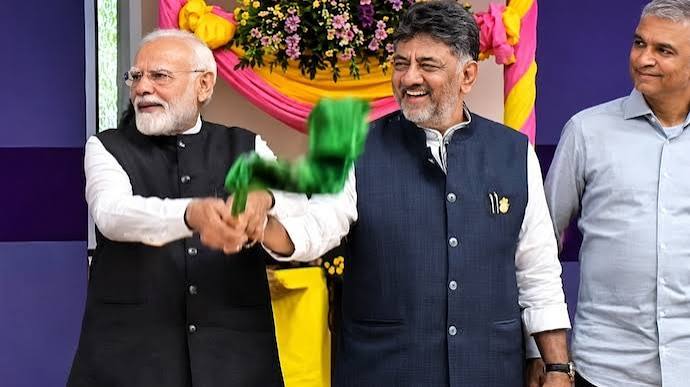
BENGALURU: The Bengaluru Metro Pink Line entered a new phase on Friday, November 13, after Prime Minister Narendra Modi and Karnataka Chief Minister D K Shivakumar jointly flagged off services on its newly inaugurated elevated section. The two leaders also travelled on the metro train, marking the opening of a major addition to Bengaluru’s public transport network.
The inauguration covered the 7.5-kilometre elevated stretch connecting Kalena Agrahara and Tavarekere. Developed at an estimated cost of ₹3,470 crore, the project is expected to improve connectivity across southern Bengaluru and provide commuters with another public transport option.
The PM Modi Bengaluru Metro inauguration also attracted attention because the Prime Minister and the Chief Minister travelled together on the newly opened stretch after purchasing their respective metro tickets.
According to NDTV, the two leaders jointly flagged off the services and undertook the inaugural journey.
PM Modi And DK Shivakumar Take Inaugural Metro Ride
Prime Minister Narendra Modi inaugurated the new elevated section in Bengaluru on Friday. Karnataka Chief Minister D K Shivakumar accompanied him during the programme.
Before boarding the train, both leaders purchased separate metro tickets from the counter. They subsequently travelled on the newly inaugurated corridor, with the Chief Minister explaining the infrastructure and its expected benefits to the Prime Minister.
The journey was part of the inauguration programme, which highlighted the expansion of Bengaluru’s urban transport infrastructure.
Other public representatives and officials also participated in the inaugural journey, including Bengaluru South MP Tejasvi Surya and Karnataka minister Krishna Byre Gowda.
The Bengaluru Metro Pink Line inauguration represents another step in expanding the city’s rail-based public transport network, particularly in areas where road congestion has created challenges for daily commuters.
7.5-Km Elevated Section Opens To The Public
The newly inaugurated elevated section covers approximately 7.5 kilometres, connecting Kalena Agrahara to Tavarekere.
The section forms part of the larger Pink Line project, which has a planned total length of 21.25 kilometres and comprises 18 stations.
However, the entire corridor has not yet become operational. The elevated portion includes six stations, while the remaining 12 stations belong to the underground section, which is still under construction.
The distinction is important because Friday’s inauguration does not mean that passengers can use the entire 21.25-kilometre corridor.
The elevated section is the portion being opened for passenger operations, while work on the underground component remains ongoing.
The project has been developed at an estimated cost of ₹3,470 crore, making it a significant addition to Karnataka’s urban transport infrastructure.
When Will Passengers Be Able To Use The New Services?
Although the inauguration took place on November 13, regular passenger services on the newly opened elevated section are scheduled to begin on Saturday, November 14, at 6 am.
This means commuters will be able to start using the new stretch from the following morning rather than immediately after the inauguration ceremony.
The opening is particularly relevant for people travelling through the Kalena Agrahara, Tavarekere and surrounding areas.
The new connection is expected to provide an alternative to road-based transportation for passengers travelling along the corridor.
For regular commuters, the availability of another metro stretch could offer greater flexibility when planning journeys, particularly during peak traffic periods.
Double-Decker Corridor Adds Another Infrastructure Feature
One of the infrastructure features discussed during the inaugural journey was the double-decker elevated corridor.
According to the reported details of the programme, Shivakumar explained to Modi how the arrangement combines a metro rail line with a flyover.
Such infrastructure is designed to accommodate different transportation requirements within a shared corridor, potentially making more efficient use of available urban space.
Bengaluru has experienced sustained pressure on its road network as residential areas, commercial centres and employment hubs have expanded.
The integration of metro infrastructure with road connectivity is therefore an important part of the city’s broader transport development strategy.
However, the actual impact on traffic conditions will depend on passenger adoption, service frequency, connectivity with other transport options and the completion of the remaining metro sections.
Bengaluru’s Metro Network Continues To Expand
The PM Modi Bengaluru Metro inauguration comes as Karnataka continues to invest in major infrastructure projects across the state.
The Pink Line is expected to strengthen connectivity in southern Bengaluru, with the underground section forming the remaining part of the larger corridor.
Once the entire project becomes operational, passengers will have access to a longer metro connection with both elevated and underground infrastructure.
The development is also part of a wider infrastructure programme announced during the Prime Minister’s Karnataka visit. The Prime Minister’s Office had outlined projects worth more than ₹15,600 crore across Bengaluru, covering urban mobility, renewable energy, power transmission and other sectors.
For Bengaluru, the immediate significance of Friday’s inauguration is the addition of a new operational metro stretch. The opening provides commuters with another transport option while construction continues on the remaining underground section.
The Bengaluru Metro Pink Line will begin regular passenger operations at 6 am on November 14. Its long-term contribution to the city’s transport system will become clearer as passenger services expand and the remaining corridor progresses towards completion.