Delhi AQI Today: 5 Alarming Facts as Capital Becomes World’s Most Polluted Major City
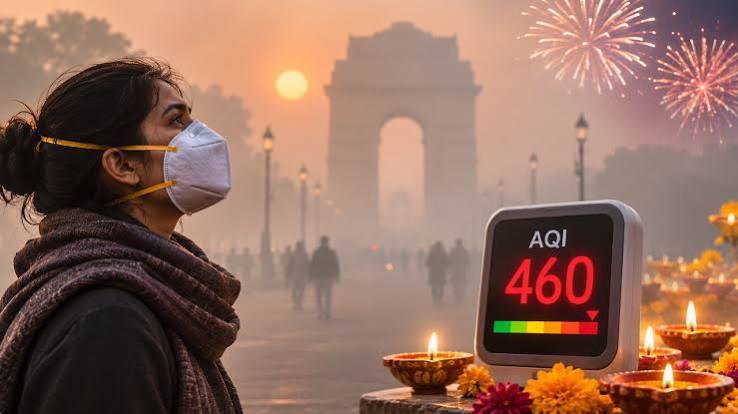
NEW DELHI: Delhi AQI today reached hazardous levels on Friday, November 13, pushing India’s national capital ahead of Lahore to become the world’s most polluted major city, according to Swiss air-quality monitoring organisation IQAir. The city recorded an AQI of 334 on IQAir’s scale, while India’s Central Pollution Control Board (CPCB) reported a significantly higher reading of 403, placing Delhi in the severe category under India’s national classification.
The worsening Delhi air pollution situation has reduced visibility across several parts of the capital, with dense smog covering roads and affecting normal outdoor conditions. The deterioration has renewed concerns about public health as millions of residents face prolonged exposure to polluted air during the winter season.
According to Reuters, Delhi overtook Lahore in the global pollution ranking on Friday as hazardous air quality spread across the city, which has a population of approximately 20 million.
Delhi AQI Today: Capital Overtakes Lahore In Global Ranking
IQAir placed Delhi at the top of its global ranking of major cities on Friday, with an AQI reading of 334. Lahore, which had been among the most polluted cities in recent days, fell behind the Indian capital.
An AQI reading of up to 50 is generally considered good under the US AQI classification used by IQAir. At this level, air quality presents little or no health risk for most people.
The reading of 334 falls into IQAir’s hazardous category, indicating a serious deterioration in atmospheric conditions.
However, the two major monitoring systems reported different figures. While IQAir recorded 334, the CPCB reported an AQI of 403, categorising the situation as severe.
The difference does not necessarily indicate an error in either measurement. IQAir and India’s pollution monitoring authorities use different AQI scales and calculation methodologies. Their readings should therefore not be compared as though they represent identical measurements.
The distinction is important when interpreting Delhi AQI today, particularly when international pollution rankings are compared with India’s official air-quality classifications.
Dense Smog Reduces Visibility Across New Delhi
The deterioration has become visible across several parts of the capital.
Vehicles and motorcycles were seen moving through dense smog, while reduced visibility affected the appearance of major roads and surrounding infrastructure. Videos circulated by news agency ANI also showed pollution obscuring streetlights along some of the city’s main roads.
The conditions have once again brought the issue of urban air quality into focus, particularly as winter approaches and atmospheric conditions become less favourable for dispersing pollutants.
For commuters, motorists and people who spend extended periods outdoors, reduced visibility is an additional concern. However, the available reporting does not establish any specific number of traffic accidents or injuries caused by Friday’s smog.
The deterioration also highlights the difference between the visible effects of pollution and the less noticeable exposure to fine particulate matter, which can remain harmful even when visibility improves.
Why Delhi Air Pollution Gets Worse During Winter
The latest deterioration is part of a recurring seasonal pattern across northern India and neighbouring Pakistan.
During colder months, atmospheric conditions can make it harder for pollutants to disperse. Cold, relatively stagnant air, low wind speeds and limited vertical mixing can allow emissions to accumulate closer to the ground.
Several sources contribute to the pollution burden.
Vehicle emissions remain an important source, particularly in densely populated urban areas where large numbers of cars, motorcycles and commercial vehicles operate daily.
Construction activities and road dust also contribute to particulate pollution. Dust generated by construction, demolition and movement of vehicles can increase the concentration of airborne particles.
Agricultural residue burning is another seasonal contributor in northern India. Smoke from crop-residue burning can travel across state boundaries and add to the existing pollution load.
These factors can combine with unfavourable weather conditions to produce particularly poor air quality.
The problem is not restricted to Delhi. Other northern Indian cities also experience seasonal pollution episodes, although the intensity and composition of pollution vary according to local emission sources and weather conditions.
Health Concerns Grow As Air Quality Reaches Hazardous Levels
The latest readings have renewed concerns about the health consequences of prolonged exposure to polluted air.
Fine particulate matter, particularly PM2.5, is a significant public-health concern because these particles are small enough to penetrate deep into the respiratory system. Exposure can aggravate existing respiratory conditions and increase risks to cardiovascular and respiratory health.
Children, older adults and people with existing heart or lung conditions are particularly vulnerable to poor air quality.
Even otherwise healthy individuals may experience irritation of the eyes, nose and throat, coughing or breathing discomfort when exposed to heavily polluted air.
The broader relationship between airborne particles and public health has also been examined in research concerning wildfire smoke and health risks. Although wildfire smoke and urban pollution have different sources, both highlight the importance of monitoring harmful airborne particles and limiting public exposure.
Air Pollution Control Remains A Major Challenge
The latest episode also raises questions about the effectiveness of pollution-control measures across the National Capital Region.
Delhi’s air-quality challenges involve several sources operating simultaneously. Addressing vehicle emissions alone, for example, cannot resolve pollution caused by construction dust, industrial activity, waste burning and agricultural residue burning.
Long-term improvements require coordination between local authorities, neighbouring states and central government agencies.
Measures such as better public transport, dust suppression, stricter control of construction emissions, cleaner industrial operations and alternatives to agricultural residue burning can contribute to reducing the overall pollution burden.
The importance of sustained municipal action is also reflected in the Centre’s annual assessment of urban pollution-control efforts. In the Swachh Vayu Survekshan 2026 clean-air ranking, Lucknow secured the top position among million-plus cities, demonstrating the role of city-level interventions in addressing air-quality challenges. However, rankings based on pollution-control performance should not be confused with real-time AQI measurements.
What Happens Next For Delhi’s Air Quality?
Delhi’s position at the top of IQAir’s pollution ranking on November 13 highlights the severity of the current episode. However, global city rankings are updated regularly, meaning positions and readings can change as weather conditions and pollution concentrations fluctuate.
The difference between IQAir’s 334 and CPCB’s 403 also demonstrates why readers should pay attention to the monitoring system and classification accompanying an AQI figure.
For residents, the immediate concern remains exposure to hazardous air. Following official air-quality advisories, limiting strenuous outdoor activity during severe pollution episodes and using appropriate respiratory protection when advised can help reduce exposure.
The latest Delhi AQI today reading is a reminder that the capital’s seasonal pollution problem remains unresolved. While individual interventions can help reduce exposure, sustained improvements will depend on controlling emissions across the wider Delhi-NCR region.
Until pollution sources are addressed consistently, winter smog is likely to remain a recurring environmental and public-health challenge for the national capital.