
Crimea Bridge Attack: 5 Critical Developments After Kerch Bridge Collapse
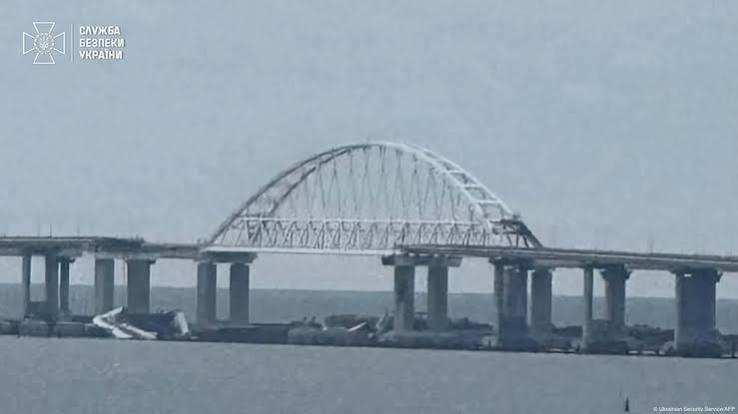
CRIMEA: The Crimea bridge attack has caused major structural damage to the Kerch Bridge connecting Russia with occupied Crimea, after Ukrainian forces reportedly struck the strategic infrastructure for a second consecutive day on November 17. Part of the bridge’s road section, including its main arch, collapsed into the Kerch Strait, according to Ukrainian military officials.
The development marks a significant escalation in Ukraine’s campaign against Russian military and logistical infrastructure. Russian authorities acknowledged structural damage and opened a criminal investigation into the attacks, while the Kremlin indicated that the bridge would be repaired.
Ukrainian President Volodymyr Zelenskyy described the operation as the culmination of a campaign lasting several weeks. The Kerch Bridge collapse has also renewed international attention on the vulnerability of infrastructure used to support Russia’s military presence in Crimea.
According to Sky News, the attack involved multiple stages, with Ukrainian forces targeting Russian defensive systems before launching the final strikes against the bridge.
1. Ukraine Strikes Kerch Bridge For A Second Consecutive Day
The attacks on the Kerch Bridge took place on November 16 and 17, according to statements from Ukraine and Russia.
The bridge, which connects the Crimean Peninsula with Russia’s Krasnodar region, is one of the most important transport links between the Russian mainland and the occupied territory.
Ukraine’s General Staff said the latest operation caused the collapse of an arch and a section of the bridge’s roadway. The damage disrupted road traffic and affected the bridge’s ability to function as a major transport connection.
The Ukrainian military described the operation as a coordinated effort involving multiple military units and different types of weapons.
Russia’s Investigative Committee also confirmed that Ukrainian unmanned aerial vehicles had attacked the structure on November 16 and 17, causing damage to the bridge.
However, Moscow’s initial statement did not provide a complete technical assessment of the damage or independently confirm every detail of Ukraine’s account.
2. Zelenskyy Reveals Details Of A Multi-Stage Military Operation
President Volodymyr Zelenskyy said the operation was planned and coordinated by Ukraine’s Security Service, known as the SBU, and the General Staff.
According to the Ukrainian president, the campaign involved several stages designed to weaken Russian defensive capabilities around the bridge before the final attack.
Ukraine said its forces targeted Russian air defence systems, radar installations and electronic warfare equipment during the preparatory phase.
The final operation reportedly involved a combination of domestically developed drones and missiles.
Zelenskyy identified several weapons used during the campaign, including Palianytsia drones, Neptune cruise missiles, Ruta drones and FP-5 Flamingo missiles.
He said the final stage involved precision-guided strikes against the bridge’s road and railway sections.
However, the specific weapons used and the operational details remain based primarily on Ukrainian military statements. Independent verification of the complete weapons deployment has not been established.
The Crimea bridge attack therefore represents a significant claim about Ukraine’s ability to conduct coordinated long-range operations against heavily protected infrastructure.
3. Russia Opens Investigation Into Bridge Damage
Russia’s Investigative Committee confirmed that attacks by Ukrainian forces had damaged the Kerch Bridge.
The committee announced that it had opened a criminal investigation under the provisions dealing with terrorist acts.
Investigators said they were examining the circumstances surrounding the attacks and attempting to identify those responsible.
The Russian government also acknowledged the seriousness of the damage.
Kremlin spokesperson Dmitry Peskov said President Vladimir Putin had been informed about the situation. He also indicated that the bridge would be restored.
Russian-installed Crimean authorities announced restrictions on traffic following the attacks.
The railway section reportedly remained standing despite sustaining damage. Rail services subsequently resumed, although the road section continued to face serious disruption.
The Kerch Bridge collapse has consequently created different levels of disruption across the structure’s road and railway connections.
4. Why The Kerch Bridge Is Strategically Important For Russia
The Kerch Bridge is approximately 19 kilometres long and connects Crimea with Russia’s Krasnodar region across the Kerch Strait.
The structure carries both road and railway traffic, making it an important connection for civilian transportation, commercial movement and Russian military logistics.
Russia constructed the bridge following its 2014 annexation of Crimea. Russian President Vladimir Putin inaugurated the road section in 2018, making it one of the most prominent infrastructure projects associated with Moscow’s control of the peninsula.
Since Russia launched its full-scale invasion of Ukraine in February 2022, the bridge has remained an important target in the conflict.
Its strategic importance comes from its ability to transport personnel, equipment and supplies between mainland Russia and Crimea.
Although Russia also maintains alternative land routes through occupied Ukrainian territory, damage to the bridge creates additional logistical challenges.
The latest Crimea bridge attack has therefore raised questions about the security of Russian military supply routes and the effectiveness of the defensive systems protecting major infrastructure.
5. Previous Attacks Raise Questions About Bridge Security
The November 2026 incident is not the first major attack against the Kerch Bridge.
In October 2022, an explosion damaged part of the bridge after a truck carrying explosives detonated. The incident caused substantial disruption to road and railway traffic.
Another major attack occurred in July 2023, when Ukrainian maritime drones struck the structure, damaging the road section.
These earlier incidents demonstrated that the bridge could be targeted despite its strategic importance and security arrangements.
The latest incident has renewed concerns about whether Russia can adequately protect critical infrastructure located far from the main battlefield.
The development also comes amid wider attacks against transport and military infrastructure in both countries.
In a related development, Russian forces reportedly struck two major bridges across the Dnipro River in Kyiv. Ukrainian authorities said the attacks damaged transport infrastructure and prompted temporary traffic restrictions. The details are covered in our report on the Kyiv bridge attack following Russian strikes.
International Attention Turns To The Russia-Ukraine Conflict
The latest Kerch Bridge collapse comes at a sensitive moment for international diplomacy, with discussions involving Russia, Ukraine and their international partners continuing.
Russian President Vladimir Putin is also preparing to attend a planned meeting with US President Donald Trump and Chinese President Xi Jinping in Shenzhen on November 19.
The upcoming gathering has attracted attention because of its potential implications for international security and the wider geopolitical situation.
Our earlier coverage of the US-China-Russia summit involving Trump, Xi and Putin examines the diplomatic significance of the meeting and the possibility of discussions involving major international conflicts.
Meanwhile, Ukraine continues to seek international support for its position on the war. President Zelenskyy’s recent diplomatic engagement with Indian Prime Minister Narendra Modi also highlighted continuing efforts to involve additional countries in discussions about a peaceful settlement.
The Crimea bridge attack adds another major development to an already complicated conflict.
For now, the full extent of the structural damage, the long-term effect on Russian military logistics and the future operational status of the bridge remain important questions.
Russia has indicated that repairs will take place, while Ukraine has presented the operation as a significant military achievement. Further technical assessments and official statements will be necessary to establish the complete consequences of the strikes.




