
SpaceX Starship Catch: 7 Historic Details From First-Ever Upper Stage Recovery
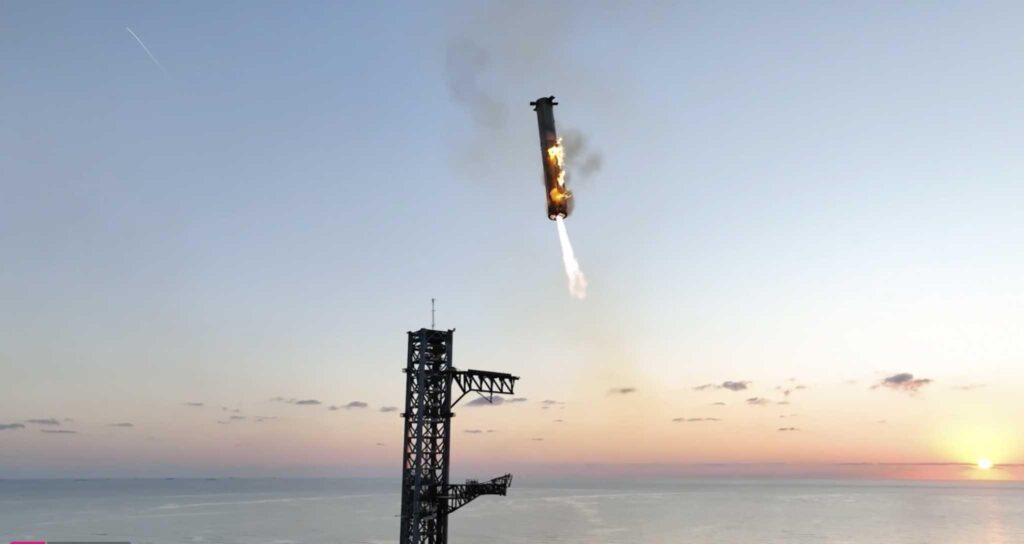
STARBASE, TEXAS: The SpaceX Starship catch has marked a historic milestone in commercial spaceflight after the company successfully recovered its Starship upper stage using the giant mechanical arms of its launch tower on Saturday, November 14, 2026.
The achievement came during Starship’s 15th test flight, when the spacecraft returned to Earth after spending approximately 22.5 hours in orbit. It completed 14 trips around the planet before descending towards SpaceX’s Starbase launch facility in South Texas, where the tower’s mechanical arms caught the returning vehicle.
The successful recovery represents the first time SpaceX has caught the Starship spacecraft itself using its launch tower system. The company had previously demonstrated similar recovery operations with its Super Heavy boosters, but catching the upper stage presented a different engineering challenge.
According to Reuters, the spacecraft also deployed 26 Starlink satellites during its orbital mission before beginning its return journey.
However, the mission did not achieve every planned objective. The Super Heavy booster failed to complete its planned return to the launch tower, meaning SpaceX has not yet demonstrated the recovery of both rocket stages during a single mission.
1. SpaceX Starship Catch Completes A Historic First
The most significant development from Flight 15 was the successful recovery of the Starship upper stage, also known as the Ship.
The 171-foot spacecraft returned to SpaceX’s Starbase facility after completing its orbital mission. During the final stages of its descent, it manoeuvred through the atmosphere before reigniting its engines to position itself vertically.
The spacecraft then descended towards the launch tower, where two enormous mechanical arms moved into position to catch it.
These arms, commonly known as chopsticks, are part of SpaceX’s Mechazilla launch and recovery system.
The system is designed to capture returning rocket vehicles and hold them above the ground, potentially eliminating the need for conventional landing legs.
Although SpaceX had previously caught Super Heavy boosters, the November 14 operation was its first successful attempt to recover the Starship upper stage directly at the launch tower.
The achievement represents a major step towards the company’s long-term objective of recovering and reusing both sections of its rocket system.
2. Starship Flight 15 Completes 14 Orbits Around Earth
The successful landing followed an extended orbital mission that began on Friday, November 13.
SpaceX launched Starship Flight 15 from its Starbase facility in Texas. The mission was designed to demonstrate several important capabilities, including satellite deployment, orbital operations and the recovery of both rocket stages.
Following separation, the Starship upper stage continued towards orbit while the Super Heavy booster began its return sequence.
The spacecraft reached an orbital altitude of approximately 161 miles, or 260 kilometres, and completed 14 orbits around Earth.
Its mission lasted approximately 22.5 hours before it began its journey back to the launch site.
The duration made it the longest mission in the Starship programme at the time, according to the reported flight details.
The successful orbital operation also demonstrated the spacecraft’s ability to remain functional throughout an extended period in space before attempting a controlled return.
3. Starship Deploys 26 Starlink Satellites In Orbit
Another important achievement during the mission involved the deployment of 26 Starlink satellites.
Starship released the satellites while operating in orbit, demonstrating its potential to transport substantial payloads into space.
This capability is particularly important for SpaceX because the company intends to use Starship as a major component of its future satellite deployment operations.
The Starlink network provides satellite-based internet connectivity, and the company continues to expand its infrastructure to serve additional customers and regions.
A fully reusable Starship system could eventually support more frequent and potentially less expensive satellite launches.
However, the November mission should be viewed as a technology demonstration rather than proof that routine commercial operations are already possible.
The company still needs to demonstrate reliable vehicle recovery, refurbishment and repeated flights before achieving that objective.
4. Super Heavy Booster Misses Its Planned Catch
Despite the successful upper-stage recovery, the mission was not a complete success.
SpaceX had planned to demonstrate a double recovery, with the Super Heavy booster returning to the launch tower shortly after separation and the Starship upper stage returning following its orbital mission.
The booster did not complete its planned recovery.
Instead, it diverted towards an offshore landing in the Gulf of Mexico after its return sequence encountered a problem.
This meant that SpaceX successfully recovered only one of the two major rocket stages during Flight 15.
The distinction is important because the company’s broader ambition involves making the entire launch vehicle reusable.
The booster and upper stage perform different functions and face different challenges during their respective return operations.
Super Heavy must return shortly after launch, while Starship has to survive orbital operations, atmospheric reentry and a controlled landing manoeuvre.
Recovering both vehicles during the same mission remains an important milestone for the programme.
5. Mechazilla Demonstrates Its Upper-Stage Recovery Capability
The launch tower’s mechanical arms played a central role in the historic recovery.
SpaceX calls the system Mechazilla, a structure designed to support the launch, handling and recovery of its Starship vehicles.
During the landing manoeuvre, Starship approached the tower in a controlled descent before rotating into a vertical position.
Its engines helped regulate the final descent, allowing the spacecraft to align with the mechanical arms.
Two small fittings near the upper section of the vehicle connected with the tower’s catching mechanism.
The spacecraft was then suspended above the ground, supported by the mechanical arms.
This approach differs from conventional rocket landings, where vehicles typically descend onto landing legs or designated landing platforms.
The successful operation demonstrates that SpaceX has made significant progress in developing a recovery system capable of handling the much larger Starship spacecraft.
It also provides an opportunity for engineers to inspect the vehicle after an orbital flight and assess how much refurbishment would be required before another launch.
6. Elon Musk’s Reusable Rocket Ambitions Move Forward
The successful recovery is closely connected to Elon Musk’s long-term plans for SpaceX.
The company’s objective is to develop a fully reusable transportation system capable of carrying satellites, cargo and eventually astronauts beyond Earth.
SpaceX wants Starship to operate with a turnaround frequency closer to commercial aircraft than traditional expendable rockets.
The company has invested more than $15 billion in the Starship development programme, according to Reuters.
The spacecraft is also central to NASA’s future lunar exploration plans.
NASA has committed $3.2 billion as part of a contract valued at more than $4 billion for SpaceX to develop a Starship-based human landing system under the Artemis programme.
Musk’s broader business activities, including his involvement in SpaceX and Starlink, have also attracted considerable public attention.
However, the latest recovery does not mean that Starship is ready for routine lunar or crewed missions.
Several technical challenges remain, particularly involving orbital refuelling, heat-shield durability and repeated vehicle recovery.
7. What The Starship Breakthrough Means For Future Space Missions
The Starship rocket latest development could have important implications for the future of commercial space transportation.
Traditional orbital launch systems often discard major rocket components after completing their missions. Recovering and reusing these components could reduce the amount of hardware that must be manufactured for every launch.
If SpaceX can eventually recover, inspect, refurbish and relaunch both Starship stages reliably, the system could support more frequent space missions.
Potential applications include satellite deployment, transporting large cargo loads, supporting space infrastructure and future lunar exploration.
The development also comes at a time when space agencies and private companies are investing in new launch technologies.
India’s space programme is pursuing its own ambitious objectives through projects such as the ISRO Gaganyaan human-spaceflight programme and its propulsion development work.
However, the approaches are different. Starship is being developed around a fully reusable launch architecture, while India’s current human-spaceflight preparations involve the LVM3 launch vehicle and associated crew systems.
NASA’s lunar ambitions also depend on the successful development of Starship’s capabilities.
The agency expects future crewed lunar missions using commercial landers to begin in 2028, although several major technical milestones remain.
For SpaceX, the immediate challenge is to repeat the successful upper-stage recovery while resolving the problems that prevented the Super Heavy booster from returning to the tower.
The SpaceX Starship catch on November 14 demonstrates that an important part of the company’s reusable rocket vision is technically achievable.
Nevertheless, the wider goal of recovering both stages and rapidly returning them to service remains unfinished.
The latest achievement is therefore a significant engineering breakthrough, but not the final demonstration of a fully reusable orbital launch system.




