Anna Hazare Responds to Sonia Gandhi’s Claims About BJP-RSS Support
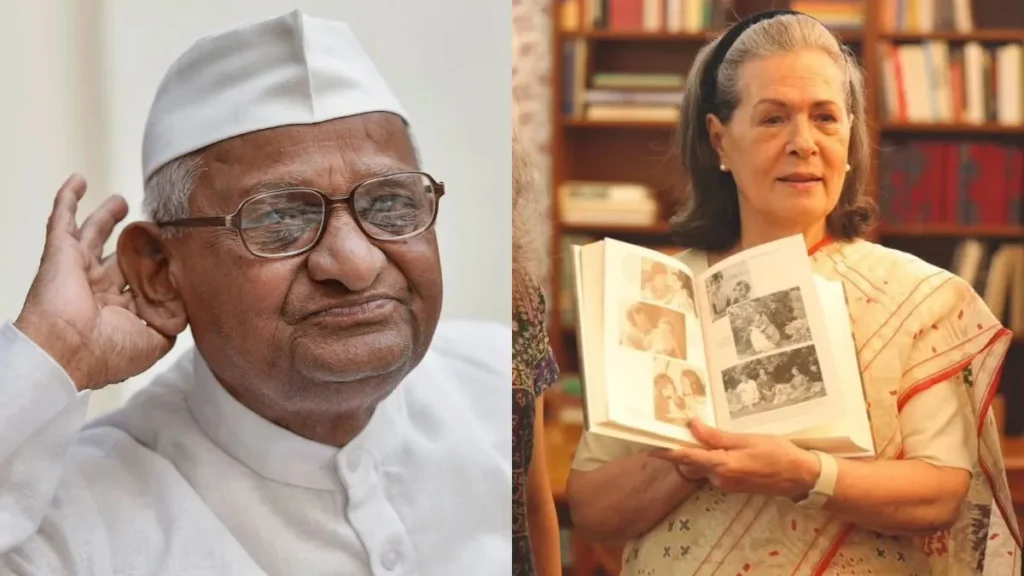
Social activist Anna Hazare has rejected Congress leader Sonia Gandhi’s account of his 2011–12 India Against Corruption movement, denying that the campaign had any connection with the Bharatiya Janata Party (BJP) or the Rashtriya Swayamsevak Sangh (RSS).
Speaking to reporters at Ralegan Siddhi in Maharashtra on Wednesday, November 11, Hazare questioned the suggestion that the movement was secretly supported by the BJP and RSS to weaken the Congress-led United Progressive Alliance (UPA) government.
“This is wrong. I don’t have any connection with the BJP or RSS. I don’t participate in their programmes. My country is my priority,” Hazare said, responding to questions about Gandhi’s recently released memoir, Belonging: A Journey of Love.
He also challenged the suggestion that his agitation was responsible for the UPA government’s defeat in the 2014 Lok Sabha elections, asking what evidence supported such a conclusion.
“Whatever I do is for my society and country. I don’t have anything to do with any party,” he said.
The exchange has brought renewed attention to one of the most prominent political movements of the UPA years and the competing accounts of its origins and political impact.
What Sonia Gandhi wrote about the Anna Hazare movement
In Belonging: A Journey of Love, Gandhi discusses the India Against Corruption movement, which brought large crowds onto the streets of Delhi in 2011 and 2012.
An excerpt from the memoir states that Hazare emerged as the public face of the campaign in 2012. It also refers to statements made by some prominent participants who subsequently said the movement had been covertly organised and supported by the BJP and RSS.
The passage reads:
“In 2012, a well-known activist from Maharashtra, Baburao ‘Anna’ (Marathi for ‘father’ or ‘elder brother’) Hazare, emerged as the figurehead of a movement that titled itself ‘India Against Corruption.’ Some of its prominent participants have stated since then that it was covertly organised and supported by the BJP and RSS.”
Gandhi also describes how the protests caught the UPA government off guard and left the administration struggling to respond to the growing anti-corruption campaign.
She writes that the government found itself on the back foot and was unable to counter what she described as the BJP’s aggressive campaign.
The distinction in the memoir is important: the passage refers to claims made by some participants about covert political support. It does not, by itself, establish that the BJP or RSS secretly organised or financed the movement.
Hazare questions Gandhi’s remarks
Hazare rejected the suggestion of political affiliation and questioned Gandhi’s basis for commenting on his intentions.
He also pointed out that the two had never met.
“Neither has she seen Anna Hazare, nor have I seen her so far. How appropriate is it to comment on something without even seeing each other,” he said.
He further criticised what he described as vague statements, arguing that public figures should exercise greater care when making remarks about others.
“A responsible person should speak responsibly. It is not right to speak vaguely. It diminishes that person’s image,” he said.
Hazare maintained that his work had been motivated by social welfare and national interests rather than the objectives of any political organisation.
Political reactions add another dimension
The disagreement has drawn responses from political leaders beyond the two principal figures.
Shiv Sena (UBT) leader Ambadas Danve supported Gandhi’s account, alleging that Hazare had been used as a front by the BJP to create unrest in the country.
Danve described the agitation as a conspiracy and questioned whether Hazare had continued to speak independently on political and public issues after the movement.
His remarks represent a separate political allegation and do not independently establish the extent of any organisational involvement in the campaign.
The BJP also responded to the wider controversy surrounding Gandhi’s memoir. BJP spokesperson Keshav Upadhaye criticised the book, questioning Gandhi’s treatment of several historical and political issues.
These reactions reflect the continuing political disagreement over how the Congress-led UPA years and the events surrounding the 2011 anti-corruption protests should be interpreted.
Why the 2011 anti-corruption movement remains politically significant
The India Against Corruption movement became one of the most visible public campaigns against corruption during Manmohan Singh’s second term as prime minister.
Hazare’s hunger strikes and the large public gatherings in Delhi brought the demand for a stronger Lokpal institution into national political debate.
The campaign centred on demands for an independent anti-corruption ombudsman with powers to investigate allegations against public officials. It attracted support from sections of civil society and drew considerable media attention.
The UPA government subsequently introduced and revised legislation dealing with the proposed institution.
The Rajya Sabha passed the Lokpal and Lokayuktas Bill on December 17, 2013, and the Lok Sabha on December 18, 2013. It received presidential assent on January 1, 2014, becoming the Lokpal and Lokayuktas Act, 2013. The law came into force on January 16, 2014.
The movement’s political significance extended beyond the legislation. It became part of a wider public debate over corruption, government accountability and the credibility of political institutions.
The 2014 general election subsequently brought an end to the UPA government’s decade in power, with the BJP-led National Democratic Alliance securing a parliamentary majority.
However, attributing that electoral outcome to one movement alone would overlook the range of political, economic and governance issues that shaped the election.
What remains disputed
The central disagreement is not simply whether the India Against Corruption movement affected the political climate during the UPA government’s final years. Its public visibility and influence on the national debate are well documented.
The contested issue is whether the BJP and RSS secretly organised or supported the agitation, as claims cited in Gandhi’s memoir suggest.
Hazare has categorically denied having any connection with either organisation. The statements reported so far do not provide independently verified documentary evidence establishing the alleged covert arrangement.
The memoir’s account and Hazare’s response therefore represent competing perspectives on the political history of the movement.
Neither the political significance of the protests nor their possible influence on public opinion should be confused with proof of who organised or supported them behind the scenes.
For now, Hazare’s response has reopened a debate over the origins of a movement that placed corruption at the centre of national politics and became an important episode in the final years of the UPA government.