Elon Musk’s xAI, Grok and SpaceXAI: What Is Changing in His AI Business?
Elon Musk’s artificial intelligence business is no longer operating as a standalone venture in the way it was originally established. SpaceX completed its acquisition of xAI on February 2, 2026, bringing the company behind Grok under its ownership. The combined operation has since expanded into a broader artificial intelligence business covering computing infrastructure, software development, and enterprise services.
SpaceX’s latest corporate filings describe the operation as its Super Intelligence (SI) segment, formerly known as the AI segment. It includes Grok, the Cursor software development platform, AI infrastructure and X, the social media platform acquired by Musk in 2022.
The restructuring gives Musk’s AI ambitions a much larger corporate foundation. It also connects the development of AI models with SpaceX’s computing resources, commercial operations and long-term infrastructure plans.
But the expansion is bringing new challenges. A recent security investigation involving applications created through Grok Build has raised concerns about how the company handles information shared through its AI products.
How xAI became part of SpaceX
Musk established xAI in July 2023, positioning it as an artificial intelligence company focused on developing advanced models and understanding the universe.
Its best-known product became Grok, a conversational AI assistant integrated with X. The platform was designed to compete with established AI assistants while using information available through X to provide responses informed by real-time discussions and events.
The corporate structure changed substantially in 2025 and 2026.
In March 2025, xAI acquired X Holdings Corp. and brought X and the original X.AI Corp. under the same parent company. SpaceX subsequently completed its acquisition of X.AI Holdings Corp. on February 2, 2026.
The September 2026 quarterly filing confirms that xAI became a wholly owned SpaceX subsidiary following the transaction.
The change was more than a financial restructuring. It placed the AI business within a company that already operates a substantial satellite network, launches rockets, and develops communications infrastructure.
SpaceX’s latest filing also uses the name Super Intelligence for its AI segment, indicating a change in how the business is organized and presented to investors.
Importantly, this does not mean every xAI-related legal entity has disappeared. SpaceX’s filings continue to identify subsidiaries and entities associated with the former xAI operations.
Grok and Cursor form the commercial foundation
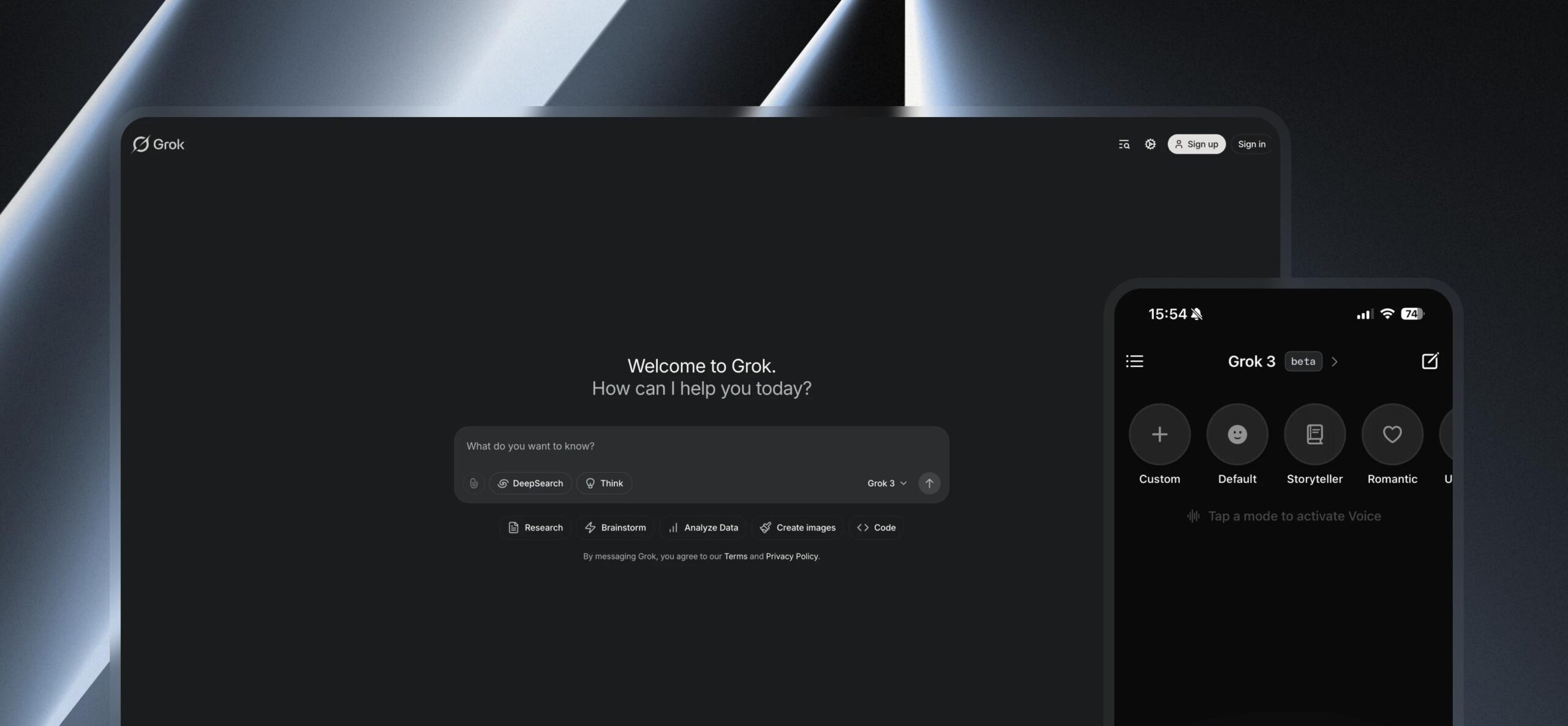
Grok remains the central consumer-facing product in Musk’s AI portfolio.
The company has continued expanding its capabilities beyond conventional chatbot interactions. Its product announcements during 2026 have included voice models, image generation, coding tools, and autonomous AI agents.
One of the more significant additions is Grok Bot, introduced as a system designed to perform tasks across connected applications and business workflows.
On November 2, SpaceXSI announced Grok Bot 1.0, describing a platform in which AI bots can work with teams, use shared context, and continue carrying out tasks without requiring a new instruction for every action. The company also introduced tools aimed at giving business teams access to data analysis through these agents.
Cursor represents another important part of the strategy.
SpaceX completed its acquisition of Anysphere, the company behind Cursor, on August 14, 2026. The acquisition was intended to bring software engineering capabilities closer to the company’s AI models and computing infrastructure.
According to SpaceX’s September quarterly filing, the transaction had an implied equity value of $60 billion and resulted in approximately $42.47 billion in aggregate purchase consideration.
Cursor contributed $608 million in revenue between its acquisition date and September 30, according to the same filing.
The acquisition gives SpaceX a direct position in the AI-assisted software development market, where companies are competing to make coding, debugging and software production increasingly automated.
Rather than concentrating exclusively on selling access to an AI chatbot, the business is now developing products for consumers, software developers and corporate customers.
AI infrastructure is becoming a major business
The scale of SpaceX’s investment in artificial intelligence is particularly visible in its latest financial results.
For the quarter ended September 30, 2026, the company’s Super Intelligence segment reported revenue of $7.56 billion, compared with $813 million in the corresponding quarter of 2025.
For the first nine months of 2026, the segment generated $10.94 billion in revenue, against $2.28 billion in the same period a year earlier.
SpaceX attributed the growth primarily to infrastructure and cloud-service agreements, Cursor’s contribution, and increased subscription revenue from Grok and X.
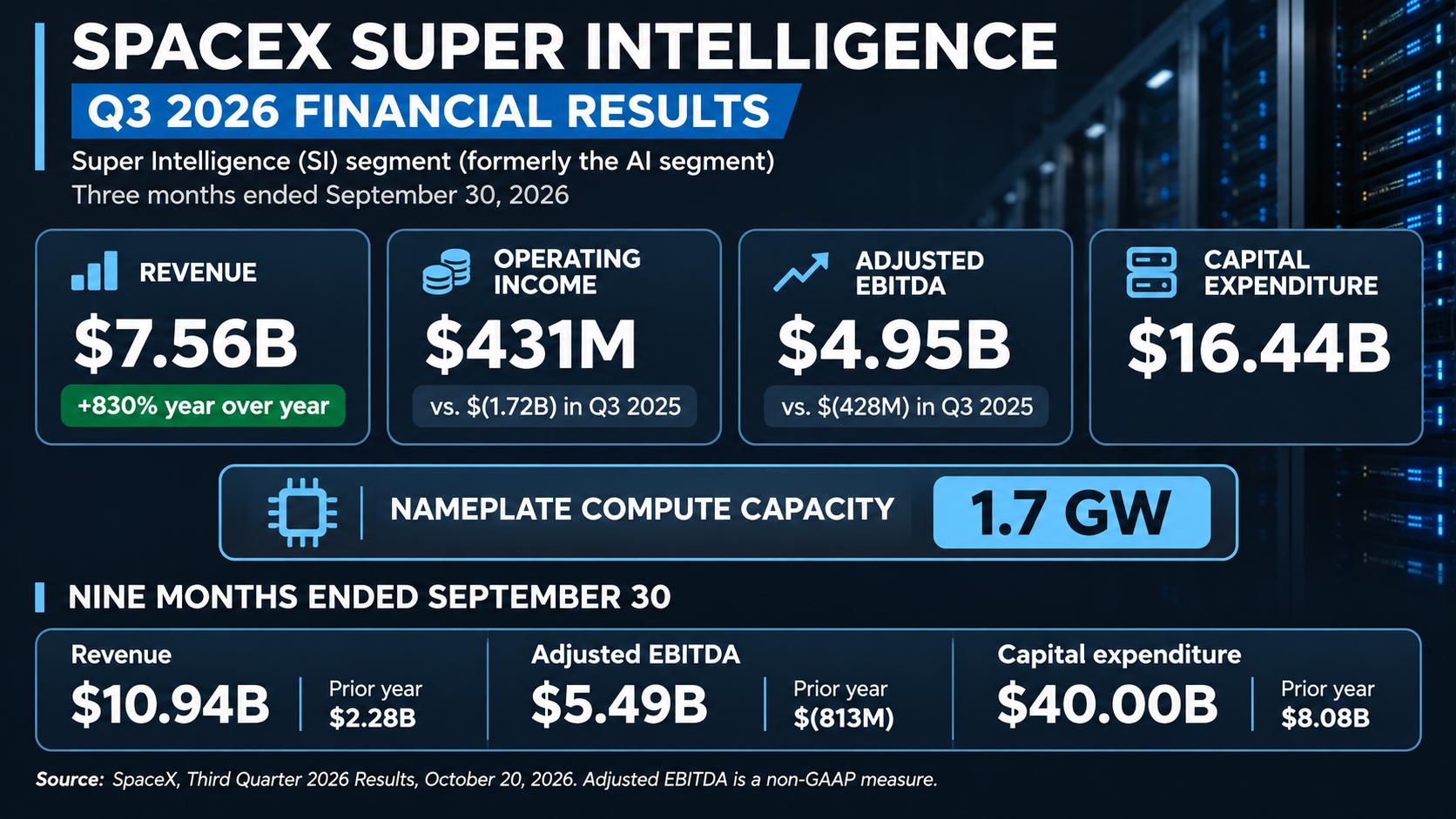
The investment figures show how heavily the company is spending to expand its computing capacity.
SpaceX reported 1.7 gigawatts of nameplate computing capacity as of September 30. Its third-quarter capital expenditure for the SI segment reached $16.44 billion, substantially higher than the $4.76 billion reported for the same quarter in 2025.
The company’s strategy extends beyond developing its own models. It is also selling computing services to other AI businesses.
In November, Reuters reported that SpaceX was planning an estimated $24 billion gas-fired power plant and supercomputing facility at Starbase, Texas. The proposal was described in a public hearing notice, with the Starbase City Commission expected to consider a related economic development agreement on December 9.
The proposed project is not an approved operating facility. Its generating capacity and the scale of the computing operation were not specified in the notice.
For Musk, securing power and computing resources is becoming as important as developing the AI models themselves.
Grok Build security findings raise questions
The company’s expansion into business software is facing an early test over data protection.
On November 10, security research firm Claroc published findings involving Grok Build, an AI-powered application builder that allows users to create websites, dashboards, and working applications through natural-language instructions.
Claroc reported that it tested 37,571 live applications and found that 35,578 could be opened without signing in. That represented approximately 94.7% of the applications examined.
The researchers said some applications contained sensitive information, including medical records, employee details, internal business documents, and commercial information.
The investigation also identified 24 applications created by SpaceXSI and X employees. Among the material were an internal sales onboarding plan, a sales territory map covering 594 accounts, and advertising proposals.
The problem involved the way Grok Build generated and shared application links. According to Claroc, the links could be discovered through passive DNS records, making applications accessible even to people who had not been invited to view them.
SpaceXSI’s response, reported by Ars Technica, differed from the researchers’ findings. A representative associated with Cursor said applications were private by default and nothing became public unless the creator chose to share it.
However, Claroc’s tests indicated that the default publishing option in the accounts it examined was set to “Anyone with the link”. Ars Technica reported that SpaceXSI removed the 24 internally created applications within hours of receiving questions from the publication.
The researchers’ findings should not be interpreted as proof that every exposed application contained sensitive information. Most were reportedly ordinary applications, while the estimates of how many contained private data were based on sampling.
The incident nevertheless raises questions about the safeguards needed when AI tools are used to build applications containing customer, employee or company information.
Legal and regulatory challenges remain
Data security is not the only issue facing Musk’s AI business.
SpaceX’s September 2026 quarterly filing disclosed multiple legal actions involving Grok’s image-generation and editing capabilities.
Several lawsuits filed in the United States allege that the tools enabled the creation and distribution of nonconsensual explicit images and sexualised content involving women and children.
These are allegations in ongoing legal proceedings, not findings that the company has been held liable. The filing also records an October 19 notice from Virginia’s attorney general indicating that the state was considering legal action over alleged misrepresentations concerning Grok’s safeguards.
The company’s computing expansion has attracted environmental scrutiny as well.
The NAACP and its Mississippi state conference filed a lawsuit in April alleging that gas turbines powering the Colossus II data centre violated the Clean Air Act because they were operating without the required permits.
The litigation remains unresolved. SpaceX’s filing records that the US government was allowed to intervene in the case, although the court declined to let it dismiss the action.
These disputes matter commercially because enterprise customers evaluating AI providers must consider not only model performance but also privacy, regulatory compliance, and operational reliability.
Musk’s broader AI ambitions extend beyond Grok
Musk’s AI strategy is also connected to his other businesses.
Tesla has invested in xAI and has explored potential collaboration with the company. SpaceX and Tesla have separately formed special committees to examine a possible merger, a proposal Musk publicly supported during SpaceX’s October 20 earnings call.
However, neither company had agreed on transaction terms, and any combination would require further approvals. The possibility of a merger should therefore not be treated as a completed deal.
The connection between AI and space infrastructure is another part of Musk’s longer-term plans.
SpaceX’s corporate filings discuss the possibility of developing computing infrastructure beyond Earth, potentially using space-based systems. The concept remains a longer-term objective rather than an established commercial service.
For now, the company’s immediate priorities are more grounded: expanding terrestrial computing capacity, improving Grok, developing AI agents and selling infrastructure and software services to customers.
The central question is whether these businesses can grow together without creating operational, financial, and regulatory problems that undermine their commercial prospects.
What happens next
The next phase of Musk’s AI expansion will be shaped by several measurable developments.
SpaceX will need to demonstrate that its growing computing infrastructure can generate sustainable returns. Grok and Grok Bot will have to compete for users and enterprise customers, while Cursor gives the company another route into the professional software market.
The company will also face pressure to demonstrate that its AI products can handle sensitive information responsibly, particularly as businesses increasingly use autonomous agents and AI-generated applications.
The November security findings have added another issue to that list. Whether SpaceXSI changes its application-sharing defaults, improves access controls, and communicates any wider security measures will be worth watching.
For now, Musk’s AI operation has moved well beyond the original xAI chatbot business. Its success will depend on whether the combined organisation can turn its considerable computing investment and expanding product portfolio into reliable, commercially sustainable services.