RAHUL GANDHI LATEST NEWS: 5 Major Points as BJP Targets Congress Leader Over Remarks About India Abroad
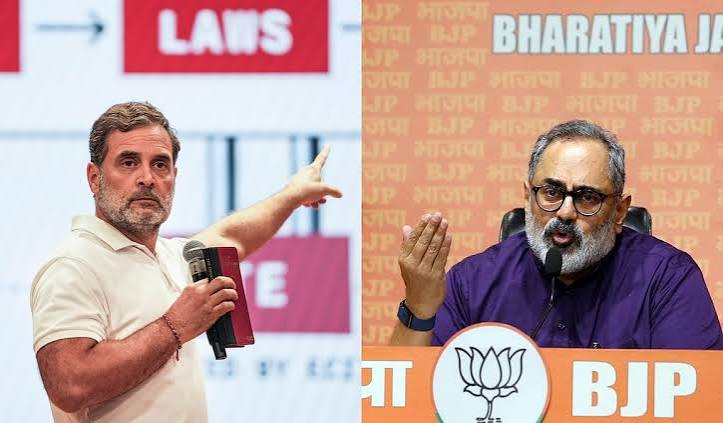
NEW DELHI: Rahul Gandhi latest news has triggered another political confrontation after the Bharatiya Janata Party (BJP) criticised the Congress leader for his comments about India’s economic condition and international standing during overseas engagements.
On Monday, November 23, senior BJP leader and former Union minister Ravi Shankar Prasad accused Rahul Gandhi of presenting India negatively before international audiences. He questioned the Congress leader’s assessment of the country’s economic performance and cited international reports to challenge his criticism.
The exchange has added another chapter to the ongoing political confrontation between the BJP and Congress, particularly over India’s economic development, foreign policy and the responsibilities of the Opposition.
1. Ravi Shankar Prasad Accuses Rahul Gandhi Of Damaging India’s Image
The latest BJP Rahul Gandhi controversy intensified after Ravi Shankar Prasad publicly questioned Gandhi’s remarks about India during overseas visits.
Prasad alleged that the Congress leader repeatedly used negative descriptions of India’s economic situation and future prospects while speaking on international platforms.
He argued that Gandhi’s statements did not adequately reflect India’s economic progress or growing influence in international affairs.
Prasad also questioned whether the Leader of the Opposition had properly examined reports published by international institutions before making such assessments.
The BJP leader’s criticism centred on the argument that political disagreements should not result in what he described as an inaccurate portrayal of India’s achievements abroad.
These remarks represent the BJP’s political position. They do not independently establish whether Gandhi’s assessment of India’s economy or foreign policy is correct.
2. BJP Cites Asia Power Index 2026 To Challenge Gandhi
One of the main arguments presented by Prasad involved the Lowy Institute’s Asia Power Index 2026.
He referred to the Australian research institute’s assessment of 27 countries across 131 indicators, highlighting India’s reported position as the third-most powerful country in Asia.
Prasad cited India’s score of 40.5 points and said the country’s position reflected improvements in its regional influence and overall capabilities.
He also highlighted the assessment of Prime Minister Narendra Modi as the second-most influential regional leader in Asia, behind Chinese President Xi Jinping.
The BJP leader used these findings to challenge Gandhi’s criticism of India’s international standing.
However, the Asia Power Index measures several dimensions of national power and regional influence. Its findings should not be interpreted as a direct measurement of every aspect of India’s economic performance.
3. BJP Also Invokes Goldman Sachs, IMF And World Bank Reports
Prasad also referred to economic assessments published by Goldman Sachs, the International Monetary Fund (IMF) and the World Bank.
Citing a Goldman Sachs report from November 2026, he said India was projected to remain the fastest-growing major economy in 2027 and could outpace China in economic growth.
He also referred to the IMF’s October assessment, describing India as an important contributor to global economic growth.
According to Prasad, these assessments contradicted Gandhi’s negative portrayal of India’s economic prospects.
The BJP leader further argued that India’s economic capacity, investment potential and contribution to global poverty reduction demonstrated the country’s growing economic importance.
It is important to distinguish the political argument from the underlying economic evidence. Economic growth forecasts are projections, not guaranteed outcomes, and assessments of national economic performance also involve employment, income distribution, investment and living standards.
4. Rahul Gandhi’s Earlier US Remarks Triggered Similar Criticism
The latest political exchange follows several controversial remarks by Gandhi during his November visit to the United States.
During an interaction at Columbia University’s School of International and Public Affairs in New York on November 17, Gandhi described India’s economic situation as an impending disaster.
He raised concerns about unemployment, the education system and the country’s manufacturing sector, arguing that the existing economic model was not creating sufficient employment opportunities.
He also criticised government initiatives, including Make in India and Start-up India, questioning their effectiveness in generating jobs.
His comments prompted criticism from BJP spokespersons, who accused him of presenting an excessively negative picture of India’s economic performance.
Gandhi’s subsequent interaction at the University of Chicago on November 19 also attracted political attention.
He described India as becoming a “side player” in international affairs, questioning the country’s diplomatic influence while discussing Pakistan’s engagement with the United States and Iran.
The BJP strongly objected to that assessment, arguing that Gandhi was undermining India’s international standing.
The earlier Rahul Gandhi Columbia University speech provides additional context about his criticism of India’s economy, unemployment and electoral institutions.
5. Congress-BJP Political Confrontation Continues
The latest BJP Rahul Gandhi controversy reflects a continuing disagreement between the ruling party and Congress over how India’s economic and diplomatic performance should be assessed.
The BJP maintains that Gandhi’s overseas criticism overlooks the country’s achievements and can negatively influence international perceptions.
Congress, meanwhile, has consistently defended the Opposition’s right to question government policies, highlight economic difficulties and scrutinise the country’s institutions.
The disagreement also raises a broader political question about the role of opposition leaders when addressing international audiences.
Criticism of government policies is a normal part of democratic debate. However, the BJP argues that Gandhi should acknowledge India’s achievements alongside the challenges he highlights.
The political disagreement is not limited to economic policy. Foreign relations, unemployment, electoral transparency and the functioning of constitutional institutions have also featured prominently in recent exchanges between the two parties.
Earlier discussions about India’s position in international groupings, including the debate involving Congress leaders Shashi Tharoor and P. Chidambaram over BRICS, have similarly highlighted differing assessments of India’s diplomatic influence and international engagement.
What Happens Next?
The latest criticism from Prasad adds to the growing political exchange surrounding Gandhi’s overseas statements.
The BJP is continuing to challenge his assessment of India’s economic performance and international position, while Congress maintains its criticism of the government’s policies.
There has been no indication in the reported exchange of a formal response from Gandhi specifically addressing Prasad’s November 23 remarks.
The Rahul Gandhi latest news development therefore remains a political confrontation rather than a new government policy announcement or an institutional dispute.
As the political debate continues, the central disagreement remains whether Gandhi’s comments represent legitimate criticism of government performance or, as the BJP alleges, an unfair portrayal of India’s progress before international audiences.