Samajwadi Party Offers Congress Just 26 Seats in 2027 Polls as Alliance Talks Hit Major Hurdle
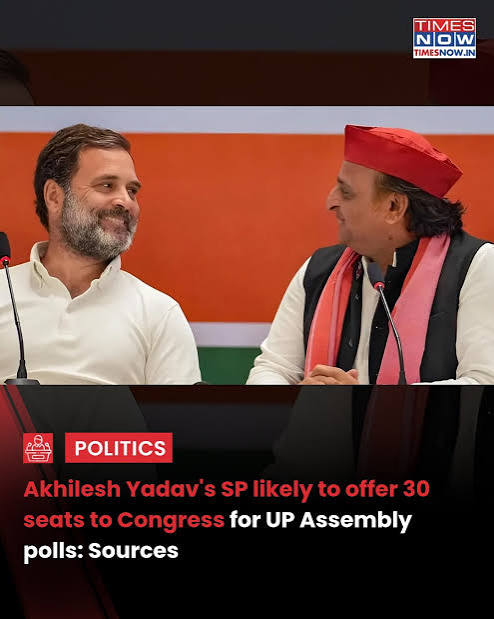
UTTAR PRADESH: The SP Congress alliance negotiations have encountered a significant disagreement after the Samajwadi Party (SP) offered Congress 26 seats for the 2027 Uttar Pradesh Assembly elections, considerably below the Congress party’s initial demand for 131 constituencies.
The proposal was conveyed during the second round of seat-sharing discussions on Tuesday, November 24, 2026, as representatives of both INDIA bloc partners continued negotiations in New Delhi. Congress subsequently revised its demand to 120 constituencies, but the two parties have yet to announce a final agreement.
The disagreement highlights the difficult negotiations facing opposition parties as they attempt to establish an electoral arrangement ahead of the next Uttar Pradesh Assembly elections, in which all 403 constituencies will be contested.
SP Congress Alliance Faces Major Disagreement Over Seat Sharing
The Samajwadi Party’s proposal of 26 seats represents a substantial gap between the negotiating positions of the two parties.
Congress initially submitted a list of 181 constituencies it wanted to contest. It subsequently reduced its proposed list to 130 seats, while its demand was reported as 131 during the initial discussions.
The Samajwadi Party, led by Akhilesh Yadav, responded with a proposal covering 26 constituencies.
According to The Indian Express, the Congress revised its demand to 120 constituencies following the SP’s offer. The discussions also witnessed disagreements over the selection of constituencies and the formula used to determine each party’s electoral share.
The difference between the two proposals remains considerable, making the negotiations an important test of the relationship between the opposition partners.
Which 26 Seats Has Samajwadi Party Offered Congress?
The Samajwadi Party’s proposed list reportedly includes two constituencies that Congress won in the 2022 Uttar Pradesh Assembly elections and four where its candidates finished second.
The two previously won constituencies are Rampur Khas and Farenda.
The four constituencies where Congress finished second are Mathura, Kheragarh, Jagdishpur and Kidwai Nagar.
The remaining 20 constituencies included in the SP proposal are:
-
Baghpat
-
Modinagar
-
Hapur
-
Jewar
-
Syana
-
Khurja
-
Khair
-
Iglas
-
Mant
-
Agra North
-
Fatehpur Sikri
-
Bilgram-Mallanwan
-
Govind Nagar
-
Nanpara
-
Gorakhpur City
-
Khajani
-
Padrauna
-
Fazilnagar
-
Pindra
-
Varanasi Cantonment
The selection reflects the Samajwadi Party’s reported argument that constituency-level electoral performance should play an important role in deciding the allocation.
The proposal is not a final seat-sharing agreement. Both parties still need to reach an understanding on the number and selection of constituencies.
Why Samajwadi Party Is Reluctant To Offer More Seats
The SP’s negotiating position is closely linked to the parties’ previous electoral performances in Uttar Pradesh.
In the 2022 Assembly elections, Congress contested 399 constituencies but won only two seats. The Samajwadi Party secured 111 seats after contesting 347 constituencies.
The 2017 Assembly elections also provide relevant background. The two parties contested together, with the SP winning 54 seats and Congress securing seven.
However, their performance improved significantly in the 2024 Lok Sabha elections, which they contested together as INDIA bloc partners.
Congress won six of the 17 parliamentary constituencies it contested, while the Samajwadi Party secured 37 of the 62 seats it contested.
These contrasting results form an important part of the current negotiations. The SP can point to its stronger Assembly performance, while Congress can refer to its improved parliamentary results and its contribution to the opposition alliance in 2024.
The disagreement is therefore not simply about the number of constituencies. It also concerns how electoral strength, local organisation and the prospects of defeating the BJP should influence the alliance arrangement.
Congress And SP Continue Negotiations Through Senior Leaders
Both parties have appointed senior representatives to handle the seat-sharing discussions.
The Samajwadi Party’s negotiating panel includes general secretary Ram Gopal Yadav, Uttar Pradesh party president Shyam Lal Pal, MPs Iqra Choudhary and Rajeev Rai, and Faizabad MP Awadhesh Prasad.
Prasad’s inclusion is significant because the SP has sought representation for its PDA grouping, which stands for Pichhde, Dalit and Alpsankhyak (backward classes, Dalits and minorities).
Congress has also appointed a team to represent its interests in the discussions. Its representatives include AICC in-charge for Uttar Pradesh Rajendra Pal Gautam, state Congress president Aradhana Mishra, working president Imran Masood and MLA Virendra Chaudhary.
The involvement of senior leaders from both organisations indicates that the negotiations are being handled at the organisational level rather than through informal discussions alone.
The parties have not publicly announced a final agreement on the proposed distribution of constituencies.
Amethi And Rae Bareli Add To The Seat-Sharing Disagreement
The proposed allocation has also attracted attention because of the Congress party’s traditional political connections with Amethi and Rae Bareli.
These constituencies have long been associated with the Nehru-Gandhi family and have remained important to Congress’s political identity in Uttar Pradesh.
The Samajwadi Party’s reported proposal of just one seat across the Amethi-Rae Bareli belt has reportedly caused dissatisfaction among Congress representatives.
For Congress, the issue extends beyond the total number of seats. The selection of constituencies where it believes it has a stronger organisational presence and electoral prospects is also important.
The disagreement illustrates why negotiations can become complicated even when two parties agree on the broader objective of contesting elections together.
What The SP Congress Alliance Negotiations Mean For 2027
The Uttar Pradesh seat sharing discussions carry considerable political importance because the state has 403 Assembly constituencies and plays a major role in national electoral politics.
The Samajwadi Party and Congress are both part of the broader INDIA opposition grouping. Their cooperation in the 2024 Lok Sabha elections produced a stronger combined electoral performance than either party achieved in the preceding state Assembly contests.
A successful arrangement for 2027 could help the opposition avoid unnecessary competition between its candidates in constituencies where both parties have an electoral presence.
However, a disagreement over constituency allocation could complicate coordination, particularly if either party believes it has been offered fewer seats than its electoral strength justifies.
For the Samajwadi Party, maintaining its leading position within the opposition alliance in Uttar Pradesh remains an important consideration. Congress, meanwhile, will want sufficient constituencies to strengthen its state-level political presence.
The SP Congress alliance therefore faces two connected challenges: agreeing on the number of seats and determining which constituencies each party should contest.
As discussions continue, the 26-seat proposal remains a negotiating position rather than a confirmed electoral arrangement.
Neither party has announced a final seat-sharing agreement, and the possibility of further changes to the proposed allocation remains open.
The coming rounds of discussions will be important in determining whether the two opposition parties can bridge their differences and establish a common electoral strategy before the 2027 Uttar Pradesh Assembly elections.