Supreme Court Questions Sanjay Raut Over His Remarks Against Judges
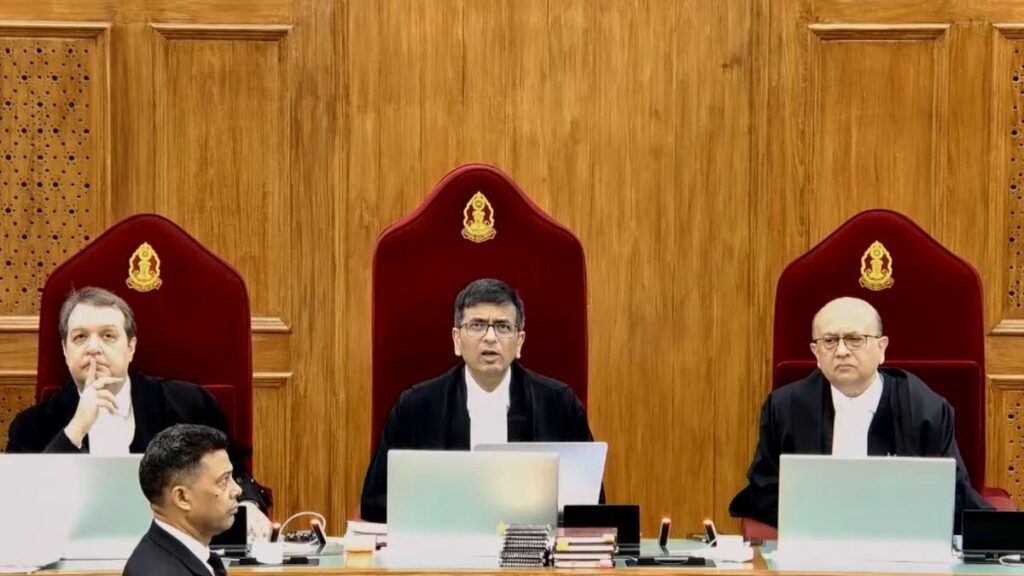
NEW DELHI: The Supreme Court on Tuesday, November 17, questioned Shiv Sena (UBT) MP Sanjay Raut over his remarks concerning Chief Justice of India (CJI) Surya Kant and the judiciary, telling the experienced parliamentarian that he should understand the importance of restraint in public statements. The observations came during criminal contempt proceedings initiated against Raut and journalist Nikhil Wagle over their alleged remarks against the judiciary.
A bench comprising Justices Aravind Kumar and Vipul M. Pancholi heard the matter after Raut appeared personally before the court. The judges also emphasised that an apology in a matter of this seriousness must come sincerely rather than being treated as a formal legal exercise.
The hearing did not conclude the contempt proceedings. Instead, the court sought further explanations from the respondents and directed them to place their positions on affidavit.
Supreme Court Questions Sanjay Raut Over Remarks Against Judges
During Tuesday’s hearing, Justice Aravind Kumar addressed Raut directly, observing that his experience as a politician, parliamentarian and former journalist should have made him aware of the need for restraint.
The judge told Raut that the court had heard his political speeches over the years and that he should understand what restraint in language meant.
The bench also questioned the sincerity of the apology already submitted in the matter. Justice Kumar observed that an apology in a case of this magnitude should come from the heart rather than merely from the mind.
The remarks followed submissions by Senior Advocate Pradeep Rai, president of the Supreme Court Bar Association (SCBA), who argued that Raut had continued making social media posts concerning the judiciary even after submitting an apology.
The SCBA’s concerns included a subsequent post referring to the Supreme Court of Albania being set on fire during protests. Rai argued that the post carried an indirect message concerning India’s Supreme Court.
These were submissions made by the petitioner, not findings formally established by the court.
Why Sanjay Raut Is Facing Criminal Contempt Proceedings
The Sanjay Raut Supreme Court controversy originated in October 2026, following comments made by the Shiv Sena (UBT) leader about the judiciary and its interactions with political figures.
The controversy developed after CJI Surya Kant declined to meet a delegation of Opposition leaders seeking to raise concerns relating to the Election Commission and the Special Intensive Revision (SIR) of electoral rolls.
Raut subsequently made allegations concerning judges attending political programmes organised by the ruling party and participating in social engagements with political leaders.
The SCBA objected to these remarks, arguing that they could undermine public confidence in the judiciary.
The association approached Attorney General R. Venkataramani seeking consent to initiate criminal contempt proceedings under Section 15 of the Contempt of Courts Act, 1971. The Attorney General granted consent on October 15, 2026.
On October 16, the Supreme Court issued notices to Raut and journalist Nikhil Wagle, asking them to explain why criminal contempt proceedings should not be initiated against them.
The proceedings also concern Wagle’s alleged objectionable social media post targeting the Chief Justice.
SCBA Raises Concerns Over Subsequent Social Media Posts
During the hearing, Pradeep Rai told the bench that Raut’s conduct after submitting an apology required further scrutiny.
He referred to an image shared by the politician showing the Supreme Court of Albania being set on fire during protests. According to Rai, the timing and context of the post suggested that it was directed indirectly at India’s Supreme Court.
Rai argued that public figures holding respected positions should be mindful of the consequences of their statements, particularly when commenting on constitutional institutions.
The court took note of these submissions and asked Raut’s legal representative to address the additional material.
Raut’s counsel maintained that an unconditional apology had already been submitted and that the politician did not intend to repeat the conduct. The lawyer also indicated that an additional affidavit could be filed if the court required one.
The bench subsequently directed Raut to submit a further affidavit explaining his position on the posts.
Nikhil Wagle Also Asked To Explain His Remarks
Journalist Nikhil Wagle is the second respondent in the contempt proceedings.
The SCBA’s petition also concerns an alleged objectionable social media post by Wagle directed at CJI Surya Kant.
Senior Advocate Indira Jaising, appearing for Wagle, informed the court that her client had deleted the post and tendered an unconditional apology.
She requested the bench to consider discharging Wagle from the proceedings, arguing that he had acknowledged his mistake and complied with the court’s earlier directions.
The court, however, required Wagle to explain his position formally through an additional affidavit.
Justice Kumar also highlighted the responsibility associated with journalism, describing the media as the fourth estate. He observed that journalists have an important role in public life and should exercise responsibility when commenting on judicial institutions.
Wagle was permitted to participate in the November 17 hearing virtually, while Raut appeared physically before the bench.
What Happens Next In The Supreme Court Contempt Case?
The Supreme Court directed both Raut and Wagle to submit additional affidavits explaining their respective social media posts.
The matter has been listed for December 8, 2026, for further consideration.
The next hearing will allow the bench to examine the explanations and apologies placed on record before deciding how the proceedings should move forward.
The case remains at the contempt proceedings stage. The court has not delivered a final judgment establishing either respondent’s guilt.
The Supreme Court News Today development has drawn attention because it involves the limits of public commentary concerning constitutional institutions and the responsibilities of politicians and journalists.
The proceedings also highlight the distinction between criticising judicial decisions and making allegations against individual judges. However, the specific legal consequences in this case will depend on the court’s assessment of the material and responses submitted by the respondents.
Why The Case Matters For Judicial Independence
The Sanjay Raut Supreme Court proceedings have brought renewed attention to the relationship between political criticism, freedom of expression and the authority of the judiciary.
In a constitutional democracy, politicians, journalists and citizens can question public institutions and express disagreement with their decisions. Criticism of judicial functioning is an important part of public debate.
At the same time, allegations against judges and statements that may undermine public confidence in the judicial process can raise questions under the law of contempt.
The Supreme Court will have to consider the statements and subsequent conduct attributed to the respondents alongside their explanations and apologies.
The proceedings should not be interpreted as a general restriction on criticism of the judiciary. Rather, the court is examining a specific petition involving particular statements and social media posts.
The latest Supreme Court News Today development therefore remains significant for the continuing debate over judicial accountability, institutional reputation and freedom of expression.
For now, the focus remains on the additional affidavits and the next hearing scheduled for December 8.