
DR Congo Hands Death Penalty to 66 Soldiers in Military Discipline Case
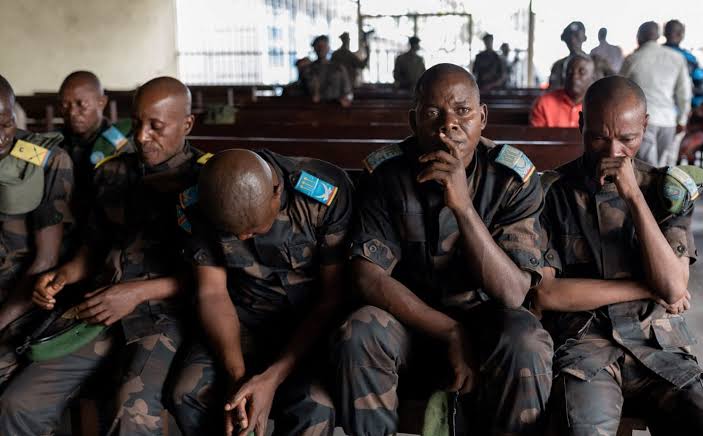
A military court in the Democratic Republic of the Congo (DR Congo) has sentenced 66 soldiers to death after finding them guilty of offences including cowardice, military mutiny and disobeying orders. The verdict was delivered on November 6 in Walikale, North Kivu province, following a 12-day trial involving 71 members of the Congolese armed forces.
Four defendants were acquitted, while another soldier received a 10-year prison sentence. The case involved troops from the 3415th Regiment of the Armed Forces of the Democratic Republic of the Congo (FARDC), who were arrested following incidents in the Walikale area in October.
The ruling was delivered by the Goma Garrison Military Court, which held proceedings in Walikale town centre.
What Led to the Death Sentences?
According to reports by Congolese state news agency Agence Congolaise de Presse (ACP) and UN-backed broadcaster Radio Okapi, the soldiers were arrested on October 20, 2026, following incidents reported in Ntoto village, within the Wanianga sector of Walikale territory.
The case initially involved 54 soldiers from the 3415th Regiment. The proceedings were subsequently expanded to include additional military personnel, bringing the total number of defendants to 71.
Radio Okapi reported that the defendants faced several charges, including military mutiny, abandonment of their posts, refusing to obey orders, wasting military ammunition, and murder.
The allegations were linked to shootings on October 16 and October 20 in the Ngora area. Those incidents reportedly left two people dead, including a soldier and a civilian, while two others were injured.
According to an earlier report by Radio Okapi, the incidents involved an altercation between soldiers and military police personnel who were attempting to prevent troops from leaving a combat zone without authorisation.
The exact circumstances surrounding the confrontation and the individual responsibility of each defendant were not fully detailed in the publicly available reports.
What Did the Military Court Decide?
The trial lasted 12 days, with hearings examining allegations of military revolt, refusal to obey orders, cowardice in the face of the enemy, and the misuse of military ammunition.
The prosecution had reportedly sought the death penalty for 70 of the 71 defendants. It requested a 10-year prison sentence for a military intelligence officer.
The court ultimately sentenced 66 soldiers to death, acquitted four defendants and handed one soldier a 10-year prison term.
Among those acquitted was a captain who served as the intelligence officer of the 3415th Regiment.
The verdict was announced late on November 6, according to the statement from the 34th Military Region cited by ACP.
Military authorities said the proceedings were intended to reinforce discipline within the armed forces as government troops continue operations against armed groups in eastern DR Congo.
Eastern DR Congo Continues to Face Armed Conflict
The case comes as government forces continue to face armed groups across North and South Kivu, two provinces in eastern DR Congo that have experienced years of insecurity.
One of the main armed groups involved in the conflict is the March 23 Movement (M23), which operates as part of the broader Alliance River Congo (AFC) coalition, also referred to in recent reporting as the Front for the Refoundation of the Nation (FRN).
The fighting has placed considerable pressure on the Congolese military, with government forces attempting to maintain control over territory and prevent further rebel advances.
The military justice system has increasingly dealt with cases involving soldiers accused of abandoning their positions or failing to follow orders during operations.
In October 2026, another military court sentenced 27 soldiers of the Republican Guard to death for cowardice. That case was heard by the Uvira Garrison Military Court.
The latest ruling in Walikale therefore represents another major death-penalty decision involving Congolese military personnel accused of misconduct during the country’s ongoing security crisis.
DR Congo’s Return to the Death Penalty
The latest sentences also draw attention to the country’s decision to resume the use of capital punishment after a lengthy suspension.
In March 2024, the Congolese government announced that it would lift its moratorium on executions, ending a suspension that had been in place for approximately two decades.
The government cited serious security threats, including treason and offences involving members of the armed forces, as reasons for the decision.
Human rights organisation Amnesty International raised concerns about the growing number of death sentences issued by military courts.
In a January 22, 2025, statement, Amnesty said at least 300 death sentences had been handed down by military courts since the government announced its intention to resume executions in March 2024. The organisation also highlighted an earlier case involving 25 soldiers sentenced to death for allegedly fleeing the enemy in Butembo.
Amnesty called on Congolese authorities to halt plans to carry out executions and work towards abolishing capital punishment.
The distinction between a death sentence and an execution remains important. Amnesty reported that it had not recorded an execution in DR Congo since 2003 in its January 2025 assessment. The latest Walikale ruling does not establish that any of the 66 soldiers have been executed.
What Happens Next?
The November 6 verdict establishes the sentences handed down by the Goma Garrison Military Court. However, publicly available reports do not provide details of any appeal proceedings, the possibility of further judicial review or a timetable for implementing the sentences.
There is also no independently verified announcement that the 66 soldiers have been executed.
The case adds to the growing number of death sentences imposed on Congolese military personnel as authorities attempt to enforce discipline within the armed forces during the conflict in the country’s east.
For now, the confirmed development is the court’s decision to sentence 66 soldiers to death. Whether those sentences will ultimately be carried out remains unconfirmed.




