Nayana Motamma Resignation: 5 Major Developments in Karnataka’s Elephant Relocation Row
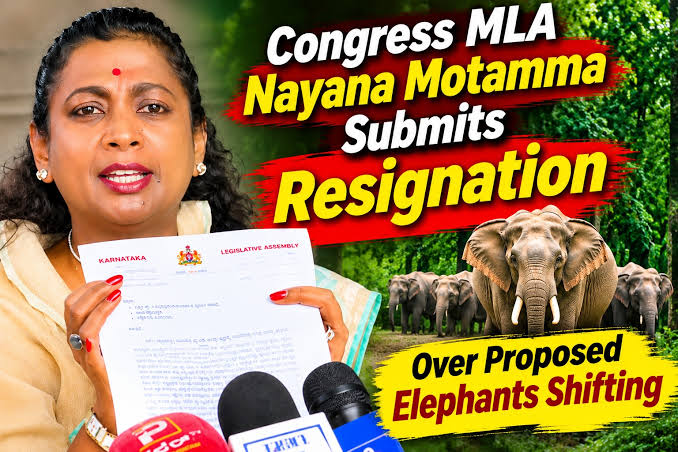
KARNATAKA: Nayana Motamma resignation became the centre of a political controversy in Karnataka after the Congress MLA submitted her resignation to the Assembly Speaker’s office on November 23, protesting a Forest Department operation to move wild elephants from Hassan district towards Bhadra Wildlife Sanctuary in Chikkamagaluru.
However, the development took another turn on November 24 when Deputy Chief Minister D.K. Shivakumar intervened and Motamma withdrew her resignation, according to subsequent reporting by The Indian Express.
The Mudigere legislator had objected to the operation, alleging that elected representatives from affected constituencies were not consulted before forest officials began driving the animals towards the region.
The dispute has exposed disagreements within the Congress government over wildlife management, public safety and the responsibilities of local representatives.
1. Why Nayana Motamma Submitted Her Resignation
Nayana Motamma, who represents the Mudigere Assembly constituency in Chikkamagaluru district, submitted her resignation in protest against the Forest Department’s elephant-driving operation.
The controversy began after wild elephants were reported moving through Belur and Sakaleshpur taluks in Hassan district.
According to reports, a herd of approximately 56 elephants had moved through the Belur region, where two people were killed in separate incidents.
Following the deaths, Hassan district in-charge minister K.M. Shivalinge Gowda supported moving the elephants towards the Bhadra Tiger Reserve.
However, legislators representing neighbouring constituencies in Chikkamagaluru objected to the proposed operation.
Motamma argued that moving elephants into their region without proper consultation could increase the risk of human-elephant conflict.
She submitted her resignation at Vidhana Soudha in Bengaluru on Monday, November 23.
The Speaker, G.S. Patil, was unavailable at the time. His office received the letter, but it had not been formally accepted.
2. Karnataka Elephant Relocation Triggers Disagreement Within Congress
The Karnataka elephant relocation operation became a political issue after three Congress legislators from Chikkamagaluru raised objections.
Apart from Motamma, Sringeri MLA T.D. Rajegowda and Chikkamagaluru MLA H.D. Thammaiah expressed concerns about the proposed movement of elephants.
The legislators argued that their constituencies already faced significant human-elephant conflict.
They warned that bringing additional elephants into the region could increase pressure on agricultural communities and settlements located near forest areas.
Motamma also questioned why the operation had started before a proposed meeting involving representatives from Hassan and Chikkamagaluru.
A meeting initially scheduled for November 25 was subsequently moved to November 30.
The legislators wanted the government to consult affected representatives, farmers’ organisations and other local stakeholders before proceeding.
Their objections were not simply about moving elephants between districts. They also concerned the methods used, the destination selected and the potential consequences for people living in affected areas.
3. Two Human Deaths Behind The Elephant-Driving Operation
The Forest Department’s operation followed fatal human-elephant conflict incidents in Hassan district.
Reports identified two human deaths in the Belur region during November 14 and 16.
The incidents increased pressure on authorities to address the presence of wild elephants near populated areas.
Hassan district in-charge minister K.M. Shivalinge Gowda defended the proposed movement, arguing that the region did not have sufficient forest cover to accommodate the animals.
He maintained that Bhadra had suitable forest areas.
However, legislators from Chikkamagaluru questioned whether driving elephants into another region would simply transfer the existing problem to different communities.
Motamma also raised concerns about the possible consequences for farmers, plantation workers and residents.
She questioned who would be responsible if the operation resulted in further human casualties or damage to agricultural livelihoods.
The disagreement highlights a wider challenge facing Karnataka’s forest authorities: reducing immediate threats to people while avoiding additional pressure on other communities and wildlife habitats.
4. D.K. Shivakumar Intervenes As MLA Withdraws Resignation
The political situation changed on November 24 following intervention by Deputy Chief Minister D.K. Shivakumar.
After initially submitting her resignation, Motamma withdrew it, according to the latest report from The Indian Express.
The development prevented the controversy from immediately becoming a vacancy issue in the Karnataka Assembly.
However, the withdrawal does not mean that all disagreements surrounding the elephant operation have been resolved.
Motamma’s central objections concerned the lack of consultation with local representatives and the potential consequences of moving elephants into her constituency.
The government now faces the challenge of addressing those concerns while also responding to the original incidents in Hassan.
The Nayana Motamma resignation episode has also attracted attention because it involved a Congress legislator challenging a decision taken under the party’s own government.
It follows other political disagreements and ministerial controversies within Karnataka, including the earlier B. Nagendra resignation during the Valmiki Corporation controversy.
5. Wildlife Conservation And Human Safety Remain Central Issues
The Karnataka elephant relocation controversy raises questions about how authorities should manage human-elephant conflict without increasing risks for other communities.
Elephants are wide-ranging animals that depend on established movement routes, suitable habitats and access to food and water.
Disrupting their movement or driving them into unfamiliar areas can create additional management challenges.
However, allowing elephants to remain near densely populated settlements can also expose residents, farmers and workers to serious risks.
Effective management therefore requires more than moving animals from one administrative district to another.
Forest authorities need to consider habitat suitability, established elephant corridors, local population patterns and the potential for conflict in receiving areas.
Community consultation is also important because residents and elected representatives often have direct knowledge of recurring wildlife movement and local safety concerns.
Other environmental emergencies, including the ONGC gas leak in Andhra Pradesh, have also highlighted the importance of coordination between authorities and affected communities when public safety is involved.
In the elephant relocation dispute, the immediate challenge is finding an approach that protects human lives without creating additional risks for wildlife or neighbouring settlements.
What Happens Next In The Karnataka Elephant Relocation Row?
With Motamma withdrawing her resignation, attention has shifted back to the government’s handling of the elephant operation.
The November 30 meeting, previously scheduled for discussions involving legislators from Hassan and Chikkamagaluru, was expected to provide an opportunity to address competing concerns.
The government will need to consider the objections raised by local representatives alongside the safety concerns that prompted the operation in the first place.
The Forest Department’s approach will also face scrutiny over the suitability of the proposed destination and the methods being used to move the animals.
For now, the political dispute has eased following Shivakumar’s intervention, but the broader problem of human-elephant conflict remains unresolved.
The latest developments show that wildlife management decisions can quickly become political issues when affected communities believe their safety and livelihoods have not been adequately considered.