26/11 Mumbai Attacks Anniversary: 5 Powerful Tributes Honour Victims and Heroes 18 Years Later
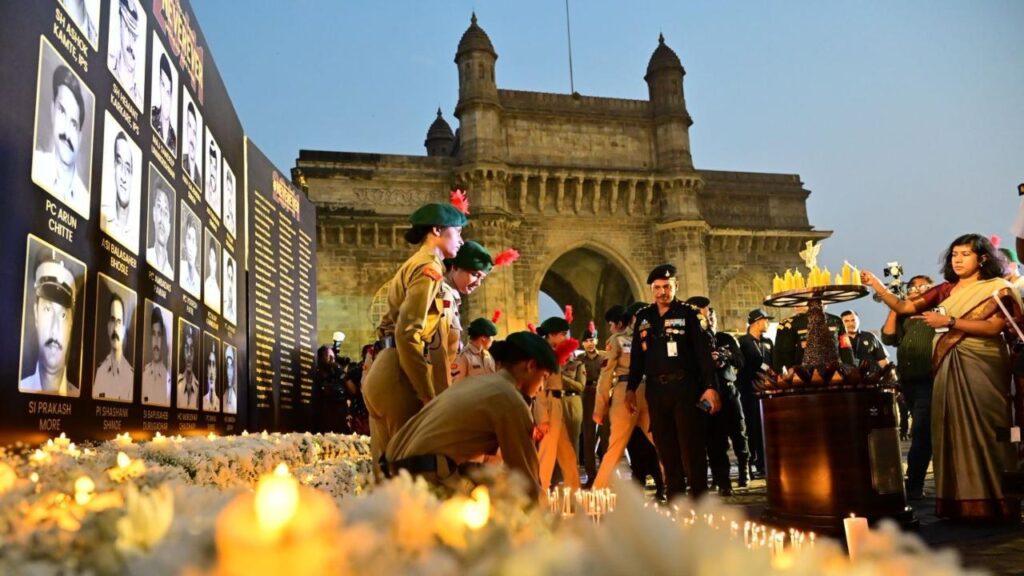
MUMBAI: India is remembering the victims and security personnel who lost their lives in the Mumbai terror attack 2008 as the country marks the 18th anniversary of the coordinated terrorist attacks that shook the financial capital on November 26. Maharashtra Governor Jishnu Dev Varma, Chief Minister Devendra Fadnavis and other senior officials paid floral tributes to the fallen personnel at Mumbai Police headquarters on Thursday.
The anniversary has also renewed attention to the security failures exposed by the attacks, the reforms introduced afterwards and the importance of maintaining preparedness against future terrorist threats.
The November 26, 2026, observance comes 18 years after 10 heavily armed terrorists carried out coordinated assaults across multiple locations in Mumbai, killing 166 people and injuring more than 300.
According to The Tribune, Maharashtra Deputy Chief Minister Sunetra Pawar, Director General of Police Sadanand Date, Mumbai Police Commissioner Deven Bharti and other officials also attended the tribute ceremony.
Maharashtra Leaders Pay Tribute To 26/11 Victims
The anniversary observance brought together senior state officials, police personnel and families of those who died during the attacks.
Governor Jishnu Dev Varma and Chief Minister Devendra Fadnavis laid floral tributes at Mumbai Police headquarters in remembrance of the personnel who sacrificed their lives while confronting the terrorists.
Deputy Chief Minister Sunetra Pawar also attended the ceremony, alongside senior police officials.
Fadnavis paid tribute to the security personnel and innocent civilians who lost their lives, remembering their courage and sacrifice in defending the city.
The presence of families of the fallen policemen added a personal dimension to the anniversary, which continues to hold deep significance for survivors and relatives of those killed.
What Happened During The Mumbai Terror Attack 2008?
The Mumbai terror attack 2008 began on the evening of November 26, when 10 terrorists associated with the Pakistan-based Lashkar-e-Taiba (LeT) entered Mumbai by sea and launched coordinated attacks across the city.
The attackers targeted several prominent locations, including:
-
Taj Mahal Palace Hotel
-
Oberoi-Trident Hotel
-
Chhatrapati Shivaji Maharaj Terminus (CSMT)
-
Nariman House
-
Leopold Cafe
-
Cama Hospital
The attacks continued until November 29, resulting in approximately 60 hours of violence and a major security operation involving Mumbai Police, the Indian Army, Navy personnel and the National Security Guard (NSG).
The terrorists targeted locations frequented by civilians, foreign visitors and business travellers.
The final death toll was 166, including Indian citizens and foreign nationals. More than 300 people were injured.
Nine attackers were killed during the security operations, while Ajmal Amir Kasab was captured alive. He was subsequently tried, convicted and sentenced to death. Kasab was executed at Yerawada Central Prison in Pune on November 21, 2012.
The attacks prompted widespread international condemnation and exposed serious weaknesses in India’s intelligence coordination, coastal security and rapid counter-terrorism response.
Force One And India’s Counter-Terrorism Preparedness
One of the most significant institutional developments following the 26/11 Mumbai attacks anniversary in 2009 was the establishment of Maharashtra’s Force One.
The specialised counter-terrorism unit was created after the 2008 attacks exposed the need for a faster state-level response to major security emergencies.
Force One was modelled on the NSG and developed to strengthen Maharashtra’s ability to respond to terrorist incidents.
The unit has undergone specialised training and is responsible for responding to serious security threats within the state.
The attacks also prompted improvements in coastal surveillance, intelligence-sharing arrangements and coordination among different security agencies.
The importance of these measures remains relevant as India continues to address threats from organised terrorist networks. Recent developments involving India’s position on international counter-terrorism cooperation have also highlighted the continuing security concerns surrounding groups such as Lashkar-e-Taiba.
India’s earlier statement on global terrorist networks at the United Nations reflects the country’s continuing emphasis on international accountability and action against terrorist organisations.
Security Lessons From The 26/11 Attacks Remain Relevant
Eighteen years after the attacks, security preparedness remains an important part of India’s national security agenda.
The events of November 2008 demonstrated how coordinated attacks across multiple locations can create significant challenges for local police forces and emergency responders.
They also exposed the importance of identifying threats early, sharing intelligence between agencies and ensuring that specialised response teams can reach affected locations quickly.
India’s security agencies continue to monitor terrorist networks and conduct operations against suspected militants.
For example, recent counter-terrorism operations in Jammu and Kashmir have involved coordinated action by police and other security forces. The Kulgam encounter involving Lashkar-e-Taiba commander Lateef Bhat is among the developments highlighting the continuing operational challenges faced by security agencies.
India has also repeatedly raised concerns about cross-border terrorism at international forums. External Affairs Minister S. Jaishankar has previously highlighted terrorism as a central concern in India’s foreign policy and diplomatic relationships.
His remarks on Pakistan-related terrorism concerns underline the continuing importance New Delhi attaches to the issue.
Families Of Victims And Survivors Remember Those Lost
For the families of those killed in the attacks, November 26 is not simply an anniversary. It is a reminder of the lives lost and the lasting consequences of the violence.
The victims included civilians, police personnel, security officers and foreign nationals who were caught in the coordinated assaults.
The courage displayed by police officers and security personnel during the operation remains central to the annual commemorations.
Among those remembered are senior police officers Hemant Karkare, Ashok Kamte and Vijay Salaskar, who were killed while responding to the attacks, as well as NSG commando Major Sandeep Unnikrishnan and Mumbai Police officer Tukaram Omble.
Omble played a crucial role in capturing Kasab alive, despite sustaining multiple bullet injuries.
The annual tributes also recognise the work of survivors and emergency responders who helped people during the attacks.
India Marks 18 Years With A Renewed Commitment To Security
The 26/11 Mumbai attacks anniversary is an occasion to remember the victims while examining how the country’s security institutions have evolved since 2008.
The attacks exposed major weaknesses in India’s preparedness, but they also led to changes in counter-terrorism arrangements, specialised response capabilities and coastal security.
The continued operations of units such as Force One and the NSG reflect the importance of maintaining specialised capabilities against serious threats.
As India marks 18 years since the tragedy, the central message remains the need for vigilance, effective intelligence coordination and a rapid response to threats.
The lives lost during the Mumbai terror attack 2008 remain a reminder of the human cost of terrorism and the responsibility of security agencies to protect civilians.