Kerala High Court News: 5 Key Details in Crucial LTTE Revival Case Bail Order
KERALA: Kerala High Court news gained attention on November 24 after the court granted conditional bail to Muhammed Asmin, a Sri Lankan national who had remained in judicial custody for nearly four years in an alleged conspiracy to revive the banned Liberation Tigers of Tamil Eelam (LTTE).
The Division Bench of Justices Raja Vijayaraghavan V and K V Jayakumar delivered the decision on November 23, 2026. The court held that Asmin’s continued detention could not be justified after a special National Investigation Agency (NIA) court had granted him a pardon in 2023 and he had agreed to cooperate with the prosecution as an approver.
The court also directed the Kerala government to take steps to bring him under the state’s Witness Protection Scheme, emphasising the importance of protecting individuals who assist criminal investigations.
Why The Kerala High Court Granted Bail
The LTTE revival case concerns allegations of a transnational conspiracy involving foreign drug networks and operatives associated with the banned organisation.
According to the prosecution, the alleged conspiracy involved attempts to finance and facilitate the revival of the LTTE through drug trafficking, arms smuggling and other unlawful activities.
Asmin was arrested on December 19, 2022. During the investigation, he volunteered to disclose information about the alleged offences and the individuals involved.
On December 19, 2023, the Special Court for NIA Cases in Chennai granted him a pardon under the applicable criminal procedure provisions. Following his acceptance of the pardon, he became an approver and was expected to assist the prosecution by providing evidence.
An approver is a person who was initially implicated in an offence but receives a pardon in exchange for making a full and truthful disclosure of relevant information and cooperating with the prosecution.
Despite receiving the pardon, Asmin remained in judicial custody. His subsequent bail application was rejected by the special court on September 18, 2026.
He challenged that decision before the Kerala High Court.
Court Says Continued Detention Cannot Be Justified
The High Court considered the period Asmin had already spent in custody, the pardon granted to him and his changed legal position as an approver.
The bench observed that he was no longer seeking bail in the ordinary capacity of an accused person because he had accepted the pardon and agreed to assist the prosecution as a witness.
The court also considered that some co-accused who had become approvers in connected proceedings had already been granted bail.
It concluded that statutory restrictions governing the release of an accused could not automatically be extended to an approver merely because the underlying allegations involved serious offences.
The judgment also examined the distinction between Sections 306 and 307 of the Code of Criminal Procedure (CrPC), which deal with the granting of pardons to individuals who agree to provide evidence.
The court held that the statutory requirement under Section 306(4)(b), concerning the detention of an approver until the conclusion of the trial, did not apply in the same manner to a pardon granted by a Special Court under Section 307.
It also considered the restrictions under the Unlawful Activities (Prevention) Act (UAPA) and the Narcotic Drugs and Psychotropic Substances (NDPS) Act.
The bench concluded that these restrictions could not be mechanically applied to Asmin while his pardon remained in force and he was serving as a prosecution witness.
NIA’s Allegations In The LTTE Revival Case
The prosecution alleged that the conspiracy involved foreign drug lords and key operatives of the banned LTTE organisation working with international criminal networks operating across Pakistan, Sri Lanka and India.
According to the allegations presented before the court, the network intended to generate funds and facilitate the organisation’s revival through illegal drug transactions and the movement of weapons.
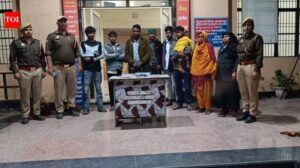
The investigation reportedly uncovered the alleged conspiracy following the interception and seizure of more than 300 kilograms of heroin, AK-56 assault rifles and 1,000 rounds of live ammunition.
The NIA attributed a significant role to Asmin, alleging that he helped facilitate the movement of drug consignments and participated in activities connected with financing the alleged operation.
These are prosecution allegations and should not be treated as judicial findings establishing Asmin’s guilt.
The High Court’s decision concerned his continued detention after he became an approver. It did not amount to a finding that the alleged conspiracy did not exist or that the remaining accused were innocent.
Kerala High Court Orders Witness Protection
An important part of the judgment concerned Asmin’s safety after agreeing to cooperate with the prosecution.
The bench observed that individuals who provide information against other accused persons may face threats, intimidation or retaliation. It stressed that protecting such witnesses is essential for the effective functioning of the criminal justice system.
The court directed the Secretary to the Kerala government’s Home Department to take immediate steps to bring Asmin within the protective framework of the Kerala Witness Protection Scheme.
The judges emphasised that witness protection is not simply an individual security measure. It is also necessary to ensure that witnesses can fulfil their responsibilities without fear.
The direction is particularly significant because Asmin’s role as an approver requires him to provide evidence against other individuals allegedly involved in the case.
The court said the authorities must give proper consideration to his safety so that he can assist the prosecution without apprehension of retaliation.
Bail Granted With Several Conditions
Although the Kerala High Court news brought relief to Asmin, the court imposed several conditions to ensure his availability during the investigation and trial.
The principal conditions include:
-
Personal bond: Asmin must execute a bond of ₹1 lakh and provide two solvent sureties of ₹1 lakh each, subject to the satisfaction of the special court.
-
Passport surrender: He must surrender his passport, if available. If he does not possess one, he must submit an affidavit confirming that he has no valid passport or other travel document.
-
Movement restrictions: He must remain within Ernakulam district and cannot leave without prior permission from the special court.
-
Regular reporting: He must appear before the investigating officer or a designated NIA officer in Ernakulam every Saturday between 10 am and 11 am until further orders.
-
No contact with accused persons: He cannot communicate or establish contact with other accused persons in the case.
-
Witness protection: He cannot attempt to influence, threaten, intimidate or interfere with prosecution witnesses.
-
Media restrictions: He cannot hold press conferences, interact with the media or make public statements concerning the case.
The court also required him to provide his complete residential address and current mobile phone number to the NIA investigating officer. He must remain available whenever required for questioning or other lawful proceedings.
Bail Does Not Give Him Automatic Right To Stay In India
The court made an important distinction between granting bail and determining the immigration status of a foreign national.
Although Asmin has been granted conditional bail, the order does not give him an automatic right to remain in India.
The Foreigners Regional Registration Office (FRRO) and other competent authorities remain free to initiate or continue proceedings concerning his immigration status under applicable laws.
The authorities can also take lawful measures to regulate his movement or require him to reside at a designated location.
This clarification means that his release from judicial custody does not prevent separate immigration-related action by the appropriate authorities.
What Happens Next?
The LTTE revival case will continue against the remaining accused, with Asmin expected to fulfil his obligations as an approver and prosecution witness.
His release is conditional, and he remains subject to the restrictions imposed by the High Court and the requirements of the ongoing legal proceedings.
The judgment also highlights an important legal distinction between an accused person and an approver who has received a pardon and agreed to assist the prosecution.
By directing the state to consider witness protection while granting conditional bail, the Kerala High Court has addressed both the prolonged detention and the security concerns associated with his cooperation.
The decision does not close the investigation or determine the guilt of the remaining accused. The prosecution must still establish its allegations through the judicial process.