Strait of Hormuz Crisis: 5 Alarming Developments as Iran US Tensions Escalate
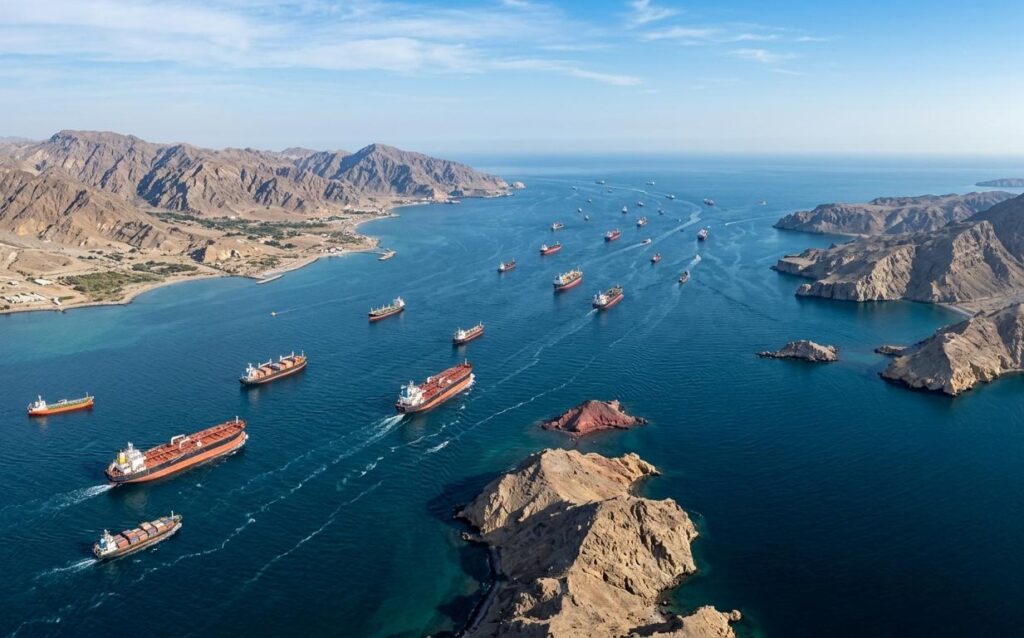
MIDDLE EAST: The Strait of Hormuz Crisis has intensified after a fresh wave of attacks on commercial vessels and an Iranian drone operation targeting a US military radar installation in Bahrain raised concerns about a wider confrontation in the Gulf. The developments came on Tuesday, November 17, 2026, as Iran, the United States and regional mediators continued diplomatic efforts to prevent further escalation.
Iran’s Islamic Revolutionary Guard Corps (IRGC) said it had targeted a US military radar system at Sheikh Isa Air Base in Bahrain. Bahraini authorities, however, reported that the incoming drones were intercepted, with no casualties or damage reported.
At the same time, attacks on commercial shipping have increased around the strategically important waterway. A tanker crew member was reported missing following an attack near the Omani port city of Khasab, while Iranian military claims about additional vessels catching fire remain independently unverified.
According to Reuters, the latest developments have complicated diplomatic efforts involving Oman and Qatar, while disruption to shipping continues to threaten international energy supplies.
1. Strait Of Hormuz Crisis Deepens After Fresh Tanker Attacks
The latest maritime incidents have increased concerns about the safety of commercial vessels travelling through the Strait of Hormuz.
On November 17, reports emerged that a tanker had been attacked while passing through the waterway, leaving its crew situation uncertain. The United Kingdom Maritime Trade Operations (UKMTO) also reported that a tanker crew member was unaccounted for following an attack north of Khasab, Oman.
The incidents form part of a broader pattern of attacks on commercial shipping during November.
Iran’s Revolutionary Guards also claimed that an LNG carrier and an oil tanker had caught fire after striking naval mines in the strait. However, these claims had not been independently verified at the time of reporting.
The distinction is important because military statements about attacks do not automatically establish the identity of the vessels, the cause of an incident or the extent of damage.
The growing number of maritime incidents has made shipping companies increasingly concerned about vessel safety, insurance exposure and the reliability of energy transportation through the Gulf.
2. Indian Seafarers Face Serious Risks After TARA GAS Attack
The latest attacks have also raised concerns in India because of the involvement of Indian nationals working aboard commercial vessels in the region.
A Panama-flagged LPG tanker, TARA GAS, carrying 25 crew members, including 24 Indian nationals, was attacked twice while transiting the Strait of Hormuz on November 16.
India’s Union Shipping Minister Sarbananda Sonowal initially confirmed that the entire crew was safe. However, a subsequent attack forced the crew to abandon the vessel.
In a later update, the minister confirmed that 24 crew members had been accounted for, while one Indian seafarer remained missing.
Indian authorities were coordinating with the ship management company and regional rescue agencies to locate the missing crew member and provide assistance to those rescued.
The incident has highlighted the direct consequences of the Strait of Hormuz Crisis for countries whose citizens work in international shipping.
The situation is particularly important for India because of its dependence on energy imports and the large number of Indian maritime workers employed on commercial vessels operating across international shipping routes.
Further details are available in our report on the TARA GAS attack and missing Indian seafarer.
3. Iran Targets US Military Radar Installation In Bahrain
The maritime security situation is unfolding alongside a separate military confrontation between Iran and the United States.
On Tuesday, Iran’s Revolutionary Guards said they had launched drones towards a US military radar installation at Sheikh Isa Air Base in Bahrain.
Bahrain is strategically important to Washington because it hosts the headquarters of the US Navy’s Fifth Fleet, which oversees naval operations across a major part of the Middle East.
Iran described its operation as retaliation for what it alleged were continued violations of Iranian airspace by American military drones.
However, the United States and Bahrain rejected claims of a successful strike.
Bahraini authorities said their air defence systems intercepted the incoming drones. US Central Command also confirmed that multiple Iranian one-way attack drones had been intercepted without damage to American equipment or injuries to US personnel.
Iran’s announcement therefore does not establish that the radar installation was destroyed or damaged.
The latest incident follows earlier reported Iranian drone operations involving American military facilities in Bahrain on November 13 and November 15.
These developments have added another dimension to the Iran US Tensions, increasing pressure on regional governments to prevent the confrontation from expanding.
4. Oil Prices And Global Energy Supplies Face Fresh Uncertainty
The Strait of Hormuz is among the world’s most important energy transportation routes.
Before the current war, approximately one-fifth of global oil and liquefied natural gas supplies passed through the waterway. The route connects the Persian Gulf with the Gulf of Oman and the wider Arabian Sea.
Its importance means that prolonged shipping disruption can affect energy markets far beyond the Middle East.
According to Reuters, the waterway is now largely blocked by Iran, creating serious difficulties for international shipping and energy transportation.
Brent crude futures were trading at approximately $92.61 per barrel on Tuesday, November 17.
The price remains substantially above pre-war levels, although it is below the wartime peak of $126.41 recorded in April.
For India, higher international crude prices can increase the country’s import bill, put pressure on inflation and raise transportation and industrial costs.
The impact is not limited to oil-importing countries. Energy producers, shipping companies, refiners and manufacturers also face uncertainty when important maritime routes become difficult to navigate.
The relationship between maritime security and crude prices was also examined in our earlier coverage of Brent crude price movements amid Strait of Hormuz shipping disruptions.
5. Oman And Qatar Push For Diplomacy As Iran US Tensions Continue
Despite the latest military developments, diplomatic efforts to reduce tensions are continuing.
Iranian Foreign Minister Abbas Araqchi visited Oman on Tuesday, where he discussed maritime security and the protection of international shipping corridors with Oman’s Foreign Minister Badr Albusaidi.
The discussions focused on safeguarding maritime routes and maintaining the movement of global shipping and trade.
Meanwhile, Qatari and Iranian officials were expected to meet in Doha as part of efforts to bring Washington and Tehran closer to an agreement.
Qatar has been working to narrow differences between the parties and prevent further expansion of the conflict.
The diplomatic discussions are particularly important because the Strait of Hormuz has become one of the central issues in negotiations.
US President Donald Trump has indicated that Washington will maintain its naval blockade on Iran, while Tehran continues to disrupt shipping through the waterway.
The disagreement over maritime access, military operations and security arrangements remains a major obstacle to reducing tensions.
The confrontation has also created political pressure within the United States. Four Democratic-aligned senators have opposed government spending arrangements that would allow the administration to continue military operations against Iran without restrictions.
Our earlier report on US lawmakers challenging Trump’s Iran war funding examines the growing political debate in Washington.
What Happens Next In The Strait Of Hormuz Crisis?
The immediate outlook remains uncertain as military activity, shipping disruptions and diplomatic negotiations continue simultaneously.
For commercial shipping companies, the priority is the safety of vessels and crew members operating in the Gulf. Repeated attacks could increase insurance premiums, force operators to reconsider routes and create further uncertainty around energy deliveries.
For India, the missing seafarer aboard TARA GAS remains an immediate concern. The government is also facing broader questions about protecting Indian nationals working in conflict-sensitive maritime regions.
For the United States and Iran, the challenge is preventing maritime incidents and military confrontations from undermining diplomatic negotiations.
The Iran US Tensions have already extended beyond direct military exchanges, affecting international shipping, energy markets and regional security arrangements.
The Strait of Hormuz Crisis therefore represents more than a regional maritime security problem. Its consequences could reach energy-importing economies, international trade networks and millions of consumers if shipping disruption continues.
Whether diplomatic efforts can restore safer passage through the waterway will be one of the most important developments to watch in the coming days.